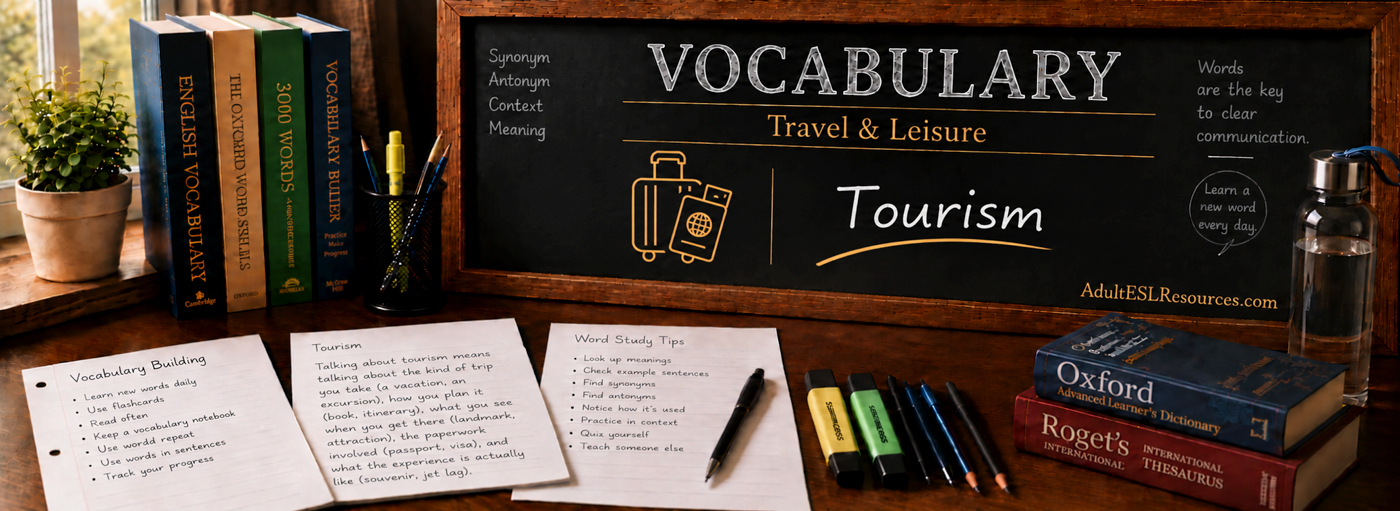
Tourism Vocabulary
Part of the Travel & Leisure vocabulary group in Teacher-In-A-Box, this lesson explores the vocabulary used to describe trip types, booking and planning, sights and attractions, travel documents, and travel experiences — language useful in almost any country, even though travel customs and requirements vary from place to place.
Connected vocabulary, not a glossary
Tourism vocabulary works as a system.
Talking about tourism means talking about the kind of trip you take (a vacation, an excursion), how you plan it (book, itinerary), what you see when you get there (landmark, attraction), the paperwork involved (passport, visa), and what the experience is actually like (souvenir, jet lag).
This lesson groups vocabulary by what it’s used to describe — trip types, booking and planning, sights and attractions, travel documents, and travel experiences — and shows how the words in each area relate to and differ from one another. Entry requirements, booking processes, and travel customs vary widely between countries, so this lesson focuses on vocabulary you can use to talk about travel anywhere, rather than any one country’s rules.
You will leave this lesson able to describe travel experiences more precisely, wherever you happen to be going.
1. Types of trips
Different words describe different kinds of trips.
trip — a general word for any journey somewhere and back, for any length of time: “They took a short trip to the coast.”
getaway — a short trip taken to relax or escape everyday life: “They planned a weekend getaway.”
excursion — a short organized trip, often as part of a longer holiday: “The hotel offered an excursion to the old town.”
vacation vs. holiday
vacation / holiday — both describe time away from work or school, often spent travelling; “vacation” is more common in American English, “holiday” in British English, though both are widely understood: “They’re on holiday until next week.”
2. Booking and planning
Planning a trip has its own everyday vocabulary.
itinerary — a planned schedule of a trip, including places and dates: “She emailed everyone the itinerary.”
accommodation — a general word for a place to stay, such as a hotel or rental: “They still needed to arrange accommodation.”
cancellation — the act of cancelling a booking, often affecting whether money is refunded: “Check the cancellation policy before you book.”
booking vs. reservation
booking / reservation — both describe arranging something in advance, such as a room or a seat; the two are largely interchangeable, though “reservation” is often used for restaurants and “booking” more broadly: “They have a reservation for two at eight o’clock.”
3. Sights and attractions
Vocabulary for what visitors go to see and do.
sightseeing — visiting and looking at interesting places, usually as a tourist: “They spent the day sightseeing.”
landmark — a well-known place, often notable for its history or appearance: “The old bridge is a landmark in the city.”
tour — an organized visit to a place, usually led by a guide: “They joined a walking tour of the old town.”
tourist vs. traveler
tourist / traveler — a tourist is someone visiting a place, usually for leisure; a traveler is the broader term for anyone travelling from one place to another. In everyday use, some people use traveler to describe a more independent style of travel, but that distinction is not fixed.
4. Travel documents
International travel usually involves some paperwork.
Entry requirements and the documents needed vary a great deal between countries, so this lesson teaches the words rather than any one country’s requirements.
boarding pass — a document or digital pass that allows a passenger onto a plane: “She showed her boarding pass at the gate.”
customs — the checkpoint at a border where officials check travellers and goods entering a country: “They went through customs after landing.”
passport vs. visa
passport — an official document proving your identity and nationality, used for international travel: “Make sure your passport hasn’t expired.”
visa — official authorization that allows someone to travel to, enter, or stay in a country for a particular purpose or period, depending on that country’s rules: “She applied for a visa before the trip.”
5. Travel experiences
Vocabulary for how a trip actually feels, not just what’s planned.
souvenir — an item bought or kept to remember a trip: “She bought a small souvenir from the market.”
jet lag — tiredness and disorientation caused by travelling quickly across time zones: “He felt jet lag for a couple of days.”
culture shock — the feeling of confusion or discomfort that can come from experiencing an unfamiliar culture: “She experienced some culture shock during her first week.”
homesick — missing home while away: “He felt a little homesick during the long trip.”
Vocabulary in context
See the vocabulary working together.
Here is a short passage using several words from this lesson together.
She booked a short getaway and put together an itinerary before she left. Once there, she spent most days sightseeing, visiting a few well-known landmarks. On the way home, she picked up a souvenir at the airport, and spent the next two days recovering from jet lag.
Unpacking what this vocabulary communicates:
booked a short getaway…itinerary → the trip was planned in advance.
sightseeing…landmarks → describes how she spent her time as a visitor.
picked up a souvenir → a small habit connected to remembering the trip.
recovering from jet lag → a common physical effect of long-distance travel.
The passage doesn’t name a specific destination, currency, or set of entry requirements, so the vocabulary can be applied across many different travel situations.
Don’t confuse these
Choosing the right word changes what a sentence communicates.
vacation / holiday
Both describe time away from work or school — the choice is mostly a difference between American and British English.
booking / reservation
The two are largely interchangeable — “reservation” is often used for restaurants, “booking” more broadly for travel and accommodation.
tourist / traveler
A tourist is someone visiting a place, usually for leisure; a traveler is the broader term for anyone travelling from one place to another, sometimes used to suggest a more independent style of travel.
passport / visa
A passport proves identity and nationality; a visa is official authorization to travel to, enter, or stay in a country, depending on that country’s rules.
Natural word partnerships
These combinations are worth learning as fixed units.
For the general idea behind combinations like these, see:
Common errors
Mistakes are useful when you understand why they happen.
I go in vacation next week.
I’m going on vacation next week.
The fixed preposition is “on vacation,” not “in vacation.”
I did a lot of touristic activities.
I did a lot of sightseeing.
“Touristic” isn’t standard English — use “sightseeing” or “tourist activities” instead.
I need to make my passport.
I need to renew my passport.
The natural collocation is “renew” (or “get”) a passport, not “make” one.
I have a big jet lag.
I have bad jet lag.
“Jet lag” is uncountable and doesn’t take “a,” and “bad” is the usual intensifier, not “big.”
I bought a souvenir for remember the trip.
I bought a souvenir to remember the trip by.
Use the infinitive “to remember,” not “for remember.”
Your turn
Choose the word that fits.
These activities are part of the learning process. There are no scores, no grades and no limit on how many times you may try.
“The broader term for anyone travelling from one place to another, not just someone visiting for leisure.” Which word best fits?
Which word is the broader term, not limited to leisure visits?
“An official document proving your identity and nationality, used for international travel.” Which word best fits?
Is this proof of identity, or official authorization to enter a country?
“A well-known place, often notable for its history or appearance.” Which word best fits?
Is this a place, or an item you take home with you?
Try it another way
Complete the sentences.
Type the word that fits each gap.
Notice the difference
Rewrite each sentence using the correct word.
I go in vacation next week.
I need to make my passport.
Alternate practice
Use the vocabulary productively, not just recognise it.
Complete the summary
Fill each gap with one word from this lesson: itinerary, sightseeing, landmarks, souvenir, jet lag.
“She booked a getaway and planned an ___ before she left. Once there, she spent most days ___, visiting a few well-known ___. On the way home, she picked up a ___, and spent two days recovering from ___.”
Sort into groups
Sort these words into the area they belong to (Types of Trips / Booking & Planning / Sights & Attractions / Travel Documents / Travel Experiences):
Describe a situation
In two or three sentences, describe a fictional travel situation using at least four words from this lesson.
Quick review
Five areas, connected by the everyday experience of travel.
Types of trips — vacation vs holiday, plus trip, getaway, and excursion.
Booking and planning — booking vs reservation, plus itinerary, accommodation, and cancellation.
Sights and attractions — tourist vs traveler, plus sightseeing, landmark, attraction, tour, and guide.
Travel documents — passport vs visa, plus boarding pass and customs.
Travel experiences — souvenir, jet lag, culture shock, and homesick.
Watch for — vacation vs holiday, booking vs reservation, tourist vs traveler, passport vs visa.
Remember
Entry requirements and travel customs change from place to place, while much of the core vocabulary remains widely useful.
Visa rules, booking processes, and local customs vary between countries, but vocabulary such as itinerary, landmark and jet lag is useful across many travel contexts.
Related vocabulary
Explore related areas of vocabulary.
Explore the rest of the Travel & Leisure vocabulary group below.