Politics Vocabulary
Part of the Society & Culture vocabulary group in Teacher-In-A-Box, this lesson explores the vocabulary used to describe government, elections, and political debate — in a neutral, descriptive way, regardless of what you think about any particular issue.
Connected vocabulary, not a glossary
Political vocabulary works as a system.
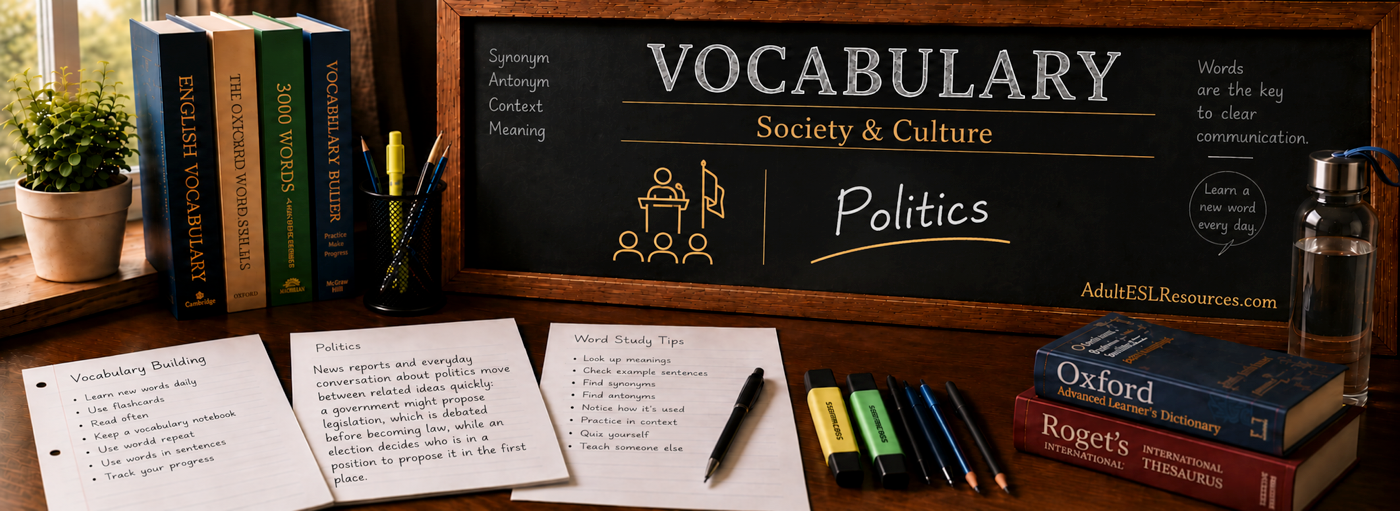
News reports and everyday conversation about politics move between related ideas quickly: a government might propose legislation, which is debated before becoming law, while an election decides who is in a position to propose it in the first place.
This lesson is not about any particular party, policy, or point of view. It groups vocabulary by what it’s used to describe — government and power, elections, law-making, and political debate — and shows how the words in each area relate to and differ from one another.
You will leave this lesson able to describe political processes and discussions more precisely, whatever your own views happen to be.
1. Government and power
Who holds power, and how they’re organised.
authority — the recognised power to make decisions or enforce rules: “The council has the authority to approve local building projects.”
political party — an organised group that shares similar political goals and puts forward candidates for election: “Several political parties are represented in parliament.”
coalition — an arrangement where two or more parties govern together, usually because no single party has enough support to govern alone: “The election resulted in a coalition government.”
government vs. state
A useful vocabulary distinction, not a constitutional definition — the exact institutions involved vary between countries.
government — the specific group of people currently in charge, which changes over time: “The government changed after the last election.”
state — the permanent institutions and territory of a country, which continue regardless of who is currently governing: “The state provides public services such as roads and schools.”
2. Elections and representation
Elections decide who represents whom.
candidate — a person standing for election to a political position: “Three candidates are standing in this constituency.”
constituency — an electoral area represented in an elected body; depending on the system, voters may elect one or more representatives: “She has represented this constituency for eight years.”
term — the fixed length of time someone holds an elected position: “The president serves a four-year term.”
election vs. referendum
election — voters choose a person or party to represent them: “A general election is held every few years.”
referendum — voters decide directly on one specific question or issue, rather than choosing a representative: “The country held a referendum on the new proposal.”
3. Law-making
Turning an idea into a law is a process, with its own vocabulary.
This lesson covers the political process itself; the legal system it produces is covered in Law.
This is one common type of law-making process; exact procedures vary between political systems.
bill — a proposed law that has not yet been approved: “The bill will be debated in parliament next week.”
amend — to make a formal change to a proposed or existing law: “The bill was amended before the final vote.”
reform — a significant change intended to improve or alter an existing system: “The government introduced healthcare reform.”
policy vs. politics vs. politician vs. political
Four closely related words that are easy to mix up.
policy (noun) — a specific plan of action on a particular issue: “The party’s education policy focuses on smaller class sizes.”
politics (noun) — the general activity or field of government and public affairs: “She’s always been interested in politics.”
politician (noun) — a person who works in politics, often as an elected official: “The politician answered questions from journalists.”
political (adjective) — relating to politics: “It was a difficult political decision.”
4. Political debate
Disagreement has its own vocabulary too.
opposition — the party or group that disagrees with, and formally challenges, those in government: “The opposition criticised the new policy.”
position / viewpoint — the stance someone takes on an issue: “Her position on the reform has been consistent.”
5. Political systems
These are descriptive terms, not judgements.
Political science uses these words to classify systems and positions — they describe, without ranking one as better than another. The exact meaning of these terms can vary slightly between countries and languages.
democracy — a system in which citizens choose their government through elections: “The country transitioned to democracy in the 1990s.”
monarchy — a system with a king or queen as head of state: “Several European countries are constitutional monarchies.”
left-wing / right-wing — descriptive terms for political positions, often relating to views on the role of government or the economy, used across the political spectrum rather than as an insult or compliment: “Commentators described the policy as left-wing; others disagreed with that label.”
Vocabulary in context
See the vocabulary working together.
Here is a short, neutral passage using several words from this lesson together.
The government proposed new legislation to reform the tax system. The bill was debated in parliament and amended before being passed into law. The opposition argued the reform would affect small businesses, while supporters said it would increase long-term revenue.
Unpacking what this vocabulary communicates:
proposed new legislation → the process of a new law began, but nothing was decided yet.
the bill was debated and amended → the proposal went through discussion and formal changes before any final decision.
passed into law → the bill was formally approved and became binding.
the opposition argued → a specific, named political role — not simply “people who disagree” in general.
The passage presents both the reform’s supporters and its critics without favouring either — that even-handed framing is deliberate, since this lesson teaches vocabulary, not a position on the policy itself.
Don’t confuse these
Choosing the right word changes what a sentence communicates.
policy / politics / politician / political
Ask: is this a specific plan (policy), the general activity (politics), a person (politician), or a description (political)?
government / state
Ask: is this about the current group in power (government), or the permanent institutions of the country (state)?
election / referendum
Ask: are voters choosing a representative (election), or deciding on one specific question directly (referendum)?
bill / law
A bill is a proposal that has not yet been approved; a law is what it becomes once passed.
Natural word partnerships
These combinations are worth learning as fixed units.
For the general idea behind combinations like these, see:
Common errors
Mistakes are useful when you understand why they happen.
She wants to study politic at university.
She wants to study politics at university.
The academic subject and general field is “politics,” not “politic.”
The government made a new law about recycling immediately.
The government passed a new law about recycling.
In the process described in this lesson, laws are “passed,” while a proposed law is described as a “bill” before it becomes law.
He is a very politic person.
He is a very political person.
The adjective is “political,” not “politic” (a rare, different word meaning “wise” or “tactful”).
She is candidate for the election.
She is a candidate for the election.
“Candidate” is a countable noun and needs an article here.
The bill became a law yesterday without any vote.
The bill was passed into law yesterday, after being voted on.
In the simplified process described in this lesson, a bill is debated and voted on before being passed into law. Exact legislative procedures vary between political systems.
Your turn
Choose the word that fits.
These activities are part of the learning process. There are no scores, no grades and no limit on how many times you may try.
“The party’s plan to reduce class sizes in schools.” Which word best describes this specific plan?
Is this a specific plan, a general field, or a person?
Voters are asked to answer “yes” or “no” to one specific question directly, rather than choosing a representative. What is this called?
Are voters choosing a representative, or deciding a specific question directly?
“Public roads and schools continue to be provided no matter which party is currently in power.” Which word best fits this idea?
Does this describe something permanent, or the group currently in charge?
Try it another way
Complete the sentences.
Type the word that fits each gap.
Notice the difference
Rewrite each sentence using the correct word.
She wants to study politic at university.
He is a very politic person.
Alternate practice
Use the vocabulary productively, not just recognise it.
Complete the summary
Fill each gap with one word from this lesson: bill, amended, passed, opposition, election.
“After the ___, a new government proposed a ___ on public transport funding. It was debated and ___ before finally being ___ into law, despite objections from the ___.”
Sort into groups
Sort these words into the area they belong to (Government & Power / Elections / Law-Making / Debate):
Describe a situation
In two or three sentences, describe a fictional political situation using at least four words from this lesson.
Quick review
Five areas, connected by process and precision.
Government & power — government vs state, authority, and coalitions.
Elections & representation — election vs referendum, candidates, and constituencies.
Law-making — policy vs politics vs politician vs political, plus bill, legislation, amend, and reform.
Political debate — opposition, position, and viewpoint.
Political systems — descriptive terms like democracy, monarchy, and left/right-wing.
Watch for — policy vs politics, government vs state, election vs referendum.
Remember
Political vocabulary describes a process, not a position.
Words like policy, legislation, election and opposition describe how political systems work — understanding them doesn’t require agreeing with any particular party or policy, only being able to talk about the process clearly.
Related vocabulary
Explore related areas of vocabulary.
Explore the rest of the Society & Culture vocabulary group below.