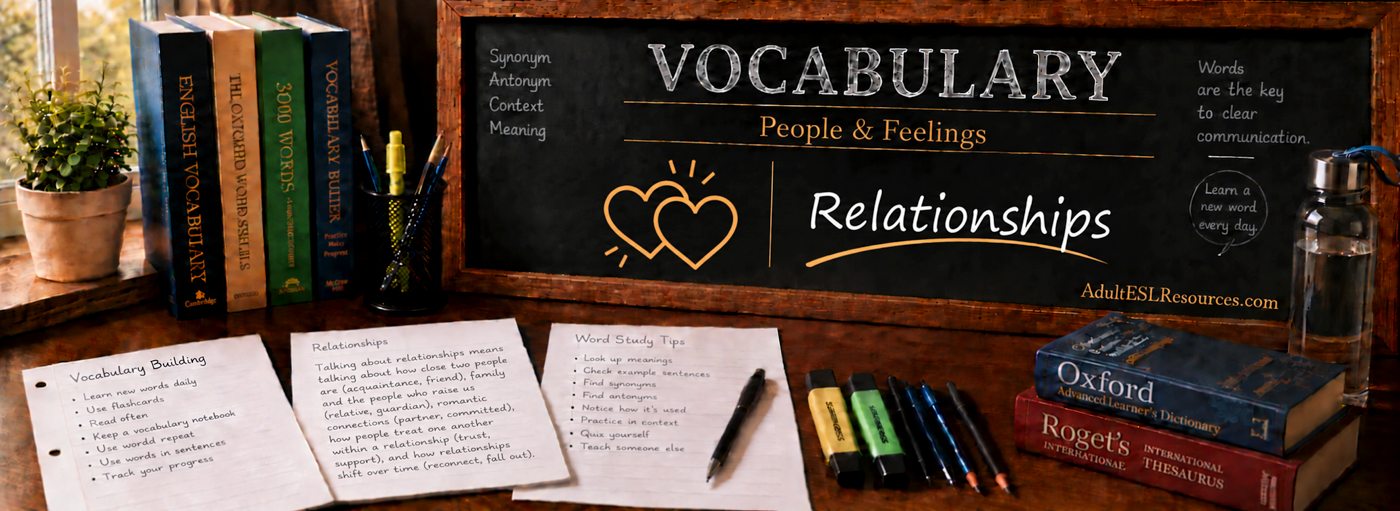
Relationships Vocabulary
Part of the People & Feelings vocabulary group in Teacher-In-A-Box, this lesson explores the vocabulary used to describe types of relationships, family and close ties, romantic relationships, relationship dynamics, and changes in relationships — language useful for talking about the people in your life wherever you happen to be.
Connected vocabulary, not a glossary
Relationships vocabulary works as a system.
Talking about relationships means talking about how close two people are (acquaintance, friend), family and the people who raise us (relative, guardian), romantic connections (partner, committed), how people treat one another within a relationship (trust, support), and how relationships shift over time (reconnect, fall out).
This lesson groups vocabulary by what it’s used to describe — types of relationships, family and close ties, romantic relationships, relationship dynamics, and changes in relationships — and shows how the words in each area relate to and differ from one another. Family structures, relationship customs, and how people define terms like “family” or “partner” vary enormously between cultures and households, so this lesson focuses on vocabulary that applies broadly rather than any one family or relationship structure.
You will leave this lesson able to talk about relationships more precisely, whatever the relationship looks like.
1. Types of relationships
Different words describe how close two people are.
relationship — a connection between two or more people: “They have a close relationship.”
colleague — a person you work with: “She discussed the project with a colleague.”
stranger — a person you don’t know at all: “He asked a stranger for directions.”
acquaintance vs. friend
acquaintance / friend — an acquaintance is someone you know a little, often through a specific context, without much personal closeness; a friend is someone you know well and share mutual trust and affection with: “He’s just an acquaintance from the gym, but she’s been a close friend for years.”
2. Family and close ties
Vocabulary for family and the people who raise us.
relative — a person connected to you by family: “Several relatives came to the celebration.”
sibling — a brother or sister: “She has two siblings, both older than her.”
extended family — family members beyond the household someone grew up in, such as grandparents, aunts, uncles, and cousins: “His extended family gathers once a year.”
guardian vs. parent
guardian / parent — a parent is specifically a child’s mother or father; a guardian is a person with formally recognized or legal responsibility for a child’s care, which may or may not be the same person as a parent, depending on the legal or family system involved: “A parent is often also a child’s guardian, but in some situations another person, such as a relative or other formally appointed caregiver, may hold that responsibility.”
3. Romantic relationships
Vocabulary for romantic connections.
partner — the person someone is in a serious romantic relationship with, regardless of marital status: “She introduced her partner at the party.”
engaged — having formally agreed to marry, in whatever way that’s recognized in a given place: “They got engaged last spring.”
single — not currently in a romantic relationship: “He’s been single since last year.”
dating vs. committed
dating / committed — dating describes being romantically involved with someone, and how serious, exclusive, or long-term that is can vary a great deal; committed describes an ongoing romantic relationship in which both people have made a meaningful commitment to it, though what that commitment includes — such as whether it’s exclusive — isn’t fixed by the English word itself and depends on the people involved: “They’d been dating for a few months before they described the relationship as committed, though what that meant was something the two of them defined for themselves.”
4. Relationship dynamics
Vocabulary for how people treat one another within a relationship.
support (verb) — to give help, encouragement, or comfort to someone: “She supported him through a difficult time.”
communicate — to share thoughts, feelings, or information clearly with someone: “They communicate well, even when they disagree.”
conflict — a disagreement or clash between people: “A small conflict grew into a bigger argument.”
trust vs. rely on
trust / rely on — trust describes a general belief that someone is honest, reliable, or has good intentions; rely on describes depending on someone specifically to do something or be there when needed, which doesn’t always require that same deeper personal trust: “She trusts her neighbor completely, and also relies on him to collect her mail when she travels.”
5. Changes in relationships
Vocabulary for how relationships shift over time.
fall out (phrasal verb) — to have a serious disagreement that damages or ends a relationship: “The two business partners fell out over money.”
make up (phrasal verb) — to resolve a disagreement and restore a relationship: “They made up after a long argument.”
lose touch — to gradually stop staying in contact with someone: “They lost touch after she moved abroad.”
Vocabulary in context
See the vocabulary working together.
Here is a short passage using several words from this lesson together.
They’d been close friends since childhood, but after she moved abroad for work, they slowly grew apart. A misunderstanding over a forgotten promise led to a falling out that lasted almost a year. Eventually, a mutual friend helped them reconnect, and after an honest conversation, they made up.
Unpacking what this vocabulary communicates:
close friends…grew apart → describes a relationship that gradually became less close over distance and time.
falling out → describes a serious disagreement that damaged the relationship.
reconnect…made up → describes restoring the relationship after the disagreement was resolved.
The passage doesn’t name a specific country, workplace, or disagreement, so the vocabulary can be applied to almost any relationship situation.
Don’t confuse these
Choosing the right word changes what a sentence communicates.
acquaintance / friend
An acquaintance is someone you know a little without much personal closeness; a friend is someone you know well and share mutual trust with.
guardian / parent
A parent is specifically a child’s mother or father; a guardian has formally recognized or legal responsibility for a child’s care, which may or may not be the same person — the exact arrangement depends on the legal system involved.
dating / committed
Dating describes being romantically involved with someone, with how serious or exclusive that is varying widely; committed describes an ongoing relationship both people have meaningfully committed to, without the English word itself requiring exclusivity.
trust / rely on
Trust describes a general belief that someone is honest or well-intentioned; rely on describes depending on someone specifically to do something or be there.
Natural word partnerships
These combinations are worth learning as fixed units.
For the general idea behind combinations like these, see:
Common errors
Mistakes are useful when you understand why they happen.
She is married with him.
She is married to him.
The fixed preposition is “married to,” not “married with.”
I know her since five years.
I’ve known her for five years.
Use present perfect with “for” and a length of time, not simple present with “since” plus a duration.
He has a friendship close with his cousin.
He has a close friendship with his cousin.
Adjectives come before the noun in English — “a close friendship,” not “a friendship close.”
They fall out last year and never spoke again.
They fell out last year and never spoke again.
Use the past tense “fell out,” not the base form “fall out,” to describe a completed event.
She relies in her sister for advice.
She relies on her sister for advice.
The fixed preposition is “rely on,” not “rely in.”
Your turn
Choose the word that fits.
These activities are part of the learning process. There are no scores, no grades and no limit on how many times you may try.
“Someone you know a little, without much personal closeness.” Which word best fits?
Which word describes less closeness than a friendship?
“A person with formally recognized or legal responsibility for a child’s care, which may or may not be the same as being that child’s parent.” Which word best fits?
Which word describes formally recognized responsibility for a child, rather than the biological relationship itself?
“Depending on someone specifically to do something or be there when needed.” Which fits best?
Which phrase is about depending on someone for something specific, not a general belief?
Try it another way
Complete the sentences.
Type the word that fits each gap.
Notice the difference
Rewrite each sentence using the correct word.
She is married with him.
She relies in her sister for advice.
Alternate practice
Use the vocabulary productively, not just recognise it.
Complete the summary
Fill each gap with one word or phrase from this lesson: friends, grew apart, falling out, reconnect, made up.
“They’d been close ___ since childhood, but after she moved abroad for work, they slowly ___. A misunderstanding over a forgotten promise led to a ___ that lasted almost a year. Eventually, a mutual friend helped them ___, and after an honest conversation, they ___.”
Sort into groups
Sort these words into the area they belong to (Types of Relationships / Family & Close Ties / Romantic Relationships / Relationship Dynamics / Changes in Relationships):
Describe a situation
In two or three sentences, describe a fictional relationship situation using at least four words from this lesson.
Quick review
Five areas, connected by the everyday experience of relationships.
Types of relationships — acquaintance vs friend, plus relationship, colleague, and stranger.
Family and close ties — guardian vs parent, plus relative, sibling, and extended family.
Romantic relationships — dating vs committed, plus partner, engaged, and single.
Relationship dynamics — trust vs rely on, plus support, communicate, and conflict.
Changes in relationships — grow apart, reconnect, fall out, make up, and lose touch.
Watch for — acquaintance vs friend, guardian vs parent, dating vs committed, trust vs rely on.
Remember
Family structures and relationship customs vary widely between cultures, but the vocabulary for describing relationships stays widely useful.
Who counts as family, and how a relationship is defined or formalized, can differ from place to place, but vocabulary such as trust, reconnect and extended family is useful across almost any relationship situation.
Related vocabulary