Personality Traits Vocabulary
Part of the People & Feelings vocabulary group in Teacher-In-A-Box, this lesson explores the vocabulary used to describe personality in general, sociability, confidence and assertiveness, how people treat others, and traits in action — language useful for describing people wherever you happen to be.
Connected vocabulary, not a glossary
Personality vocabulary works as a system.
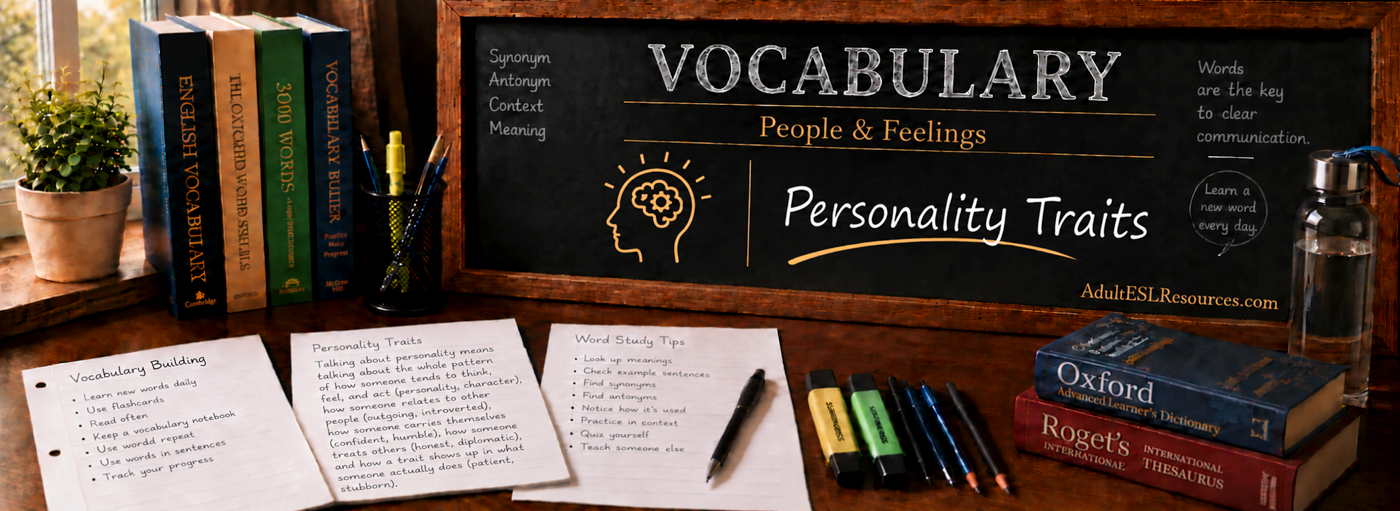
Talking about personality means talking about the whole pattern of how someone tends to think, feel, and act (personality, character), how someone relates to other people (outgoing, introverted), how someone carries themselves (confident, humble), how someone treats others (honest, diplomatic), and how a trait shows up in what someone actually does (patient, stubborn).
This lesson groups vocabulary by what it’s used to describe — personality in general, sociability, confidence and assertiveness, how people treat others, and traits in action — and shows how the words in each area relate to and differ from one another. People describe personality differently across languages and cultures, and the same trait can sound like a compliment in one context and a criticism in another, so this lesson focuses on vocabulary that applies to personality in general rather than any one way of judging it.
You will leave this lesson able to describe people’s personalities more precisely, whoever you happen to be talking about.
1. Personality in general
Different words describe personality at different levels.
trait — a particular quality that forms part of someone’s personality: “Patience is one of her most noticeable traits.”
nature — a person’s basic character, especially as it shows in how they usually behave: “It’s just his nature to stay calm under pressure.”
temperament — a person’s characteristic way of reacting emotionally, especially how calm or excitable they tend to be: “The two children had very different temperaments.”
personality vs. character
personality / character — personality refers to a person’s overall pattern of thinking, feeling, and behaving, including traits like being outgoing or quiet; character often refers more specifically to a person’s moral qualities, such as honesty and integrity, though the two words overlap in everyday use: “She has a warm personality, and everyone who knows her speaks highly of her character.”
2. Sociability
Vocabulary for how someone relates to other people.
outgoing — comfortable meeting and talking with people, especially those you don’t know well: “He’s outgoing and makes friends easily.”
extroverted — tending to feel energized by spending time with other people: “She’s extroverted and loves large gatherings.”
reserved — tending to keep thoughts and feelings to yourself rather than sharing them openly: “He’s fairly reserved until he gets to know someone.”
introverted vs. shy
introverted / shy — introverted describes someone who tends to feel most comfortable with less social stimulation and often recharges by spending time alone; shy describes someone who feels nervous or uncomfortable in social situations, whether or not they enjoy those situations otherwise. A person can be introverted without being shy, and shy without being introverted: “He’s introverted and prefers a quiet evening at home, but he isn’t shy — he speaks confidently once a conversation starts.”
3. Confidence and assertiveness
Vocabulary for how someone carries themselves.
assertive — able to state opinions or needs clearly and firmly, without being aggressive: “She was assertive in the negotiation without raising her voice.”
humble — not claiming excessive importance or credit for your own abilities or achievements: “He stayed humble despite his success.”
modest — not boastful about your abilities or achievements: “She gave a modest account of her role in the project.”
confident vs. arrogant
confident / arrogant — confident describes someone who feels secure in their own abilities without needing to diminish others; arrogant describes someone with an exaggerated sense of their own importance who tends to dismiss or look down on other people: “He answered every question with confidence, never arrogance, giving other people’s ideas credit too.”
4. How people treat others
Vocabulary for how someone interacts with the people around them.
kind — considerate and caring toward other people: “She’s kind to everyone she meets.”
generous — willing to give time, money, or help freely: “He’s generous with his time when a colleague needs help.”
diplomatic — able to handle disagreements or sensitive situations without causing offense: “She stayed diplomatic even when the discussion got tense.”
honest vs. blunt
honest / blunt — honest describes someone who tells the truth; blunt describes someone who expresses that truth (or an opinion) very directly, in a way that can come across as harsh regardless of how accurate it is. Someone can be honest without being blunt, or blunt without necessarily being more honest than anyone else: “His feedback was honest but so blunt that a few people found it hard to hear.”
5. Traits in action
Vocabulary for how a trait shows up in what someone actually does.
determined — committed to achieving a goal despite difficulty: “She stayed determined even after several setbacks.”
stubborn — unwilling to change your mind or approach, even when it might help to: “He can be stubborn about doing things his own way.”
impulsive — acting quickly, without carefully thinking things through first: “His impulsive decision surprised everyone.”
cautious — careful to avoid risk or mistakes: “She took a cautious approach to the new project.”
Vocabulary in context
See the vocabulary working together.
Here is a short passage using several words from this lesson together.
At the meeting, she came across as confident, never arrogant, and gave her honest opinion without being blunt about it. Her colleague was more introverted, saying little, though no one would call him shy — he simply preferred to listen. When the discussion grew tense, she stayed diplomatic, and even though he could be stubborn about his own ideas, her patience eventually won him over.
Unpacking what this vocabulary communicates:
confident…never arrogant → describes someone secure in themselves without dismissing others.
honest…without being blunt → describes truthfulness delivered with some care.
introverted…not shy → describes a preference for less social stimulation, not nervousness.
diplomatic…stubborn…patience → describes handling disagreement calmly despite resistance.
The passage doesn’t name a specific person, workplace, or culture, so the vocabulary can be applied to almost any situation involving people.
Don’t confuse these
Choosing the right word changes what a sentence communicates.
personality / character
Personality refers to a person’s overall pattern of thinking, feeling, and behaving; character often refers more specifically to moral qualities such as honesty and integrity.
introverted / shy
Introverted describes a preference for less social stimulation and recharging alone; shy describes nervousness in social situations. A person can be one without the other.
confident / arrogant
Confident describes feeling secure in your own abilities without diminishing others; arrogant describes an exaggerated sense of importance that dismisses other people.
honest / blunt
Honest describes telling the truth; blunt describes expressing it very directly, in a way that can seem harsh.
Natural word partnerships
These combinations are worth learning as fixed units.
For the general idea behind combinations like these, see:
Common errors
Mistakes are useful when you understand why they happen.
He is very confidence when he speaks in public.
He is very confident when he speaks in public.
Use the adjective “confident,” not the noun “confidence,” after “is.”
He is agree that his brother is stubborn.
He agrees that his brother is stubborn.
“Agree” is a verb on its own and isn’t used with “is.”
She has a personality strong.
She has a strong personality.
Adjectives come before the noun in English — “a strong personality,” not “a personality strong.”
She’s known as her generosity.
She’s known for her generosity.
The fixed preposition is “known for,” not “known as,” when describing a quality someone is known for.
He always come out of his shell at parties.
He always comes out of his shell at parties.
Third-person singular present tense needs an “-s”: “he comes,” not “he come.”
Your turn
Choose the word that fits.
These activities are part of the learning process. There are no scores, no grades and no limit on how many times you may try.
“Secure in one’s own abilities without needing to diminish others.” Which word best fits?
Which word doesn’t involve looking down on other people?
“Prefers less social stimulation and recharges by spending time alone.” Which word best fits?
Which word describes a preference, rather than nervousness in social situations?
“Direct in a way that can seem harsh, regardless of how accurate it is.” Which word best fits?
Which word describes how something is said, rather than whether it’s true?
Try it another way
Complete the sentences.
Type the word that fits each gap.
Notice the difference
Rewrite each sentence using the correct word.
She has a personality strong.
He is confidence about his plan.
Alternate practice
Use the vocabulary productively, not just recognise it.
Complete the summary
Fill each gap with one word from this lesson: confident, introverted, shy, diplomatic, stubborn.
“At the meeting, she came across as ___, never arrogant. Her colleague was more ___, though no one would call him ___ — he simply preferred to listen. When the discussion grew tense, she stayed ___, and even though he could be ___ about his own ideas, her patience eventually won him over.”
Sort into groups
Sort these words into the area they belong to (Personality in General / Sociability / Confidence & Assertiveness / How People Treat Others / Traits in Action):
Describe a situation
In two or three sentences, describe a fictional person’s personality using at least four words from this lesson.
Quick review
Five areas, connected by the everyday experience of describing people.
Personality in general — personality vs character, plus trait, nature, and temperament.
Sociability — introverted vs shy, plus outgoing, extroverted, and reserved.
Confidence and assertiveness — confident vs arrogant, plus assertive, humble, and modest.
How people treat others — honest vs blunt, plus kind, generous, and diplomatic.
Traits in action — determined, stubborn, patient, impulsive, and cautious.
Watch for — personality vs character, introverted vs shy, confident vs arrogant, honest vs blunt.
Remember
How personality is expressed and judged varies between people and cultures, but the vocabulary for describing it stays widely useful.
Which traits stand out and how they’re valued can differ from person to person and culture to culture, but vocabulary such as confident, honest and diplomatic is useful across almost any conversation about people.
Related vocabulary