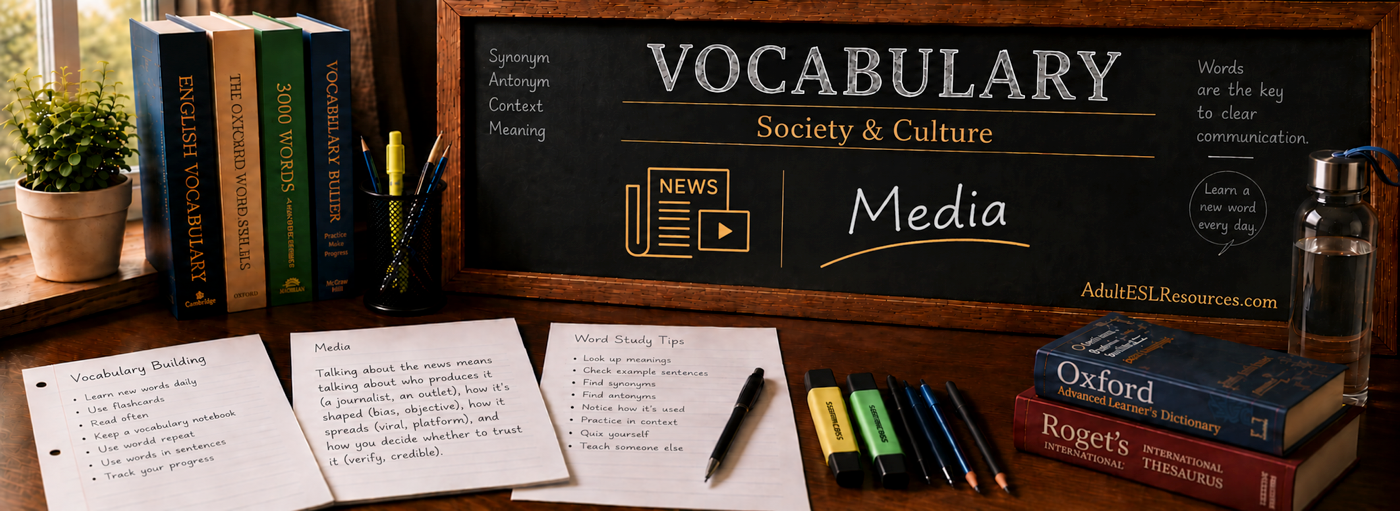
Media Vocabulary
Part of the Society & Culture vocabulary group in Teacher-In-A-Box, this lesson explores the vocabulary used to describe news, reporting, bias, and social media — the language for talking about how information is created, shared, and evaluated, without judging any particular outlet or platform.
Connected vocabulary, not a glossary
Media vocabulary works as a system.
Talking about the news means talking about who produces it (a journalist, an outlet), how it’s shaped (bias, objective), how it spreads (viral, platform), and how you decide whether to trust it (verify, credible).
This lesson is not about any particular news outlet, platform, or story. It groups vocabulary by what it’s used to describe — forms of media, reporting, bias and objectivity, social media, and credibility — and shows how the words in each area relate to and differ from one another.
You will leave this lesson able to describe and evaluate media more precisely, whatever you happen to be reading, watching, or sharing.
1. Media and its forms
“Media” covers many different ways information reaches people.
outlet — a specific organisation that produces and distributes news or content: “Several outlets covered the same event.”
broadcast (noun/verb) — to send out audio or video content, especially on television or radio: “The interview was broadcast live.”
publication — a newspaper, magazine, website, or similar, or the act of publishing something: “The article appeared in a well-known publication.”
media vs. medium
medium (singular) — one specific channel or method for communicating information, such as television, radio, or print: “Television is still an important medium for reaching older audiences.”
media (plural of medium, but often used as a collective noun) — several or all such channels together: “The media covered the story widely.”
2. News and reporting
Different words describe different kinds of coverage.
headline — the short title at the top of a news piece, meant to summarise or attract attention: “The headline didn’t fully match the details in the article.”
source — a person, document, or organisation that provides information for a report: “The journalist relied on an anonymous source.”
breaking news — news being reported as it’s still happening, often before all the details are confirmed: “The channel interrupted its programme for breaking news.”
report vs. article vs. story
report — a factual account of an event, often used for news specifically: “The report described what happened at the scene.”
article — a written piece in a publication, which can be a report, an opinion piece, or something else: “She wrote an article about local businesses.”
story — a general, informal word for any piece of news coverage, whatever form it takes: “Every outlet ran the same story that morning.”
3. Bias and objectivity
This is a media-literacy skill, not a judgement about any outlet.
These words describe how coverage can be shaped — they apply to any source, in any language, regardless of its politics.
bias (noun) — a tendency to favour one perspective over others: “Readers should be aware of possible bias in any source.”
subjective — based on personal opinion or feeling, rather than only on verifiable facts: “The review was clearly subjective.”
balanced — presenting relevant perspectives fairly, rather than favouring one side: “The programme aimed for balanced coverage.”
biased vs. objective
biased (adjective) — favouring one perspective, often without acknowledging other views: “Critics called the coverage biased.”
objective (adjective) — presenting facts without favouring any particular side: “The report aimed to be objective.”
4. Social media and digital media
Digital platforms have added their own vocabulary.
viral — describes content that spreads quickly to a large number of people, usually online: “The video went viral within hours.”
algorithm — a set of automated rules that decides what content a platform shows a user; the exact rules vary between platforms: “The algorithm shows content based on what you’ve previously viewed.”
feed — the constantly updating stream of posts a user sees on a platform: “She scrolled through her feed on the train.”
influencer — someone with a large online following whose posts can shape others’ opinions or habits: “The influencer posted a review of the product.”
5. Media literacy and credibility
Deciding what to trust has its own vocabulary too.
credible — worthy of belief or trust, usually because of a track record of accuracy: “She checked whether the source was credible.”
verify — to check that something is actually true before accepting or sharing it: “Always verify a claim before sharing it further.”
fact-check — to investigate a specific claim to determine whether it’s accurate: “Several organisations fact-checked the statement.”
misinformation vs. disinformation
misinformation — false information, shared without any intention to deceive: “He accidentally shared some misinformation.”
disinformation — false information created and shared deliberately to mislead people: “The report warned about a disinformation campaign.”
Vocabulary in context
See the vocabulary working together.
Here is a short, neutral passage using several words from this lesson together.
When a fire broke out at a local factory, several outlets published reports within minutes. One outlet’s headline emphasised the danger to nearby residents, while another focused on the company’s response. As unverified claims began circulating on social media, readers were reminded to check multiple sources and verify details before sharing them further.
Unpacking what this vocabulary communicates:
several outlets published reports → different organisations covered the same event.
one outlet’s headline emphasised…while another focused on → the same event was framed differently, without either framing being labelled right or wrong.
unverified claims circulating on social media → information was spreading before anyone had confirmed it was accurate.
verify details before sharing → a practical media-literacy habit, applicable to any story on any platform.
The passage uses a generic factory fire rather than a real event — the vocabulary of reporting and verifying applies the same way regardless of what’s actually being covered.
Don’t confuse these
Choosing the right word changes what a sentence communicates.
media / medium
Medium is one channel (television, radio, print); media refers to several or all of them together.
report / article / story
Ask: is this a factual account (report), a written piece that could be any kind of content (article), or the general, informal word for a news item (story)?
biased / objective
Biased coverage favours one perspective; objective coverage presents facts without favouring any side.
misinformation / disinformation
Misinformation is false information shared by mistake; disinformation is false information shared deliberately to mislead.
credible / verify
Credible describes a source worth trusting; verify is the action of checking whether a specific claim is true.
Natural word partnerships
These combinations are worth learning as fixed units.
For the general idea behind combinations like these, see:
Common errors
Mistakes are useful when you understand why they happen.
She is a journalism.
She is a journalist.
“Journalism” is the field or profession; “journalist” is the person who works in it.
This report is very bias.
This report is very biased.
“Bias” is the noun; the adjective form is “biased.”
I read about it on the media.
I read about it in the media.
The fixed preposition is “in the media,” not “on the media.”
The video went viral in social media.
The video went viral on social media.
The fixed preposition is “on social media,” not “in social media.”
He accidentally shared some disinformation.
He accidentally shared some misinformation.
“Disinformation” implies deliberate intent to mislead; accidental false information is “misinformation.”
Your turn
Choose the word that fits.
These activities are part of the learning process. There are no scores, no grades and no limit on how many times you may try.
“False information created and shared deliberately to mislead people.” Which word best fits?
Does this word imply the false information was shared on purpose, or by mistake?
“To check that a claim is actually true before accepting or sharing it.” Which word best fits?
Which word means “to check whether something is true”?
“Presenting facts without favouring any particular side.” Which word best fits?
Does this word describe coverage that favours one side, or coverage that doesn’t?
Try it another way
Complete the sentences.
Type the word that fits each gap.
Notice the difference
Rewrite each sentence using the correct word.
This report is very bias.
The video went viral in social media.
Alternate practice
Use the vocabulary productively, not just recognise it.
Complete the summary
Fill each gap with one word from this lesson: outlet, headline, biased, verify, viral.
“One news ___ ran a ___ that some readers felt was ___. Before sharing it further, a few people took time to ___ the claim, but by then the post had already gone ___.”
Sort into groups
Sort these words into the area they belong to (Media & Forms / News & Reporting / Bias & Objectivity / Social Media / Credibility):
Describe a situation
In two or three sentences, describe how you would check whether a piece of online news is trustworthy, using at least four words from this lesson.
Quick review
Five areas, connected by how information moves and how it’s judged.
Media and its forms — media vs medium, outlets, and broadcasts.
News and reporting — report vs article vs story, headlines, and sources.
Bias and objectivity — biased vs objective, subjective, and balanced.
Social media — viral, algorithm, feed, and influencer.
Media literacy and credibility — credible, verify, fact-check, and misinformation vs disinformation.
Watch for — media vs medium, biased vs objective, misinformation vs disinformation.
Remember
Media vocabulary describes how information is made and judged, not which sources are right.
Words like bias, verify, viral and misinformation help you talk about, and think critically about, any piece of media you encounter — whatever the outlet, platform, or language.
Related vocabulary
Explore related areas of vocabulary.
Explore the rest of the Society & Culture vocabulary group below.