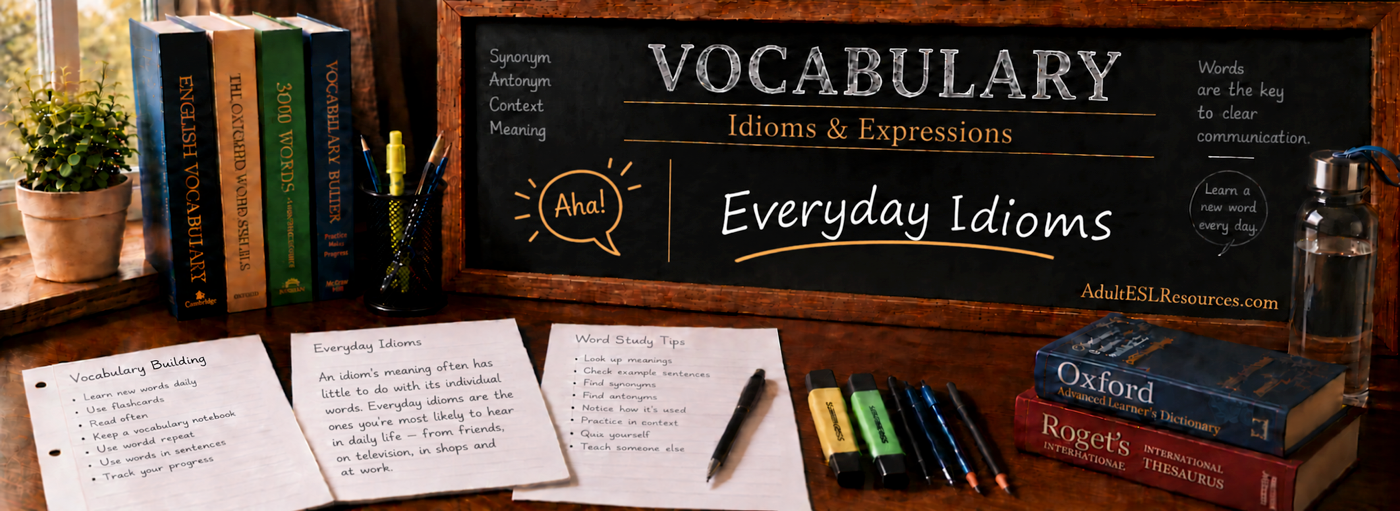
Everyday Idioms
A substantial collection of common, everyday idioms you’ll hear and use constantly in daily conversation, along with the basics of how to use them naturally.
The idioms you hear every day
Everyday idioms are everywhere in ordinary conversation.
An idiom’s meaning often has little to do with its individual words. Everyday idioms are the ones you’re most likely to hear in daily life — from friends, on television, in shops and at work — long before you meet the more specific or sophisticated expressions used elsewhere in this section.
This page works two ways at once. It is a short introduction to how idioms work, and it is a substantial reference collection you can return to whenever you want to expand your everyday English.
Before you begin
Common and useful, not rare or specialised.
On this page, “everyday” means idioms used constantly in ordinary daily conversation — the kind you’re likely to hear and use almost immediately. They tend to be simpler and more widely known than the less frequent, more nuanced expressions covered elsewhere in this section.
For more sophisticated expressions used in more specific situations, explore Advanced Idioms.
The Everyday Idiom Library
36 common idioms for daily life.
Each entry gives you the meaning and a natural example sentence, with a short note where it helps. Browse in any order, and come back whenever you want to add a few more expressions to your everyday English.
Daily Routines & Small Talk
call it a day
Meaning: stop an activity for now, especially at the end of a period of work.
“It’s already 6pm — let’s call it a day.”
piece of cake
Meaning: something very easy to do.
“Don’t worry about the test — it’ll be a piece of cake.”
hit the sack
Meaning: go to bed.
“I’m exhausted — I’m going to hit the sack.”
Note: also commonly heard as “hit the hay”.
spill the beans
Meaning: reveal a secret.
“Don’t spill the beans about the surprise party!”
on the tip of my tongue
Meaning: almost able to remember or say something, but not quite.
“Her name is on the tip of my tongue — I just can’t remember it.”
break the ice
Meaning: say or do something that helps people feel more relaxed together, especially when meeting for the first time.
“He told a joke to break the ice at the start of the meeting.”
Feelings & Health
under the weather
Meaning: feeling slightly unwell.
“I’m feeling a bit under the weather today.”
feel like a million dollars
Meaning: feel extremely good, healthy or confident.
“After the holiday, she felt like a million dollars.”
over the moon
Meaning: extremely happy.
“He was over the moon when he got the job.”
down in the dumps
Meaning: feeling sad or low.
“She’s been a bit down in the dumps since the exam results came out.”
have butterflies in your stomach
Meaning: feel nervous, especially before something important.
“I always get butterflies in my stomach before a presentation.”
green with envy
Meaning: very jealous of someone.
“He was green with envy when he saw her new car.”
Time & Money
cost an arm and a leg
Meaning: be very expensive.
“That watch must have cost an arm and a leg.”
save for a rainy day
Meaning: save money for a time in the future when you might need it.
“It’s a good habit to save a little each month for a rainy day.”
in the nick of time
Meaning: at the last possible moment, just before it’s too late.
“We got to the station in the nick of time.”
once in a blue moon
Meaning: very rarely.
“We only go to the cinema once in a blue moon these days.”
around the clock
Meaning: all day and all night, without stopping.
“The team worked around the clock to finish the project.”
time flies
Meaning: time passes very quickly, especially when you’re enjoying yourself.
“I can’t believe it’s already midnight — time flies!”
Work & Effort
give it a shot
Meaning: try something, even if you’re not sure it will work.
“I’ve never cooked this before, but I’ll give it a shot.”
get the hang of something
Meaning: learn how to do something, usually after some practice.
“It took me a while, but I finally got the hang of the new software.”
bite the bullet
Meaning: decide to do something difficult or unpleasant that you’ve been avoiding.
“I finally bit the bullet and booked the dentist appointment.”
keep your chin up
Meaning: stay positive during a difficult time.
“I know it’s been a hard week — keep your chin up.”
in over your head
Meaning: dealing with something more difficult than you can handle.
“I think he’s a bit in over his head with this project.”
cut corners
Meaning: do something in the easiest or cheapest way, often lowering the quality.
“They cut corners on the renovation, and it shows.”
Decisions & Opinions
make up your mind
Meaning: decide.
“Have you made up your mind about which course to take?”
on the same page
Meaning: having the same understanding or opinion as someone else.
“Let’s make sure we’re on the same page before the meeting.”
sit on the fence
Meaning: avoid making a decision or taking a side.
“He’s been sitting on the fence about the job offer for weeks.”
the best of both worlds
Meaning: a situation where you can enjoy the advantages of two different things at once.
“Working from home two days a week gives her the best of both worlds.”
no big deal
Meaning: something unimportant, not something to worry about.
“Don’t worry about being late — it’s no big deal.”
jump on the bandwagon
Meaning: start doing or supporting something because it has suddenly become popular.
“A lot of people jumped on the bandwagon once the trend took off.”
Social Situations & Relationships
hit it off
Meaning: get along well with someone immediately.
“They hit it off right away at the party.”
break the news
Meaning: tell someone something important, often serious or unexpected.
“I had to break the news that the trip was cancelled.”
have your hands full
Meaning: be very busy, especially with responsibilities that take all your attention.
“With three kids and a new puppy, she really has her hands full.”
get cold feet
Meaning: become nervous or hesitant about doing something, especially something important.
“She got cold feet just before the interview.”
small world
Meaning: said when you unexpectedly discover a connection or coincidence.
“You know my cousin too? Small world!”
get on someone’s nerves
Meaning: annoy or irritate someone, especially through repeated behaviour.
“His constant tapping on the desk really gets on my nerves.”
The central idea
Every idiom asks you to judge four things.
Before using an idiom from the library above with confidence, it helps to check each of the following.
01
Meaning
What does the expression actually mean, beyond the literal words?
02
Context
Does the situation genuinely call for this particular expression?
03
Register
Does its level of formality suit your audience and purpose?
04
Natural usage
Are you using the exact wording and form the expression normally takes?
Putting it into practice
Meaning, context, register and natural usage — briefly
A quick look at how each of the four checks plays out in real use.
Meaning: the words rarely give it away
Under the weather has nothing to do with rain or sunshine — it means feeling slightly unwell. Most everyday idioms simply have to be learned, the way you learned them in the library above.
Context: the right idiom for the right moment
Break the ice fits the start of a meeting or a first meeting between people, while hit the sack fits the end of the day. Using either in the wrong situation can sound just as odd as using the wrong word.
Natural usage: keeping the exact form
Cost an arm and a leg always uses “a leg”, and break the ice always keeps “the ice”. The verb can change tense freely — “cost an arm and a leg”, “will cost an arm and a leg” — but the core wording of the idiom itself generally cannot.
Conversational
I was totally under the weather, sorry!
Suitable in a quick, casual message to a friend.
More formal
I was unwell and unable to attend.
Suitable in a formal email to a tutor or employer.
Conversational
Let’s just call it a day and finish tomorrow.
Suitable when chatting casually with colleagues.
More formal
We will continue this tomorrow.
Suitable in a written note or formal message.
Common errors
Mistakes are useful when you understand why they happen.
I’m feeling a little under the weathers today.
I’m feeling a little under the weather today.
“Weather” is never made plural in this idiom, even though it might feel natural to add an “s”.
I need to hit sack early tonight.
I need to hit the sack early tonight.
Small words like “the” cannot be dropped from a fixed idiom, even though they seem unimportant.
(in a formal email to a professor) I was totally under the weather so I couldn’t make it, sorry!!
I was unwell and unable to attend.
“Under the weather” is conversational. A formal email calls for a plainer, more neutral way of saying the same thing.
Let’s break ice before the meeting starts.
Let’s break the ice before the meeting starts.
The idiom always includes “the” — “break ice” on its own isn’t a recognised expression.
This soup cost me an arm and a foot. (translated directly from another language)
This soup cost me an arm and a leg.
Idioms rarely translate word for word between languages. English pairs “an arm” with “a leg”, not “a foot”.
Your turn
Practise using idioms from the library.
These activities are part of the learning process. There are no scores, no grades and no limit on how many times you may try.
What does it mean if someone says they’re “under the weather”?
It’s a mild, everyday way of saying you don’t feel 100%.
“It’s already 6pm and I’m exhausted — let’s ___ and finish the rest tomorrow.”
“Hit the sack” means going to bed specifically — this sentence is about stopping work, not sleeping.
Which of these would be least appropriate in a formal email to your professor?
Idioms like “under the weather” belong in casual conversation, not formal writing.
Both “hit the sack” and “call it a day” involve stopping for now — but which one specifically means going to bed?
A “sack” here is an old, informal word related to a bed.
Try it another way
Complete each idiom.
Type the missing word.
Notice the difference
Correct the idiom mistake.
Rewrite each sentence so the idiom is used correctly.
I need to hit sack early tonight.
This soup cost me an arm and a foot.
(in a formal email) I was totally under the weather so couldn’t make it, sorry!!
Quick review
Four checks. One confident decision.
Meaning — learn what the idiom actually means; the words themselves rarely tell you
Context — check the situation genuinely calls for this particular expression
Register — match the idiom’s formality to your audience and purpose
Natural usage — keep the exact wording and form the expression normally takes
Remember
An idiom is only useful when it is understood, appropriate and natural.
You don’t need to use every idiom in the library above right away. Pick a few that fit your own everyday conversations, check their meaning, context and register, and come back for more whenever you’re ready.