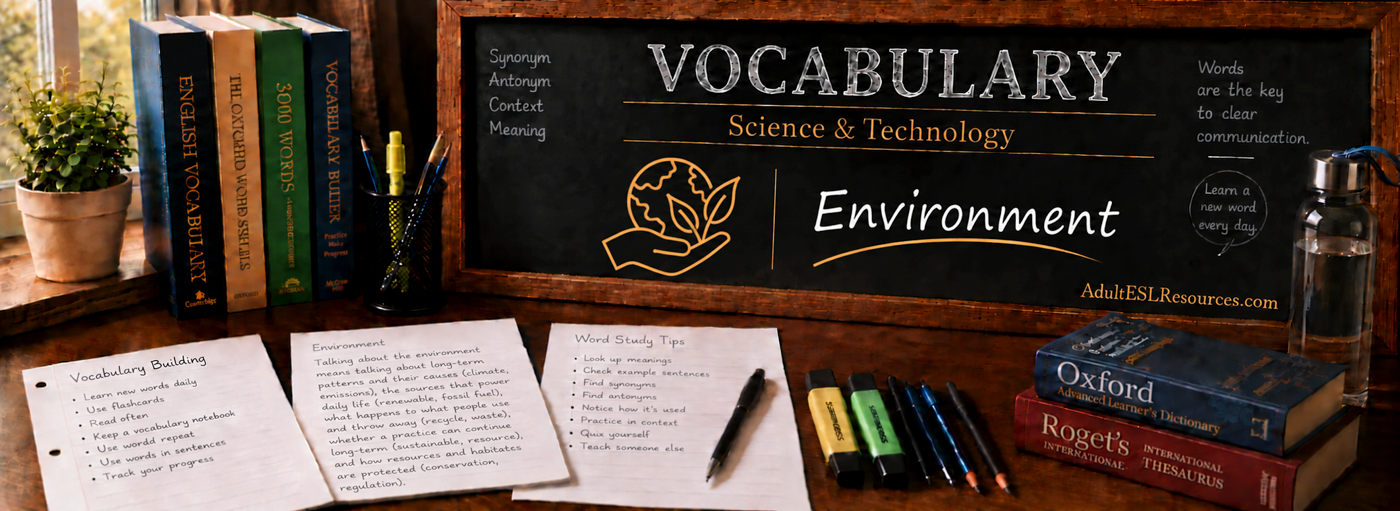
Environment Vocabulary
Part of the Science & Technology vocabulary group in Teacher-In-A-Box, this lesson explores the vocabulary used to describe climate and emissions, renewable energy, recycling and waste, sustainability, and conservation and policy — language useful for talking about environmental topics wherever you happen to be.
Connected vocabulary, not a glossary
Environment vocabulary works as a system.
Talking about the environment means talking about long-term patterns and their causes (climate, emissions), the sources that power daily life (renewable, fossil fuel), what happens to what people use and throw away (recycle, waste), whether a practice can continue long-term (sustainable, resource), and how resources and habitats are protected (conservation, regulation).
This lesson groups vocabulary by what it’s used to describe — climate and emissions, renewable energy, recycling and waste, sustainability, and conservation and policy — and shows how the words in each area relate to and differ from one another. Environmental priorities, laws, and programs vary widely between countries and communities, so this lesson focuses on vocabulary that applies to environmental topics in general rather than any one country’s approach or a specific policy debate.
You will leave this lesson able to talk about environmental topics more precisely, wherever you happen to be.
1. Climate and emissions
Different words describe short-term conditions and long-term patterns.
emissions — gases released into the air, often as a byproduct of burning fuel: “The factory reduced its emissions over the past decade.”
greenhouse gas — a gas that traps heat in the atmosphere: “Carbon dioxide is a well-known greenhouse gas.”
warming — a gradual increase in temperature: “Scientists have measured warming in many regions.”
climate vs. weather
climate / weather — climate is the long-term pattern of weather conditions in a place or region; weather is the atmospheric conditions at a particular time and place: “Today’s weather was unusually cold, but that doesn’t say much about the region’s climate.”
2. Renewable energy
Vocabulary for where power comes from.
energy — the power used to do work, such as heating a home or running a machine: “The building’s energy comes from several different sources.”
solar — relating to energy from the sun: “They installed solar panels on the roof.”
wind — relating to energy from moving air: “The wind farm powers thousands of homes.”
renewable vs. nonrenewable
renewable / nonrenewable — renewable energy comes from sources that naturally replenish, such as sunlight or wind; nonrenewable energy comes from sources such as fossil fuels that take an extremely long time to form and can eventually run out: “The town is shifting from nonrenewable to renewable sources of energy.”
3. Recycling and waste
Vocabulary for what happens to what people use and throw away.
waste — material that is thrown away because it’s no longer wanted or needed: “The city collects waste twice a week.”
landfill — a site where waste is buried in the ground: “Less waste ends up in the landfill now.”
compost — organic material, such as food scraps, that breaks down and can be used to enrich soil: “She turns her vegetable scraps into compost.”
recycle vs. reuse
recycle / reuse — to recycle is to process used material so it can be made into usable material or products again; to reuse is to use an item or material again, for the same purpose or a new one, without putting it through the recycling process: “Instead of throwing away the jar, she reused it as a storage container, and recycled the bottle she couldn’t reuse.”
4. Sustainability
Vocabulary for whether a practice can continue long-term.
resource — a material or supply that can be used to meet a need, such as water, wood, or energy: “Fresh water is a limited resource in some regions.”
consumption — the amount of something used: “The household reduced its water consumption.”
footprint — the overall impact something has on the environment: “Flying less often lowered her carbon footprint.”
sustainable vs. eco-friendly
sustainable / eco-friendly — sustainable describes a practice that can continue over the long term without using up or damaging resources; eco-friendly is a broader, more everyday word for anything less harmful to the environment, whether or not it’s sustainable in the long run, and the two terms overlap a great deal in casual use: “The company markets its packaging as eco-friendly, though whether the practice is truly sustainable depends on the whole supply chain.”
5. Conservation and policy
Vocabulary for how resources and habitats are protected.
Environmental laws, targets, and agreements vary enormously between countries, so this lesson focuses on the general vocabulary rather than any one policy or debate.
conservation — protecting and carefully managing natural resources, often while allowing responsible use: “The conservation group monitors the local river.”
preservation — protecting something from significant damage, change, development, or interference, often by limiting its use; the two terms overlap, and their exact use can depend on context: “The preservation of the old forest was a community priority.”
policy — a course of action or set of rules adopted by a government or organization: “The new policy encouraged residents to use less water.”
target — a specific goal set to be reached by a certain time: “The city set a target for reducing waste.”
Vocabulary in context
See the vocabulary working together.
Here is a short passage using several words from this lesson together.
Scientists explained that the difference between climate and weather matters when discussing long-term change. The city set a target to increase its use of renewable energy and reduce emissions, while a new recycling program encouraged residents to reduce waste and compost food scraps instead of sending them to a landfill. A local conservation group argued that stronger regulation was needed to protect natural resources for future generations.
Unpacking what this vocabulary communicates:
climate and weather → distinguishes a long-term pattern from a single day’s conditions.
renewable energy…emissions → describes a shift in energy source and its effect on air pollution.
recycling…compost…landfill → describes different ways of handling waste.
conservation group…regulation → describes protecting resources through both community action and rules.
The passage doesn’t name a specific country, law, or agreement, so the vocabulary can be applied to almost any environmental discussion.
Don’t confuse these
Choosing the right word changes what a sentence communicates.
climate / weather
Climate is the long-term pattern of weather conditions in a place or region; weather is the atmospheric conditions at a particular time and place.
renewable / nonrenewable
Renewable energy comes from sources that naturally replenish; nonrenewable energy comes from sources that can eventually run out.
recycle / reuse
To recycle is to process used material into usable material or products again; to reuse is to use an item again, for the same purpose or a new one, without recycling it.
sustainable / eco-friendly
Sustainable describes what can continue long-term without depleting resources; eco-friendly more broadly describes anything less harmful to the environment.
Natural word partnerships
These combinations are worth learning as fixed units.
For the general idea behind combinations like these, see:
Common errors
Mistakes are useful when you understand why they happen.
The weather of our planet is changing quickly.
The climate of our planet is changing quickly.
“Weather” refers to short-term, day-to-day conditions; long-term patterns are described with “climate.”
She works for environment organization.
She works for an environmental organization.
Use the adjective form “environmental” before a noun, along with the article “an.”
The city depends of renewable energy.
The city depends on renewable energy.
The fixed preposition is “depend on,” not “depend of.”
Please do recycling of your bottles.
Please recycle your bottles.
“Recycle” is used directly as a verb; “do recycling of” is unnatural.
There is too many waste in the landfill.
There is too much waste in the landfill.
“Waste” is uncountable, so it takes “much,” not “many.”
Your turn
Choose the word that fits.
These activities are part of the learning process. There are no scores, no grades and no limit on how many times you may try.
“The long-term pattern of weather conditions in a place or region, not conditions at a particular time.” Which word best fits?
Which word describes the long-term pattern rather than conditions right now?
“Energy from a source that naturally replenishes, such as sunlight or wind.” Which word best fits?
Which word describes a source that naturally replenishes?
“To use an item again, for the same purpose or a new one, without putting it through the recycling process.” Which word best fits?
Which word means using something again without putting it through recycling?
Try it another way
Complete the sentences.
Type the word that fits each gap.
Notice the difference
Rewrite each sentence using the correct word.
The weather of the Earth is getting warmer over decades.
She works for environment organization.
Alternate practice
Use the vocabulary productively, not just recognise it.
Complete the summary
Fill each gap with one word from this lesson: climate, renewable, emissions, recycling, landfill.
“Scientists explained that the difference between ___ and weather matters when discussing long-term change. The city set a target to increase its use of ___ energy and reduce ___, while a new ___ program encouraged residents to send less waste to the ___.”
Sort into groups
Sort these words into the area they belong to (Climate & Emissions / Renewable Energy / Recycling & Waste / Sustainability / Conservation & Policy):
Describe a situation
In two or three sentences, describe a fictional environmental situation using at least four words from this lesson.
Quick review
Five areas, connected by the everyday experience of the environment.
Climate and emissions — climate vs weather, plus emissions, greenhouse gas, and warming.
Renewable energy — renewable vs nonrenewable, plus energy, fossil fuel, solar, and wind.
Recycling and waste — recycle vs reuse, plus waste, landfill, and compost.
Sustainability — sustainable vs eco-friendly, plus resource, consumption, and footprint.
Conservation and policy — conservation, preservation, regulation, policy, and target.
Watch for — climate vs weather, renewable vs nonrenewable, recycle vs reuse, sustainable vs eco-friendly.
Remember
Environmental priorities and policies vary widely between countries and communities, but the vocabulary for talking about them stays widely useful.
Which sources of energy a country relies on, or which environmental rules it sets, is a matter of local policy, but vocabulary such as emissions, renewable and sustainable is useful for talking about environmental topics almost anywhere.
Related vocabulary