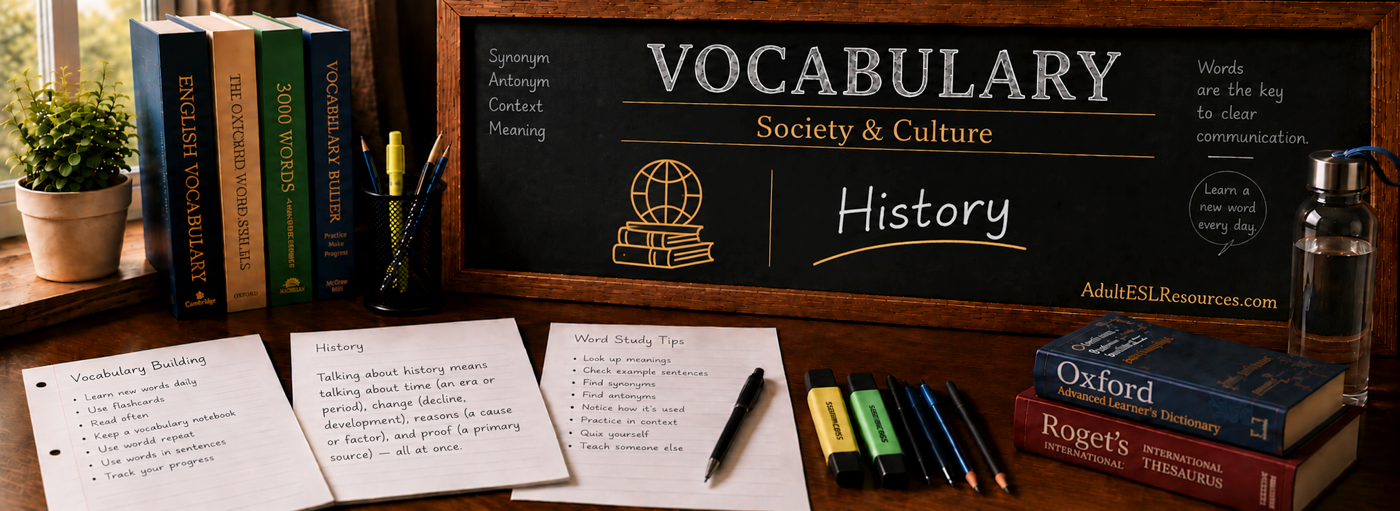
History Vocabulary
Part of the Society & Culture vocabulary group in Teacher-In-A-Box, this lesson explores the vocabulary used to describe historical time, change, causes, and evidence — the language used to study and discuss the past, rather than any single historical event.
Connected vocabulary, not a glossary
Historical vocabulary works as a system.
Talking about history means talking about time (an era or period), change (decline, development), reasons (a cause or factor), and proof (a primary source) — all at once.
This lesson is not about any specific war, empire, or historical figure. It groups vocabulary by what it’s used to describe — periods of time, change over time, cause and effect, and evidence — and shows how the words in each area relate to and differ from one another, using generic examples throughout.
You will leave this lesson able to describe historical time, change, and evidence more precisely, whatever period or subject you happen to be studying.
1. Talking about time
History is organised into blocks of time.
decade — ten years: “Fashion changed noticeably over that decade.”
century — one hundred years: “The building was constructed in the nineteenth century.”
timeline — a visual or written sequence of events in the order they happened: “The exhibit included a timeline of the region’s history.”
era vs. period vs. age
period — a general length of time, of any size, without necessarily sharing one defining feature: “Historians study many different periods.”
era — a period marked by a particular shared feature or theme: “The invention of the printing press began a new era in communication.”
age — often used for a very long period, especially one defined by a dominant technology or characteristic: “The Bronze Age is named for its use of bronze tools.”
2. Change over time
Historical vocabulary tracks how things rise, change, and fall.
emerge — to begin to appear or develop, often gradually: “New trade routes emerged during that period.”
decline — a gradual reduction in strength, importance, or size: “Historians study the decline of many past civilizations.”
revolution — a sudden, fundamental change; it can describe a change in government or society, but is also used for major changes in other areas, such as technology or ideas: “The invention of the printing press caused a revolution in how information spread.”
3. Cause and effect
Historians look for the reasons behind events.
consequence — a result that follows from an earlier event or decision: “Widespread famine was one consequence of the failed harvests.”
impact — the noticeable effect or influence something has: “The invention had a lasting impact on daily life.”
cause vs. factor
cause — something that directly produces an event or result: “Poor harvests were a direct cause of the shortage.”
factor — one of several things that contribute to an outcome, without necessarily being the single most direct reason: “Economic instability was one factor among many.”
4. Historical evidence and sources
What historians study, and how they know what happened.
artifact — an object made or used by people in the past, studied for what it reveals: “The museum displayed several ancient artifacts.”
record — a written or official account of something, kept at the time or soon after: “Tax records from that period still survive.”
archive — a collection of historical documents or records, and the place where they’re kept: “She spent months researching in the national archive.”
primary source vs. secondary source
primary source — material produced during the period being studied, or direct evidence from people or objects connected with it: “Letters and photographs from that period are primary sources.”
secondary source — later analysis or interpretation based on primary sources and other evidence: “A modern history book is usually a secondary source.”
5. Significance and interpretation
Historians don’t always agree — and that’s part of the discipline.
This vocabulary describes how history is studied and discussed, not a single fixed version of events.
legacy — the lasting effect or influence of something from the past: “The invention’s legacy can still be seen in modern technology.”
interpretation — a particular way of understanding and explaining events: “Different historians offer different interpretations of the same evidence.”
perspective — a particular way of looking at events, often shaped by whose experience is being considered: “Studying multiple perspectives gives a fuller picture of the period.”
revise — to reconsider and update an earlier explanation, usually because of new evidence: “Historians revised their earlier interpretation once new records were found.”
Vocabulary in context
See the vocabulary working together.
Here is a short, neutral passage using several words from this lesson together.
Historians have long debated why a particular ancient civilization declined. Some argue that economic factors were the primary cause, while others emphasise political instability. By examining primary sources — such as letters, records, and artifacts — historians continue to revise their interpretation as new evidence emerges.
Unpacking what this vocabulary communicates:
have long debated → historians genuinely disagree, and that disagreement is normal.
economic factors were the primary cause → one explanation among several possible ones, not a settled fact.
primary sources → firsthand material used as direct evidence.
revise their interpretation → understanding of the past changes as evidence changes.
The passage deliberately names no real civilization — the vocabulary of historical debate applies regardless of which period or place is being studied.
Don’t confuse these
Choosing the right word changes what a sentence communicates.
era / period / age
Ask: does this length of time share one defining feature (era), or is it simply a general stretch of time (period), or is it a very long span defined by one dominant characteristic (age)?
historic / historical
Historic means important or significant; historical simply means relating to the past or to history as a subject.
cause / factor
A cause directly produces a result; a factor is one of several things that contribute to it.
primary source / secondary source
A primary source comes from the time being studied; a secondary source analyses or comments on it later.
history / story
History is the study of the past, or the past itself; a story is a specific narrative, real or invented — “tell me the history of your weekend” isn’t natural English.
Natural word partnerships
These combinations are worth learning as fixed units.
For the general idea behind combinations like these, see:
Common errors
Mistakes are useful when you understand why they happen.
Can you tell me the history of your weekend?
Can you tell me about your weekend?
“History” refers to the past in general or as a subject of study, not a personal, recent narrative.
It was a historical achievement for the team.
It was a historic achievement for the team.
“Historic” means important or significant; “historical” just means relating to the past.
The museum displayed several ancient artifact.
The museum displayed several ancient artifacts.
“Artifact” is countable and needs a plural “-s” here.
The treaty caused effect on trade between the two regions.
The treaty had an effect on trade between the two regions.
“Effect” is a noun here; the verb form is “affect,” or use “had an effect on.”
Historians use primary source to write secondary source.
Historians use primary sources to write secondary sources.
Both terms are countable and are normally used in the plural in general statements like this one.
Your turn
Choose the word that fits.
These activities are part of the learning process. There are no scores, no grades and no limit on how many times you may try.
“An event widely recognised as important.” Which word best fits?
Which word means “important,” rather than simply “relating to the past”?
A letter written by someone who witnessed an event directly is an example of a ___ source.
Was this created at the time of the event, or written about it later?
“One of several things that contributed to an outcome, without being the single most direct reason.” Which word best fits?
Does this word describe the single, direct reason, or one of several contributing influences?
Try it another way
Complete the sentences.
Type the word that fits each gap.
Notice the difference
Rewrite each sentence using the correct word.
It was a historical achievement for the team.
The museum displayed several ancient artifact.
Alternate practice
Use the vocabulary productively, not just recognise it.
Complete the summary
Fill each gap with one word from this lesson: decline, primary, revised, factors, historic.
“Several economic ___ contributed to the civilization’s ___. Using newly discovered ___ sources, historians ___ their earlier account of what most called a ___ turning point.”
Sort into groups
Sort these words into the area they belong to (Time & Periods / Change Over Time / Cause & Effect / Evidence & Sources):
Describe a situation
In two or three sentences, describe a neutral historical process — for example, how historians use evidence, or how a period of change unfolds — using at least four words from this lesson.
Quick review
Five areas, connected by time, change, and evidence.
Talking about time — era vs period vs age, decades, and centuries.
Change over time — emerge, develop, decline, and revolution.
Cause and effect — cause vs factor, consequence, and impact.
Evidence and sources — primary vs secondary sources, artifacts, and records.
Significance and interpretation — legacy, interpretation, perspective, and revising conclusions.
Watch for — historic vs historical, cause vs factor, primary vs secondary source.
Remember
Historical vocabulary describes a discipline, not one fixed version of events.
Words like source, factor, interpretation and revise describe how historians study and discuss the past — understanding them doesn’t require agreeing on any single account of what happened, only being able to talk about the process of studying history clearly.
Related vocabulary
Explore related areas of vocabulary.
Explore the rest of the Society & Culture vocabulary group below.