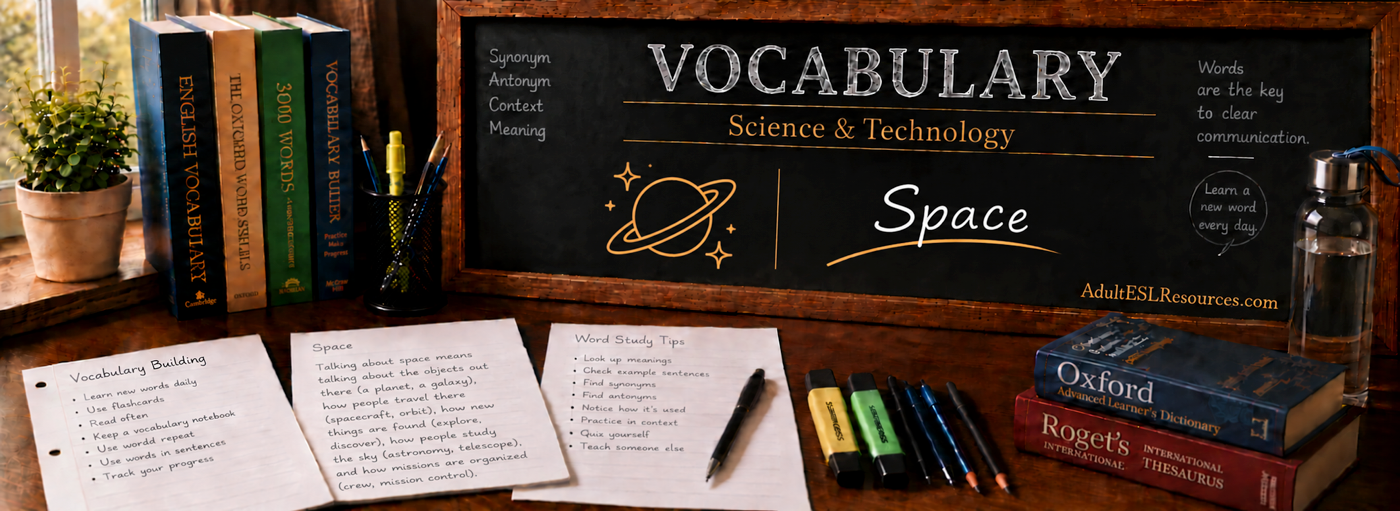
Space Vocabulary
Part of the Science & Technology vocabulary group in Teacher-In-A-Box, this lesson explores the vocabulary used to describe the solar system and beyond, space travel, exploration and discovery, observing the sky, and space agencies and missions — language useful for talking about space, wherever your curiosity takes you.
Connected vocabulary, not a glossary
Space vocabulary works as a system.
Talking about space means talking about the objects out there (a planet, a galaxy), how people travel there (spacecraft, orbit), how new things are found (explore, discover), how people study the sky (astronomy, telescope), and how missions are organized (crew, mission control).
This lesson groups vocabulary by what it’s used to describe — the solar system and beyond, space travel, exploration and discovery, observing the sky, and space agencies and missions — and shows how the words in each area relate to and differ from one another. New discoveries and missions are announced all the time, so this lesson focuses on vocabulary that stays useful regardless of what’s currently being explored.
You will leave this lesson able to talk about space and astronomy more precisely, whatever the latest news happens to be.
1. The solar system and beyond
Different words describe different kinds of objects in space.
moon — a natural satellite that orbits another object in space: “Earth has one moon.”
galaxy — an enormous system of stars, planets, and other matter held together by gravity: “Our galaxy is called the Milky Way.”
universe — everything that exists, including all galaxies, stars, and planets: “Scientists study how the universe began.”
star vs. planet
star / planet — a star is an enormous object that produces energy, including light and heat; a planet is a large celestial body that usually orbits a star and does not produce its own visible light in the same way a star does: “The night sky was full of stars, with one bright planet visible near the horizon.”
2. Space travel
Travelling in space has its own everyday vocabulary.
spacecraft — a vehicle designed to travel in space: “The spacecraft carried a crew of four.”
astronaut — a person trained to travel and work in space: “She trained for years to become an astronaut.”
launch — to send a spacecraft into space: “The rocket launched early in the morning.”
orbit vs. rotate
orbit / rotate — to orbit means to travel in a path around another object, such as a planet around a star; to rotate means to spin around one’s own axis: “The Earth rotates once a day and orbits the sun once a year.”
3. Exploration and discovery
Vocabulary for finding out what’s out there.
explore — to travel through or study something unfamiliar in order to learn more about it: “The mission was designed to explore a distant moon.”
discover — to find or learn about something for the first time: “Astronomers discovered a new object at the edge of the solar system.”
telescope — an instrument used to observe distant objects, especially in space: “She used a telescope to look at the rings of a planet.”
satellite vs. probe
satellite / probe — an artificial satellite is a human-made object placed in orbit around another body, often for observation, communication, navigation, or research; a space probe is an uncrewed spacecraft sent to collect information about space or celestial bodies, and it may fly past, orbit, or land on its target, so a probe can itself act as an orbiter. The word satellite can also describe a natural object, such as a moon, when context makes that clear: “An artificial satellite relayed the signal back to Earth, while a probe entered orbit around a distant moon to begin its survey.”
4. Observing the sky
Vocabulary for studying and watching the sky.
astronomy — the scientific study of stars, planets, and other objects in space: “She’s always been interested in astronomy.”
observatory — a building or facility equipped for observing the sky: “The observatory is open to visitors at night.”
eclipse — an event in which one object in space blocks the light of another: “They watched the eclipse together.”
comet vs. asteroid
comet / asteroid — a comet is made largely of ice, dust, and rock, and may develop a glowing coma or tail when heated as it approaches the Sun; an asteroid is an object composed mainly of rock or metal, and the two can be similar in size: “The comet developed a glowing tail as it neared the Sun, while the nearby asteroid showed no such change.”
5. Space agencies and missions
Vocabulary for how a space mission is organized.
mission — a planned project with a specific goal, such as exploring a particular location: “The mission lasted nearly a year.”
crew — the group of people working together on a spacecraft or mission: “The crew worked together to complete each task.”
mission control — the team on the ground that communicates with and supports a spacecraft or crew: “Mission control monitored the launch closely.”
spacewalk — when an astronaut leaves a spacecraft to work outside it, usually while still connected to it: “She completed her first spacewalk during the mission.”
Vocabulary in context
See the vocabulary working together.
Here is a short passage using several words from this lesson together.
The crew spent months preparing before their mission finally launched. Once in orbit, an astronaut completed a spacewalk to repair part of the spacecraft, while mission control monitored every step from the ground.
Unpacking what this vocabulary communicates:
crew…mission…launched → describes people preparing for and beginning a planned space project.
in orbit → describes travelling in a path around another object.
spacewalk…spacecraft → describes work done outside the vehicle.
mission control…ground → describes support happening from a distance.
The passage doesn’t name a specific mission, agency, or destination, so the vocabulary can be applied to almost any space exploration situation.
Don’t confuse these
Choosing the right word changes what a sentence communicates.
star / planet
A star is an enormous object that produces its own energy, including light and heat; a planet usually orbits a star and does not produce its own visible light in the same way.
orbit / rotate
To orbit is to travel around another object; to rotate is to spin around one’s own axis.
satellite / probe
An artificial satellite is placed in orbit around a body for observation, communication, or research; a probe is sent to gather information and may fly past, orbit, or land on its target.
comet / asteroid
A comet is made largely of ice, dust, and rock, and may develop a glowing tail as it nears the Sun; an asteroid is composed mainly of rock or metal.
Natural word partnerships
These combinations are worth learning as fixed units.
For the general idea behind combinations like these, see:
Common errors
Mistakes are useful when you understand why they happen.
The astronaut go to the moon.
The astronaut went to the moon.
Use the past tense “went” to describe a completed event.
The rocket launched to the space.
The rocket launched into space.
Use “into space” without an article — “space” here isn’t a specific, countable place.
She is interesting in astronomy.
She is interested in astronomy.
“Interested” describes how a person feels; “interesting” describes the thing itself.
The satellite is orbiting since two years.
The satellite has been orbiting for two years.
Use present perfect continuous with “for” plus a length of time, not “since.”
They discovered a planet new.
They discovered a new planet.
Adjectives come before the noun in English — “a new planet,” not “a planet new.”
Your turn
Choose the word that fits.
These activities are part of the learning process. There are no scores, no grades and no limit on how many times you may try.
“An enormous object that produces its own energy, including light and heat.” Which word best fits?
Which word describes an object that produces its own light and heat?
“To spin around one’s own axis, rather than travel around another object.” Which word best fits?
Which word means spinning in place, not travelling around something else?
“An uncrewed spacecraft sent to collect information about space or celestial bodies.” Which word best fits?
Which word describes an uncrewed spacecraft sent to gather information?
Try it another way
Complete the sentences.
Type the word that fits each gap.
Notice the difference
Rewrite each sentence using the correct word.
The astronaut go to the moon.
The rocket launched to the space.
Alternate practice
Use the vocabulary productively, not just recognise it.
Complete the summary
Fill each gap with one word from this lesson: mission, orbit, spacewalk, spacecraft, control.
“The crew spent months preparing before their ___ finally launched. Once in ___, an astronaut completed a ___ to repair part of the ___, while mission ___ monitored every step from the ground.”
Sort into groups
Sort these words into the area they belong to (Solar System & Beyond / Space Travel / Exploration & Discovery / Observing the Sky / Space Agencies & Missions):
Describe a situation
In two or three sentences, describe a fictional space situation using at least four words from this lesson.
Quick review
Five areas, connected by the everyday experience of space and astronomy.
The solar system and beyond — star vs planet, plus moon, galaxy, and universe.
Space travel — orbit vs rotate, plus spacecraft, astronaut, and launch.
Exploration and discovery — satellite vs probe, plus explore, discover, and telescope.
Observing the sky — comet vs asteroid, plus astronomy, observatory, constellation, and eclipse.
Space agencies and missions — mission, agency, crew, mission control, and spacewalk.
Watch for — star vs planet, orbit vs rotate, satellite vs probe, comet vs asteroid.
Remember
Our understanding of space keeps expanding, but the core vocabulary for talking about it stays widely useful.
New discoveries and missions are announced all the time, but vocabulary such as orbit, telescope and mission is useful across almost any space-related topic.
Related vocabulary