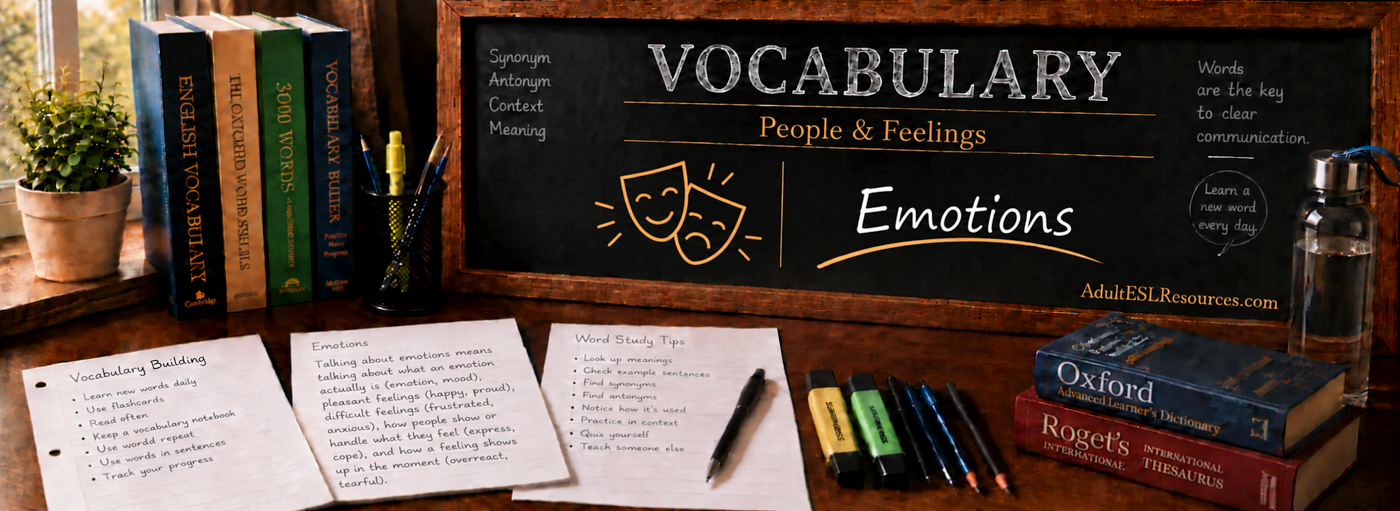
Emotions Vocabulary
Part of the People & Feelings vocabulary group in Teacher-In-A-Box, this lesson explores the vocabulary used to describe naming emotions, positive emotions, difficult emotions, expressing and managing emotions, and emotional reactions in the moment — language useful for talking about feelings wherever you happen to be.
Connected vocabulary, not a glossary
Emotions vocabulary works as a system.
Talking about emotions means talking about what an emotion actually is (emotion, mood), pleasant feelings (happy, proud), difficult feelings (frustrated, anxious), how people show or handle what they feel (express, cope), and how a feeling shows up in the moment (overreact, tearful).
This lesson groups vocabulary by what it’s used to describe — naming emotions, positive emotions, difficult emotions, expressing and managing emotions, and emotional reactions in the moment — and shows how the words in each area relate to and differ from one another. This lesson focuses on everyday vocabulary for feelings and emotional reactions, not on diagnosing or treating any mental health condition, and how openly people express emotion varies between individuals and cultures, so this lesson focuses on vocabulary that applies broadly rather than any one way of showing feelings.
You will leave this lesson able to talk about feelings more precisely, whatever the situation.
1. Naming emotions
Different words describe an emotion at different levels.
feeling — a subjective experience of an emotion: “She had a feeling of unease before the meeting.”
emotional — showing or strongly influenced by emotion: “He got emotional during the speech.”
react — to respond to something with an emotion or action: “She reacted calmly to the unexpected news.”
emotion vs. mood
emotion / mood — an emotion is a specific, often intense response to something, usually with a clear cause and a shorter duration; a mood is a more general emotional state that lasts for a period of time and doesn’t always have one clear cause: “The surprise triggered a strong emotion of joy, and she stayed in a good mood for the rest of the day.”
2. Positive emotions
Vocabulary for pleasant feelings.
excited — feeling enthusiastic anticipation about something: “He was excited about the trip.”
proud — feeling pleased about an achievement, your own or someone else’s: “She felt proud of her work.”
relieved — feeling reassured after a worry has been resolved: “He felt relieved when the test results were fine.”
happy vs. content
happy / content — happy describes joy or pleasure, often tied to something specific happening; content describes feeling satisfied and at ease with how things are, a calmer state that doesn’t depend on something new happening: “She was happy about the good news, and generally content with her life overall.”
3. Difficult emotions
Vocabulary for feelings that are harder to sit with.
sad — feeling unhappy, often because of a loss or a disappointing situation: “He felt sad when his trip was cancelled.”
disappointed — feeling let down because something didn’t meet your expectations: “She was disappointed when the event was postponed.”
frustrated — feeling annoyed or discouraged because something isn’t going the way you want: “He felt frustrated when the printer stopped working again.”
anxious vs. nervous
anxious / nervous — anxious can describe worry, unease, or apprehension, and is sometimes used for something broader or more persistent; nervous often describes tension or unease about a particular situation or event. The two words overlap considerably, and either may fit depending on the situation: “She said she felt both anxious and nervous about the interview — for her, the two words meant much the same thing.”
4. Expressing and managing emotions
Vocabulary for how people show or handle what they feel.
express — to communicate a feeling through words, expression, or action: “He found it hard to express how he felt.”
hide — to keep a feeling from being seen or known by others: “She tried to hide her disappointment.”
cope — to manage a difficult situation or feeling reasonably well: “He coped well with the sudden change of plans.”
overwhelmed vs. stressed
overwhelmed / stressed — overwhelmed describes feeling like there’s more happening or expected than you can handle at once; stressed describes feeling pressure or strain, often from ongoing demands, and doesn’t always involve that same sense of being unable to cope: “The sudden deadline left her feeling overwhelmed, on top of weeks of already feeling stressed about her workload.”
5. Emotional reactions in the moment
Vocabulary for how a feeling shows up right away.
overreact — to respond to something more strongly than the situation calls for: “He overreacted to a small mistake.”
irritable — easily annoyed, often only temporarily: “He gets irritable when he’s tired.”
snap (verb) — to react suddenly and sharply, often out of frustration: “He snapped at his colleague after a stressful day.”
Vocabulary in context
See the vocabulary working together.
Here is a short passage using several words from this lesson together.
She’d felt anxious for days before the interview, and nervous the morning of it itself. Waiting for the result left her feeling on edge, and by the time the call came she was close to tearful. When she heard she’d gotten the job, relief gave way to excitement, and later, quiet pride.
Unpacking what this vocabulary communicates:
anxious…nervous → describes worry and tension about the interview, using two overlapping words for a similar feeling.
on edge…tearful → describes visible tension building toward an emotional reaction.
relief…excitement…pride → describes a shift from difficult feelings to positive ones once the outcome is known.
The passage doesn’t name a specific job, place, or outcome in detail, so the vocabulary can be applied to almost any situation involving uncertainty and feelings.
Don’t confuse these
Choosing the right word changes what a sentence communicates.
emotion / mood
An emotion is a specific, often intense response with a clear cause; a mood is a more general state that lasts longer and doesn’t always have one clear cause.
happy / content
Happy describes joy or pleasure, often tied to something specific; content describes a calmer, longer-lasting satisfaction with how things are.
anxious / nervous
Anxious can describe worry, unease, or apprehension, sometimes broader or more persistent; nervous often describes tension about a particular event. The words overlap considerably, and either may fit in many situations.
overwhelmed / stressed
Overwhelmed describes feeling like there’s more than you can handle at once; stressed describes ongoing pressure or strain, without always involving that same sense.
Natural word partnerships
These combinations are worth learning as fixed units.
For the general idea behind combinations like these, see:
Common errors
Mistakes are useful when you understand why they happen.
I am boring at work today.
I am bored at work today.
“Bored” describes how you feel; “boring” describes the thing causing that feeling.
She was disappointed of the result.
She was disappointed with the result.
The fixed preposition is “disappointed with,” not “disappointed of.”
He calm down after a few minutes.
He calmed down after a few minutes.
Use the past tense “calmed,” not the base form “calm,” to describe a completed action.
She rarely express her feelings.
She rarely expresses her feelings.
Third-person singular present tense needs an “-s”: “she expresses,” not “she express.”
He feels very stress about the exam.
He feels very stressed about the exam.
Use the adjective “stressed,” not the noun “stress,” after “feels.”
Your turn
Choose the word that fits.
These activities are part of the learning process. There are no scores, no grades and no limit on how many times you may try.
“A specific, often intense response to something, usually with a clear cause.” Which word best fits?
Which word is more specific and shorter-lasting?
“Feeling satisfied and at ease with how things are, a calmer and longer-lasting state.” Which word best fits?
Which word describes a calmer state that doesn’t depend on something new happening?
“Often used for tension about one particular event, like an upcoming interview — though a word for broader worry could describe this too.” Which word fits best here?
Which word is more typical for one specific, upcoming event?
Try it another way
Complete the sentences.
Type the word that fits each gap.
Notice the difference
Rewrite each sentence using the correct word.
I am boring at work today.
She rarely express her feelings.
Alternate practice
Use the vocabulary productively, not just recognise it.
Complete the summary
Fill each gap with one word from this lesson: anxious, nervous, edge, tearful, relief.
“She’d felt ___ for days before the interview, and ___ the morning of it itself. Waiting for the result left her feeling on ___, and by the time the call came she was close to ___. When she heard she’d gotten the job, ___ gave way to excitement, and later, quiet pride.”
Sort into groups
Sort these words into the area they belong to (Naming Emotions / Positive Emotions / Difficult Emotions / Expressing & Managing Emotions / Emotional Reactions in the Moment):
Describe a situation
In two or three sentences, describe a fictional situation using at least four words from this lesson.
Quick review
Five areas, connected by the everyday experience of feelings.
Naming emotions — emotion vs mood, plus feeling, emotional, and react.
Positive emotions — happy vs content, plus excited, proud, and relieved.
Difficult emotions — anxious vs nervous, plus sad, disappointed, and frustrated.
Expressing and managing emotions — overwhelmed vs stressed, plus express, hide, and cope.
Emotional reactions in the moment — overreact, tearful, irritable, on edge, and snap.
Watch for — emotion vs mood, happy vs content, anxious vs nervous, overwhelmed vs stressed.
Remember
How openly people show their feelings varies between individuals and cultures, but the vocabulary for describing feelings stays widely useful.
What counts as an ordinary or a strong reaction can differ from person to person and culture to culture, but vocabulary such as frustrated, overwhelmed and relieved is useful across almost any conversation about feelings.
Related vocabulary