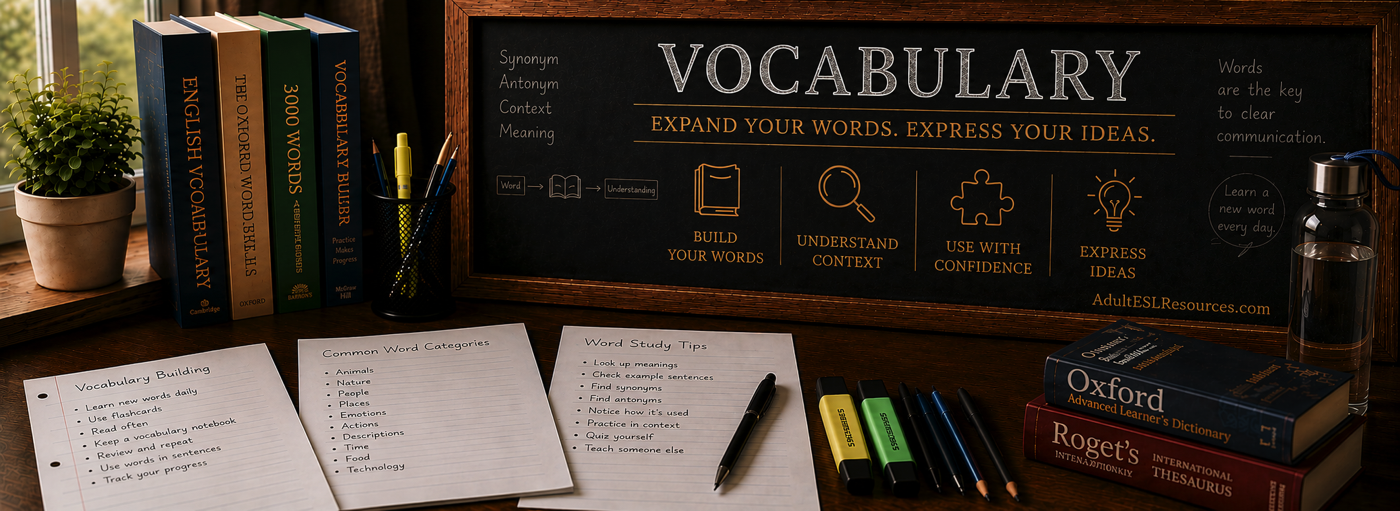
English Vocabulary
Vocabulary gives you the words and expressions you need to communicate with confidence. Explore the major areas of English vocabulary, understand how they connect, and choose the topics that best match your current learning goals.
The words that carry meaning
Vocabulary gives grammar something to say.
Vocabulary is the collection of words and expressions that allow you to name ideas, describe experiences and communicate meaning clearly. While grammar provides the structure of English, vocabulary provides the substance — the actual words you choose to express what you mean.
This section introduces the major areas of English vocabulary. Each area explores a different context or type of language and leads to more focused topics that build your word knowledge in greater depth. Explore whichever area best matches the vocabulary you would like to develop.
Choose your focus
Explore the Main Areas of Vocabulary
Each section below introduces a major area of English vocabulary. Together they provide a complete overview of the subject, while each individual section explores one area in greater depth. Select the section that best matches the vocabulary you would like to explore.
Academic
Build the vocabulary you need for academic study, formal learning and confident academic communication.
- Academic Reading and Lecture Vocabulary
- Formal and Analytical Writing Language
- Discussion and Seminar Vocabulary
- Research, Study and Exam Terms
Travel
Learn practical vocabulary for travelling, navigating new places and handling everyday travel situations.
- Transportation and Directions
- Airports, Stations and Border Crossings
- Accommodation and Bookings
- Common Travel Situations and Requests
Social
Develop the vocabulary needed for relationships, conversation and everyday social interaction.
- Meeting People and Making Conversation
- Relationships and Social Situations
- Opinions, Feelings and Reactions
- Invitations, Plans and Small Talk
Workplace
Build the vocabulary required for professional environments, workplace communication and employment situations.
- Meetings, Emails and Professional Communication
- Job Applications and Interviews
- Workplace Relationships and Teamwork
- Industries, Roles and Responsibilities
Idioms & Expressions
Explore idiomatic language and set expressions that give English much of its natural colour and character.
- Everyday Idioms
- Advanced Idioms
- Idioms by Topic
- Fixed Expressions
- Formal & Informal Expressions
Phrasal Verbs
Learn how verbs combine with particles such as up, out, off and through to create both literal and idiomatic meanings.
- Common Phrasal Verbs in Everyday English
- Literal vs Idiomatic Meanings
- Separable and Inseparable Phrasal Verbs
- Phrasal Verbs in Context
Collocations
Discover the natural word partnerships that make English sound fluent and accurate, such as make a decision or heavy rain.
- Verb and Noun Collocations
- Adjective and Noun Collocations
- Adverb and Adjective Collocations
- Collocations in Natural Context
Learn. Practise. Use.
Vocabulary that supports real communication
Vocabulary becomes useful when you understand the meaning, notice how it is used and practise using it for a real purpose.
Learn the Word or Phrase
Read clear explanations that show what a word or expression means and when it is used.
See It in Real Context
See vocabulary in complete sentences and meaningful situations rather than as isolated word lists.
Practise with Purpose
Complete focused activities that help you recognise, choose and produce the correct vocabulary.
Use It Confidently
Apply what you learn to speaking and writing so new vocabulary becomes part of your active English.
Progress, not perfection
You do not need to know every word to communicate well.
Focus on a small number of useful words or expressions at a time. Notice them, practise them and begin using them. Your vocabulary grows gradually through meaningful, repeated use.