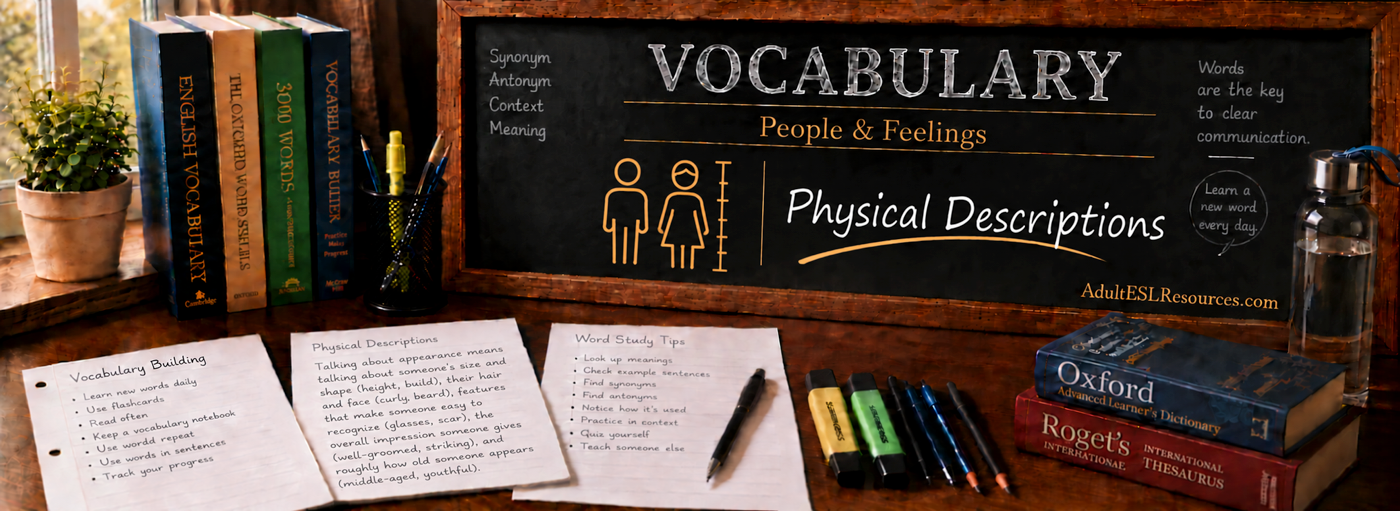
Physical Descriptions Vocabulary
Part of the People & Feelings vocabulary group in Teacher-In-A-Box, this lesson explores the vocabulary used to describe height and build, hair and face, distinguishing features, general impression, and age and general description — language useful for describing what someone looks like wherever you happen to be.
Connected vocabulary, not a glossary
Physical descriptions vocabulary works as a system.
Talking about appearance means talking about someone’s size and shape (height, build), their hair and face (curly, beard), features that make someone easy to recognize (glasses, scar), the overall impression someone gives (well-groomed, striking), and roughly how old someone appears (middle-aged, youthful).
This lesson groups vocabulary by what it’s used to describe — height and build, hair and face, distinguishing features, general impression, and age and general description — and shows how the words in each area relate to and differ from one another. This lesson focuses on neutral, descriptive vocabulary useful for introducing someone, describing a photo, or helping someone find you at a meeting point, rather than judging or ranking how someone looks, and what’s considered a polite way to describe appearance can vary between cultures, so this lesson focuses on vocabulary that applies broadly rather than any one standard.
You will leave this lesson able to describe what someone looks like more precisely, whoever you’re describing.
1. Height and build
Vocabulary for someone’s overall size and shape.
tall — above average height: “He’s quite tall for his age.”
average height — neither notably tall nor short: “She’s of average height.”
muscular — having well-developed, visible muscles: “He has a muscular build from years of training.”
build vs. weight
build / weight — build refers to the general shape, size, and structure of someone’s body, such as slim, muscular, or stocky; weight refers specifically to a measurement of how heavy someone is. “Build” is the word normally used to describe someone’s general body shape in everyday conversation, since directly commenting on someone’s weight is often considered too personal: “She has an athletic build” describes someone’s shape, not a number on a scale.
2. Hair and face
Vocabulary for describing hair and facial features.
straight (hair) — hair with no curls or waves: “She has long, straight hair.”
bald — having little or no hair on the head: “Her grandfather is bald.”
beard — hair grown on the lower part of a man’s face: “He grew a beard over the winter.”
curly vs. wavy
curly / wavy — curly describes hair that forms tight curls or coils; wavy describes hair with a looser, gentler bend, less defined than curls: “Her hair is curly at the ends but wavy near the top.”
3. Distinguishing features
Vocabulary for features that make someone easy to recognize.
glasses — lenses worn over the eyes to improve vision: “He wears glasses for reading.”
scar — a mark left on the skin after an injury has healed: “He has a small scar above his eyebrow.”
tattoo — a permanent design made on the skin with ink: “She has a small tattoo on her wrist.”
freckles vs. birthmark
freckles / birthmark — freckles are small pigmented spots on the skin that may become more noticeable with sun exposure; a birthmark is a distinctive mark on the skin that is present at birth or develops around the time of birth: “She has freckles across her nose and a birthmark on her shoulder that’s been there since she was born.”
4. General impression
Vocabulary for the overall impression someone gives.
well-groomed — neat and carefully presented in appearance: “He always looks well-groomed.”
casual — relaxed and informal in style: “She dressed casually for the trip.”
athletic — having a fit, toned build, often from regular exercise: “He has an athletic build from years of running.”
elegant vs. striking
elegant / striking — elegant describes someone graceful and stylish in a refined way; striking describes someone very noticeable, often because of an unusual or strong feature, which isn’t necessarily about style at all: “Her elegant outfit stood out, and his striking height made him easy to spot in the crowd.”
5. Age and general description
Vocabulary for roughly how old someone appears.
in his/her twenties — approximately 20 to 29 years old: “She’s in her late twenties.”
middle-aged — describing an adult who is no longer considered young but not yet considered old; the exact age range is subjective and varies by context: “He’s a middle-aged man with graying hair.”
elderly — describing older age; the word can sound impersonal or outdated when used to label an individual directly, and “older person” or “older adult” is often preferred in that situation, though conventions vary by context and culture: “The community center offers classes for older adults, though the same group might be described in a report as the elderly population.”
resemble — to look similar to someone or something, often a family member: “She resembles her mother.”
Vocabulary in context
See the vocabulary working together.
Here is a short passage using several words from this lesson together.
The woman at the gate was of average height, with curly brown hair and a small scar above one eyebrow. She wore glasses and had a striking, confident presence, dressed casually despite the long flight. He guessed she was in her thirties, though it was hard to say for certain.
Unpacking what this vocabulary communicates:
average height…curly…scar → describes size, hair, and a distinguishing feature together.
glasses…striking…casually → describes an accessory, an overall impression, and a style choice.
in her thirties…hard to say for certain → describes an approximate age, not an exact one.
The passage doesn’t name a specific person or place, so the vocabulary can be applied to almost any situation involving describing someone’s appearance.
Don’t confuse these
Choosing the right word changes what a sentence communicates.
build / weight
Build refers to someone’s general body shape and structure; weight refers specifically to how heavy someone is. “Build” is the more common, less personal word in everyday conversation.
curly / wavy
Curly hair forms tight curls or coils; wavy hair has a looser, gentler bend.
freckles / birthmark
Freckles are small pigmented spots that may become more noticeable with sun exposure; a birthmark is a distinctive mark present at birth or appearing around that time.
elegant / striking
Elegant describes being graceful and stylish; striking describes being very noticeable, often for a reason unrelated to style.
Natural word partnerships
These combinations are worth learning as fixed units.
For the general idea behind combinations like these, see:
Common errors
Mistakes are useful when you understand why they happen.
She has hair long and curly.
She has long, curly hair.
Adjectives come before the noun in English, not after.
He resembles with his father.
He resembles his father.
“Resemble” is followed directly by an object, with no preposition.
She is wear glasses.
She wears glasses.
Use the simple present “wears,” not “is wear.”
He is tall of 180 centimeters.
He is 180 centimeters tall.
State the measurement before “tall,” with no “of.”
He has a scar in his forehead.
He has a scar on his forehead.
Use “on” for a mark on the surface of the skin, not “in.”
Your turn
Choose the word that fits.
These activities are part of the learning process. There are no scores, no grades and no limit on how many times you may try.
“The general shape, size, and structure of someone’s body, such as slim or muscular.” Which word best fits?
Which word describes shape rather than a measurement?
“Hair with a looser, gentle bend, less defined than curls.” Which word best fits?
Which word describes a looser bend, rather than tight curls?
“Very noticeable, often because of an unusual or strong feature, not necessarily about style.” Which word best fits?
Which word doesn’t require being graceful or stylish?
Try it another way
Complete the sentences.
Type the word that fits each gap.
Notice the difference
Rewrite each sentence using the correct word.
She has hair long and curly.
He resembles with his father.
Alternate practice
Use the vocabulary productively, not just recognise it.
Complete the summary
Fill each gap with one word from this lesson: average, curly, scar, striking, thirties.
“The woman at the gate was of ___ height, with ___ brown hair and a small ___ above one eyebrow. She wore glasses and had a ___, confident presence, dressed casually despite the long flight. He guessed she was in her ___, though it was hard to say for certain.”
Sort into groups
Sort these words into the area they belong to (Height & Build / Hair & Face / Distinguishing Features / General Impression / Age & General Description):
Describe a situation
In two or three sentences, describe a fictional person’s appearance using at least four words from this lesson.
Quick review
Five areas, connected by the everyday task of describing what someone looks like.
Height and build — build vs weight, plus tall, short, and average height.
Hair and face — curly vs wavy, plus straight, bald, and beard.
Distinguishing features — freckles vs birthmark, plus glasses, scar, and tattoo.
General impression — elegant vs striking, plus well-groomed, casual, and athletic.
Age and general description — in his/her twenties, middle-aged, elderly, youthful, and resemble.
Watch for — build vs weight, curly vs wavy, freckles vs birthmark, elegant vs striking.
Remember
What’s considered a polite way to describe someone’s appearance varies between cultures, but the vocabulary itself stays widely useful.
Fashions, hairstyles, and even what people consider worth mentioning change over time and from place to place, but vocabulary such as build, well-groomed and resemble is useful across almost any situation involving describing someone’s appearance.
Related vocabulary