Robotics & AI Vocabulary
Part of the Science & Technology vocabulary group in Teacher-In-A-Box, this lesson explores the vocabulary used to describe robots and robotics, how robots sense and act, artificial intelligence and machine learning, generative AI and everyday interaction, and AI accuracy and human oversight — language increasingly useful in workplaces and everyday life, wherever you happen to be.
Connected vocabulary, not a glossary
Robotics and AI vocabulary works as a system.
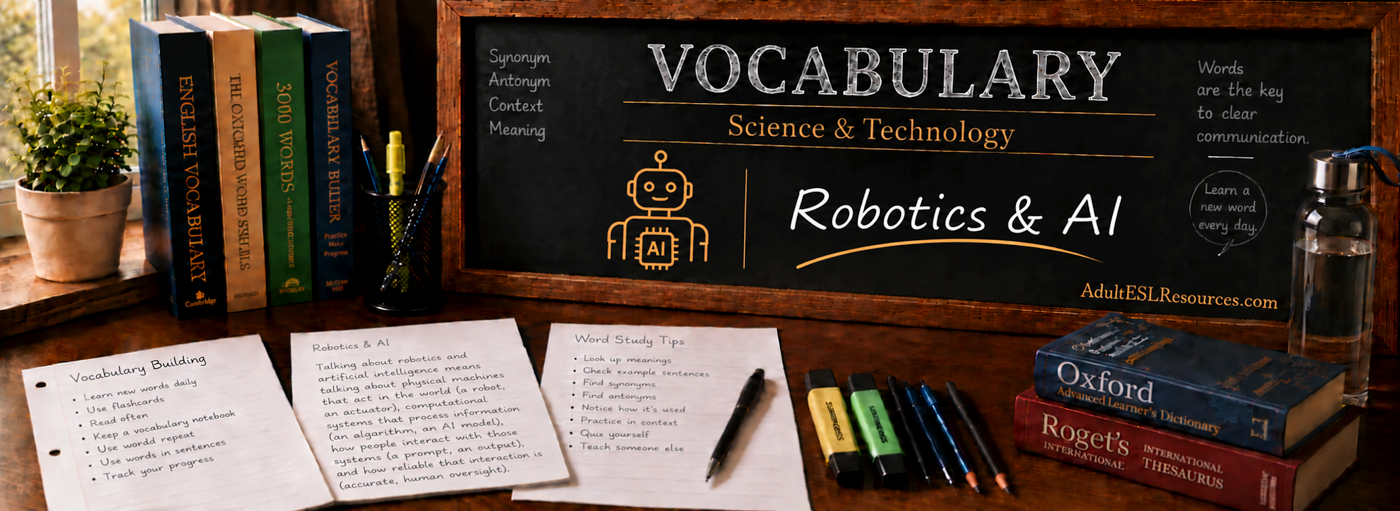
Talking about robotics and artificial intelligence means talking about physical machines that act in the world (a robot, an actuator), computational systems that process information (an algorithm, an AI model), how people interact with those systems (a prompt, an output), and how reliable that interaction is (accurate, human oversight).
This lesson groups vocabulary by what it’s used to describe — robots and robotics, how robots sense and act, artificial intelligence and machine learning, generative AI and everyday interaction, and AI accuracy and human oversight — and shows how the words in each area relate to and differ from one another. Robotics and AI are already part of many workplaces and everyday tools, and specific platforms, employers, and products change constantly, so this lesson focuses on vocabulary that applies to robotics and AI in general rather than any one system or brand.
You will leave this lesson able to talk about robots and artificial intelligence more precisely, whatever specific tools or workplace you have in mind.
1. Robots and robotics
Vocabulary for machines that perform physical tasks.
robot — a physical machine capable of performing actions in the physical world, often programmed to complete specific tasks: “The robot moved boxes from one shelf to another.”
robotics — the field concerned with designing, building, and operating robots: “She studied robotics at university.”
industrial robot — a robot designed for tasks such as manufacturing, assembly, or packaging, typically used in factories or similar settings: “The industrial robot welded each part with the same precision every time.”
automated vs. autonomous
automated / autonomous — automated describes a system that performs a task automatically according to programmed processes or triggers; autonomous describes a system able to make some decisions or adapt its actions without constant direct human control, though autonomy doesn’t mean unlimited independence: “The assembly line was fully automated, but the delivery robot was autonomous enough to choose its own route.”
robotics vs. automation
robotics / automation — robotics is the field concerned with designing, building, and operating robots; automation is the use of systems or processes to perform tasks automatically, and automation doesn’t necessarily involve robots at all. Robotics also doesn’t mean every robot is fully automated or autonomous: “The plant used automation to sort packages with no robots involved, while a separate robotics team built a prototype that still needed a person to operate it.”
2. How robots sense and act
Vocabulary for how a robot takes in information and responds to it.
sensor — a device that detects information from the environment, such as light, distance, or temperature: “A sensor stopped the robot before it collided with the shelf.”
actuator — a component that produces physical movement in a machine, converting a signal into action: “The actuator moved the robotic arm into position.”
machine vision / computer vision — technology that allows a system to interpret images or visual information: “Machine vision let the robot identify defective parts on the line.”
human-robot interaction — the ways in which people and robots communicate, cooperate, or work alongside one another: “Researchers study human-robot interaction to make workplaces safer.”
repetitive task — an action performed the same way many times, often a good candidate for automation: “Sorting identical parts is a repetitive task well suited to a robot.”
robot vs. AI
robot / AI — a robot is a physical machine capable of performing actions in the physical world; AI is computational technology, not a physical object. A robot may use AI to help it sense or decide, but not every robot uses AI, and AI does not require a physical robot at all: “The robot on the factory floor followed simple programmed steps with no AI involved, while a separate AI system analyzed sales data from an office computer.”
sensor vs. actuator
sensor / actuator — a sensor detects information from the environment or system, such as light, distance, or temperature; an actuator produces physical movement or action, converting a signal into a physical effect. In short, a sensor takes information in, and an actuator makes something happen: “A sensor detected the obstacle, and an actuator adjusted the arm’s position in response.”
machine vision vs. computer vision
machine vision / computer vision — both terms describe a system’s ability to interpret images or visual information, and their use overlaps considerably; machine vision is often used for practical, industrial applications such as inspection, measurement, or guiding equipment, while computer vision is the broader term and can describe visual interpretation in many kinds of systems, not only industrial ones. The exact usage can vary by industry or context: “The factory’s machine vision system checked each part for defects, while a separate research team applied computer vision techniques outside any industrial setting.”
3. Artificial intelligence and machine learning
Vocabulary for artificial intelligence, models, algorithms, and learning from data.
artificial intelligence — computational systems capable of tasks such as prediction, classification, pattern recognition, generation, or interpretation: “Artificial intelligence is used in fields ranging from healthcare to logistics.”
AI model — a computational system trained to identify patterns and produce predictions, classifications, decisions, or generated outputs, depending on its design: “The company built an AI model to predict equipment failures.”
machine learning — a way of developing AI systems using data, so that patterns can be learned rather than every rule being individually programmed: “Machine learning allowed the system to improve as it processed more examples.”
training data — the data used during the process of developing or training a model; not every AI system is trained the same way: “The model’s accuracy depended heavily on the quality of its training data.”
automation vs. AI
automation / AI — automation follows rules or processes to perform tasks automatically; AI refers to computational systems capable of tasks such as prediction, classification, pattern recognition, generation, or interpretation. A system may combine both, but not all automation is AI: “The assembly line used simple automation, while a separate AI system predicted which machines were likely to need maintenance.”
4. Generative AI and everyday interaction
Vocabulary for how people interact with AI systems day to day.
generative AI — a category of AI that produces new content, such as text, images, audio, video, or code, depending on the system: “She used generative AI to draft the first version of the report.”
prompt — an instruction, question, or other input given to an AI system to guide its response or output: “He wrote a detailed prompt describing exactly what he needed.”
output — what a system produces after processing input: “She reviewed the output before using it in her presentation.”
generative AI vs. AI
generative AI / AI — generative AI is one category of AI, specifically the kind that produces new content; AI is the broader term covering many other tasks as well, such as prediction and classification, so the two terms aren’t synonyms: “The company used generative AI to draft marketing copy and a separate, non-generative AI system to detect fraud.”
chatbot vs. AI assistant
chatbot / AI assistant — a chatbot is software designed primarily for conversation through text or voice; an AI assistant may also use conversation but can be designed to help perform a wider range of tasks. In everyday use, the terms can overlap: “The chatbot answered simple questions, while the AI assistant could also schedule appointments and send reminders.”
prompt vs. output
prompt / output — a prompt is the instruction, question, or other input a person gives to an AI system; the output is what the system produces after processing that input. In short, a prompt goes in, and an output comes out: “She refined her prompt until the output matched what she needed.”
5. AI accuracy and human oversight
Vocabulary for how reliable an AI response is, and who checks it.
hallucination — an output generated by an AI system that presents incorrect, unsupported, or invented information as though it were reliable; not every AI error counts as a hallucination: “The report contained a hallucination — a citation for a source that didn’t exist.”
verify — to check that something is true, accurate, or correct: “She verified the figures before including them in the summary.”
human oversight — the practice of having a person review, check, or approve the work of an automated or AI system: “Human oversight caught the error before the report was sent out.”
plausible vs. accurate
plausible / accurate — a plausible response sounds reasonable and believable; an accurate response is actually correct. An AI response can sound plausible without being accurate, which is why verification matters: “The answer sounded plausible, but it wasn’t accurate once she checked it against a reliable source.”
Vocabulary in context
See the vocabulary working together.
Here is a short passage using several words from this lesson together.
On the factory floor, an industrial robot used its sensors to complete the same repetitive task hundreds of times a day, all through simple automation. In the office upstairs, an employee entered a prompt into a generative AI system to draft a summary of the week’s production data. She reviewed the output carefully, verified the figures against the original records, and added her own human oversight before sending the summary on.
Unpacking what this vocabulary communicates:
industrial robot…sensors…repetitive task…automation → describes a physical machine repeating a programmed action, with no AI necessarily involved.
prompt…generative AI…output → describes giving an AI system an instruction and receiving generated content in return.
verified…human oversight → describes checking the AI’s work before relying on it.
The passage doesn’t name a specific company, country, or AI product, so the vocabulary can be applied to almost any workplace or everyday situation.
Don’t confuse these
Choosing the right word changes what a sentence communicates.
robot / AI
A robot is a physical machine that acts in the world; AI is computational technology and doesn’t require a physical robot at all.
automation / AI
Automation follows programmed rules to perform tasks; AI covers tasks like prediction and pattern recognition. Not all automation is AI.
automated / autonomous
Automated systems follow programmed processes; autonomous systems can make some decisions or adapt without constant human control.
generative AI / AI
Generative AI is one category of AI that produces new content; AI is the broader term covering many other kinds of tasks.
chatbot / AI assistant
A chatbot is designed primarily for conversation; an AI assistant may also perform a wider range of tasks. The terms can overlap.
algorithm / AI
An algorithm is any defined set of steps used to solve a problem, whether or not AI is involved; AI systems typically rely on many algorithms, but not every algorithm is AI.
AI-generated / AI-assisted
AI-generated content is produced substantially by an AI system; AI-assisted work is created by a person using AI as one tool in the process. The exact distinction can vary by institution, employer, or policy.
robotics / automation
Robotics is the field concerned with designing, building, and operating robots; automation is the use of systems or processes to perform tasks automatically and doesn’t necessarily involve robots.
sensor / actuator
A sensor detects information from the environment; an actuator produces physical movement or action. A sensor takes information in, and an actuator makes something happen.
machine vision / computer vision
The terms overlap considerably; machine vision is often used for practical, industrial applications, while computer vision is the broader term covering visual interpretation in many kinds of systems.
prompt / output
A prompt is the input a person gives to an AI system; the output is what the system produces after processing it. A prompt goes in, and an output comes out.
Natural word partnerships
These combinations are worth learning as fixed units.
For the general idea behind combinations like these, see:
Common errors
Mistakes are useful when you understand why they happen.
She built an AI to answer questions.
She built an AI system to answer questions.
“AI” on its own usually refers to the field or the technology in general; a specific product is more precisely called an AI system or AI model.
He made a prompt to generate the image.
He wrote a prompt to generate the image.
“Write,” “enter,” or “give” a prompt are the natural collocations; “make a prompt” is unusual.
The factory does automation for packaging.
The factory automates packaging.
“Automate” is used directly as a verb; “do automation for” is unnatural.
The model was trained with millions of examples.
The model was trained on millions of examples.
The fixed preposition is “trained on,” not “trained with.”
The chatbot gave me an information about the order.
The chatbot gave me information about the order.
“Information” is uncountable and doesn’t take the article “an.”
Your turn
Choose the word that fits.
These activities are part of the learning process. There are no scores, no grades and no limit on how many times you may try.
“A physical machine capable of performing actions in the physical world.” Which word best fits?
Which word describes a physical machine, rather than computational technology?
“Able to make some decisions or adapt its actions without constant direct human control.” Which word best fits?
Which word describes a system that can adapt on its own, rather than simply following fixed steps?
“An AI output that presents incorrect or invented information as though it were reliable.” Which word best fits?
Which word names an AI output that invents information?
Try it another way
Complete the sentences.
Type the word that fits each gap.
Notice the difference
Rewrite each sentence using the correct word.
He made a prompt to generate the image.
The chatbot gave me an information about the order.
Alternate practice
Use the vocabulary productively, not just recognise it.
Complete the summary
Fill each gap with one word from this lesson: automation, sensors, prompt, output, oversight.
“On the factory floor, an industrial robot used its ___ to complete the same repetitive task hundreds of times a day, all through simple ___. In the office upstairs, an employee entered a ___ into a generative AI system to draft a summary. She reviewed the ___ carefully and added her own human ___ before sending the summary on.”
Sort into groups
Sort these words into the area they belong to (Robots & Robotics / How Robots Sense & Act / Artificial Intelligence & Machine Learning / Generative AI & Interaction / AI Accuracy & Human Oversight):
Describe a situation
In two or three sentences, describe a fictional workplace situation using at least four words from this lesson, such as automation, robot, AI, prompt, output, or verify.
Quick review
Five areas, connected by the growing role of robots and AI in everyday life.
Robots and robotics — automated vs autonomous and robotics vs automation, plus robot, industrial robot.
How robots sense and act — robot vs AI, sensor vs actuator, and machine vision vs computer vision, plus human-robot interaction and repetitive task.
Artificial intelligence and machine learning — automation vs AI, plus AI model, machine learning, training data, and algorithm.
Generative AI and everyday interaction — generative AI vs AI, chatbot vs AI assistant, and prompt vs output.
AI accuracy and human oversight — plausible vs accurate, plus hallucination, verify, and reliable.
Watch for — robot vs AI, automation vs AI, automated vs autonomous, robotics vs automation, sensor vs actuator, machine vision vs computer vision, generative AI vs AI, chatbot vs AI assistant, prompt vs output.
Remember
The specific tools, platforms, and workplaces that use robots and AI keep changing, but the vocabulary for talking about them stays widely useful.
Which robot, AI system, or platform someone uses depends on their workplace or product of choice, but vocabulary such as automation, prompt and human oversight is useful across almost any robotics or AI conversation.
Related vocabulary