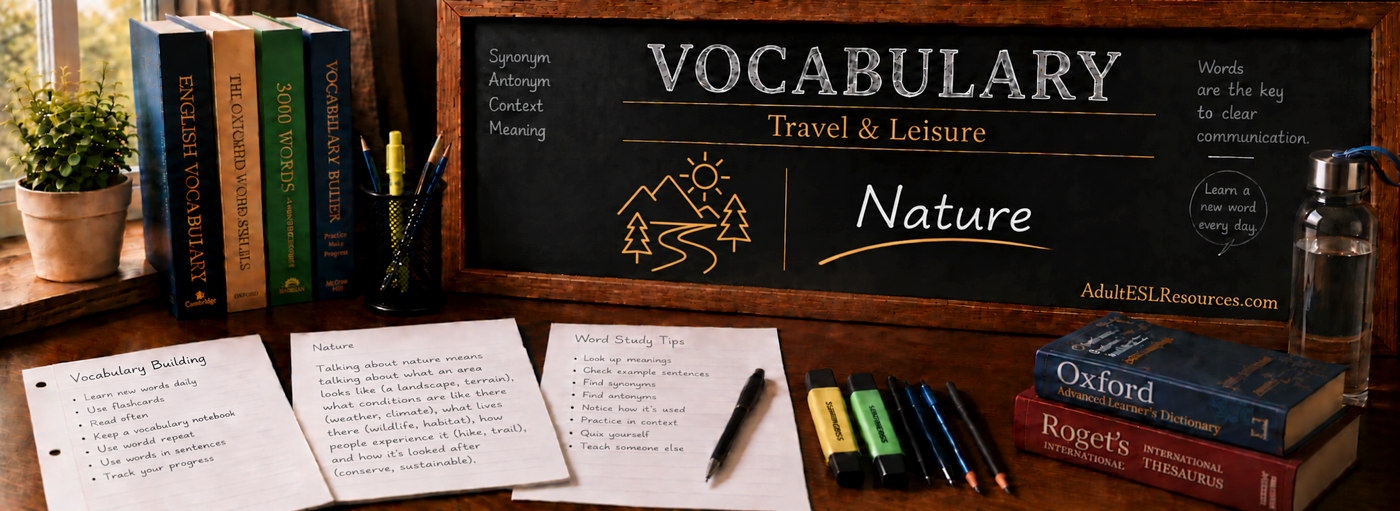
Nature Vocabulary
Part of the Travel & Leisure vocabulary group in Teacher-In-A-Box, this lesson explores the vocabulary used to describe landscapes and natural features, weather and climate, wildlife, outdoor activities, and conservation — language useful for talking about the natural world almost anywhere, however different it looks from place to place.
Connected vocabulary, not a glossary
Nature vocabulary works as a system.
Talking about nature means talking about what an area looks like (a landscape, terrain), what conditions are like there (weather, climate), what lives there (wildlife, habitat), how people experience it (hike, trail), and how it’s looked after (conserve, sustainable).
This lesson groups vocabulary by what it’s used to describe — landscapes and natural features, weather and climate, wildlife, outdoor activities, and conservation — and shows how the words in each area relate to and differ from one another. Climates, landscapes, and wildlife vary enormously between regions, so this lesson focuses on vocabulary that applies to nature in general rather than any one place’s specific conditions.
You will leave this lesson able to describe the natural world more precisely, wherever you happen to encounter it.
1. Landscapes and natural features
Different words describe the physical shape of a place and how it looks.
terrain — the physical features of an area of land, especially in terms of how difficult it is to move across: “The terrain was too rocky for a bike.”
wilderness — an area of land still in its natural state, without much human development: “They hiked deep into the wilderness.”
coastline — the outline or shape of the land along the sea: “The coastline here is full of small bays.”
landscape vs. scenery
landscape / scenery — landscape usually describes the physical shape and features of an area; scenery emphasizes how visually pleasing or dramatic those features look: “The landscape includes both mountains and forest, and the scenery is stunning from the viewpoint.”
2. Weather and climate
Talking about conditions in the moment versus over time uses different words.
Specific climates and weather patterns vary a great deal by region, so this lesson focuses on the vocabulary itself rather than any one place’s conditions.
forecast — a prediction of what the weather will be like: “The forecast says it will rain tomorrow.”
temperature — a measurement of how hot or cold something is, including the air: “The temperature dropped overnight.”
humid — describes air that contains a noticeable amount of moisture, often feeling warm and damp: “It gets very humid in summer.”
weather vs. climate
weather / climate — weather describes atmospheric conditions at a particular time and place; climate describes the typical weather pattern of a region over a long period: “Today’s weather is unusually cold for this region’s climate.”
3. Wildlife
Vocabulary for animals and the places they live.
wildlife — animals living in their natural environment, not kept as pets or on farms: “The park is known for its wildlife.”
species — a group of living things that share certain characteristics and can reproduce together: “Several rare species live in this forest.”
endangered — describes a species at risk of disappearing entirely: “The organization works to protect endangered animals.”
habitat vs. ecosystem
habitat / ecosystem — a habitat is the natural environment where a particular species normally lives; an ecosystem is the wider system of living things and their environment interacting together: “Losing this habitat would affect the whole local ecosystem.”
4. Outdoor activities
Vocabulary for spending time in nature.
trail — a path, often through natural areas, used for walking or hiking: “They followed the trail to the waterfall.”
camp — to sleep outdoors, often in a tent, away from home: “They camped near the lake for the weekend.”
explore — to travel through an area in order to learn about it: “They spent the day exploring the coastline.”
hike vs. walk
hike / walk — a walk is any movement on foot; a hike specifically refers to a long walk, often over natural or hilly terrain, usually done for exercise or enjoyment: “They went for a short walk after dinner, then a longer hike over the weekend.”
5. Conservation
Vocabulary for looking after the natural world.
Conservation priorities and approaches vary between regions and countries, so this lesson focuses on the general vocabulary rather than any one place’s policies.
conserve — to protect and use something carefully so it isn’t damaged or used up: “The park works to conserve local plant life.”
sustainable — able to continue over time without causing lasting damage to the environment: “They use more sustainable farming methods.”
pollution — harmful substances introduced into the environment: “Air pollution affects the whole region.”
Vocabulary in context
See the vocabulary working together.
Here is a short passage using several words from this lesson together.
The trail wound through dense wilderness before opening onto a wide landscape of hills and coastline. According to the forecast, humid weather was expected later, so they hiked quickly to reach the overlook while the ground was still dry. Along the way, a guide pointed out a habitat used by several endangered species.
Unpacking what this vocabulary communicates:
trail…wilderness → describes a path through a natural, undeveloped area.
landscape of hills and coastline → describes the physical features of the area.
humid weather…forecast → a prediction about conditions later that day.
habitat…endangered species → the environment supporting animals at risk.
The passage doesn’t name a specific country, climate, or set of species, so the vocabulary can be applied to natural places almost anywhere.
Don’t confuse these
Choosing the right word changes what a sentence communicates.
landscape / scenery
A landscape describes the physical shape and features of an area; scenery emphasizes how visually pleasing those features look.
weather / climate
Weather describes conditions at a particular time and place; climate describes the typical pattern of a region over a long period.
habitat / ecosystem
A habitat is the environment where a species normally lives; an ecosystem is the wider system of living things and their environment.
hike / walk
A walk is any movement on foot; a hike specifically means a long walk over natural or hilly terrain.
Natural word partnerships
These combinations are worth learning as fixed units.
For the general idea behind combinations like these, see:
Common errors
Mistakes are useful when you understand why they happen.
The climate today is very cold.
The weather today is very cold.
“Weather” describes short-term daily conditions; “climate” describes a region’s long-term pattern.
We did camping last weekend.
We went camping last weekend.
The natural collocation is “go camping,” not “do camping.”
It’s raining since this morning.
It’s been raining since this morning.
Use the present perfect continuous with “since,” not the simple present.
We hiked during three hours.
We hiked for three hours.
Use “for” with a length of time, not “during.”
We must protect of the wildlife.
We must protect the wildlife.
“Protect” is followed directly by its object — no “of” is needed.
Your turn
Choose the word that fits.
These activities are part of the learning process. There are no scores, no grades and no limit on how many times you may try.
“Emphasizes how visually pleasing or dramatic natural surroundings look, rather than their physical shape.” Which word best fits?
Which word emphasizes visual appeal rather than physical shape?
“The typical weather pattern of a region over a long period, not conditions on one particular day.” Which word best fits?
Which word describes a long-term pattern rather than one day’s conditions?
“A long walk, often over natural or hilly terrain, usually done for exercise or enjoyment.” Which word best fits?
Which word specifically suggests natural or hilly terrain?
Try it another way
Complete the sentences.
Type the word that fits each gap.
Notice the difference
Rewrite each sentence using the correct word.
We did camping last weekend.
We hiked during three hours.
Alternate practice
Use the vocabulary productively, not just recognise it.
Complete the summary
Fill each gap with one word from this lesson: wilderness, landscape, forecast, hiked, habitat.
“The trail wound through dense ___ before opening onto a wide ___ of hills and coastline. According to the ___, humid weather was expected later, so they ___ quickly to reach the overlook. Along the way, a guide pointed out a ___ used by several endangered species.”
Sort into groups
Sort these words into the area they belong to (Landscapes & Natural Features / Weather & Climate / Wildlife / Outdoor Activities / Conservation):
Describe a situation
In two or three sentences, describe a fictional outdoor or nature situation using at least four words from this lesson.
Quick review
Five areas, connected by the everyday experience of nature.
Landscapes and natural features — landscape vs scenery, plus terrain, wilderness, and coastline.
Weather and climate — weather vs climate, plus forecast, temperature, and humid.
Wildlife — habitat vs ecosystem, plus wildlife, species, and endangered.
Outdoor activities — hike vs walk, plus trail, camp, and explore.
Conservation — conserve, protect, sustainable, and pollution.
Watch for — landscape vs scenery, weather vs climate, habitat vs ecosystem, hike vs walk.
Remember
Climates, landscapes, and wildlife vary enormously from region to region, but the vocabulary for describing nature stays widely useful.
What a landscape looks like and which species live there depends entirely on where you are, but vocabulary such as terrain, habitat and sustainable is useful across almost any natural setting.
Related vocabulary
Explore related areas of vocabulary.
Explore the rest of the Travel & Leisure vocabulary group below.