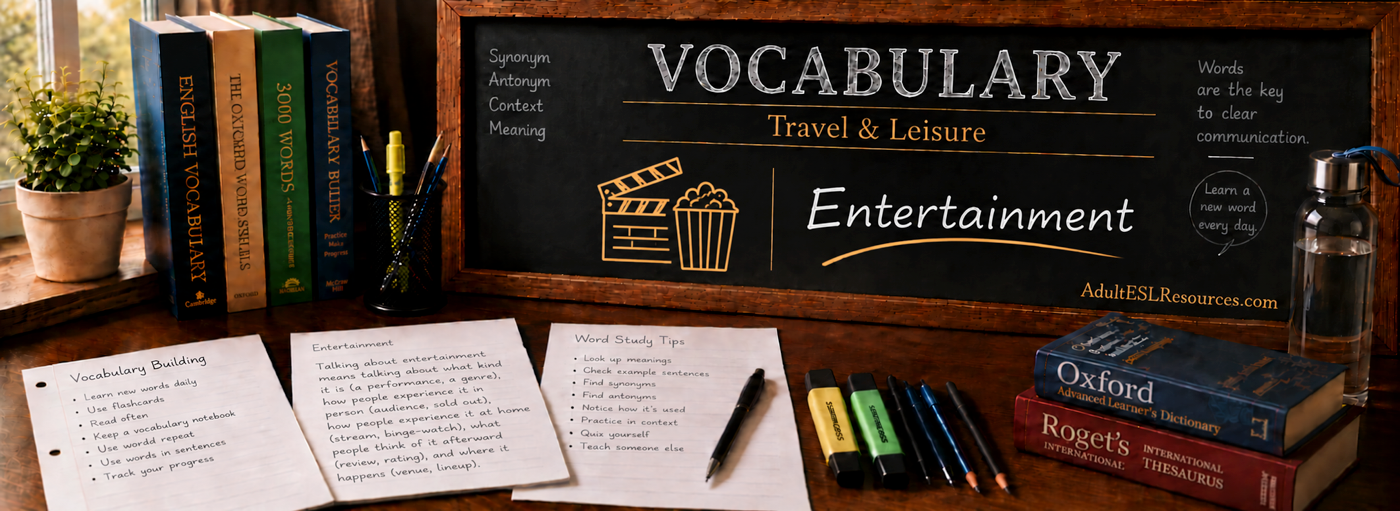
Entertainment Vocabulary
Part of the Travel & Leisure vocabulary group in Teacher-In-A-Box, this lesson explores the vocabulary used to describe types of entertainment, going out, streaming and media consumption, reviews and opinions, and events and venues — language useful for talking about almost any kind of entertainment, wherever you happen to enjoy it.
Connected vocabulary, not a glossary
Entertainment vocabulary works as a system.
Talking about entertainment means talking about what kind it is (a performance, a genre), how people experience it in person (audience, sold out), how people experience it at home (stream, binge-watch), what people think of it afterward (review, rating), and where it happens (venue, lineup).
This lesson groups vocabulary by what it’s used to describe — types of entertainment, going out, streaming and media consumption, reviews and opinions, and events and venues — and shows how the words in each area relate to and differ from one another. What counts as popular entertainment, and how people usually experience it, varies enormously between cultures, so this lesson focuses on vocabulary that applies to entertainment in general rather than any one form of it.
You will leave this lesson able to describe entertainment and media more precisely, whatever you enjoy watching, hearing, or attending.
1. Types of entertainment
Different words describe entertainment in general and specific kinds of it.
entertainment — anything intended to amuse, interest, or hold people’s attention, such as movies, music, or theater: “The city offers plenty of entertainment options.”
performance — an act of performing something in front of an audience: “Her performance received a standing ovation.”
genre — a category of entertainment defined by style or subject, such as comedy or drama: “Horror isn’t her favorite genre.”
movie vs. film
movie / film — both refer to a motion picture; “movie” is more common in American English, “film” in British English, and “film” can also sound slightly more formal or artistic: “They watched a movie last night.” / “It’s considered a classic film.”
2. Going out
Experiencing entertainment in person has its own everyday vocabulary.
go out — to leave home for entertainment or a social activity: “They go out to the theater once a month.”
sold out — describes an event for which all tickets have been sold: “The concert was sold out within an hour.”
applause — clapping to show appreciation for a performance: “The show ended with loud applause.”
audience vs. crowd
audience / crowd — an audience is a group of people specifically watching or listening to a performance; a crowd is simply a large group of people gathered together, whether or not they’re paying attention to anything in particular: “The audience fell silent, even though a crowd had gathered outside as well.”
3. Streaming and media consumption
Watching or listening at home has its own everyday vocabulary.
subscribe — to pay regularly for access to a service, such as a streaming platform: “She subscribes to two different streaming services.”
binge-watch — to watch many episodes of a show in a row: “They binge-watched the whole season in a weekend.”
episode — a single part of a television series: “The finale episode was two hours long.”
watch vs. stream
watch / stream — “watch” is the general act of viewing something; “stream” specifically means watching or listening to content sent over the internet in real time, without downloading it first: “They streamed the match live instead of watching it on television.”
4. Reviews and opinions
Vocabulary for talking about what people thought of something.
critic — someone whose job is to give a professional opinion about entertainment: “The critic gave the film four stars.”
recommend — to suggest that something is worth seeing or experiencing: “She recommended the documentary to everyone.”
overrated — describes something that is praised more than it deserves: “He thought the movie was overrated.”
review vs. rating
review / rating — a review is a written or spoken opinion explaining what someone thought and why; a rating is a shorter score, often numbers or stars, summarizing that opinion: “The review explained why the critic gave it only three stars in the rating.”
5. Events and venues
Vocabulary for live entertainment events.
venue — the place where an event takes place: “The venue holds about two thousand people.”
lineup — the list of performers or acts appearing at an event: “The festival lineup includes several well-known bands.”
festival — an organized event, often outdoors and over several days, featuring multiple performances: “They go to a music festival every summer.”
Vocabulary in context
See the vocabulary working together.
Here is a short passage using several words from this lesson together.
He’d been meaning to see the show for weeks, but tickets to the venue kept selling out. When a friend finally recommended streaming a recording instead, he binge-watched the whole thing in one evening and left a five-star rating.
Unpacking what this vocabulary communicates:
kept selling out → describes high demand for an event’s tickets.
recommended streaming → suggests something worth watching, delivered over the internet.
binge-watched…one evening → watched a large amount of content in a single sitting.
left a five-star rating → a short, numerical way of expressing an opinion.
The passage doesn’t name a specific show, platform, or venue, so the vocabulary can be applied to almost any kind of entertainment.
Don’t confuse these
Choosing the right word changes what a sentence communicates.
movie / film
Both refer to a motion picture — the choice is mostly a difference between American and British English.
audience / crowd
An audience is specifically watching or listening to a performance; a crowd is just a large group of people gathered together.
watch / stream
Watch is the general act of viewing something; stream specifically means viewing content sent over the internet in real time.
review / rating
A review is a written or spoken opinion explaining what someone thought; a rating is a shorter score summarizing it.
Natural word partnerships
These combinations are worth learning as fixed units.
For the general idea behind combinations like these, see:
Common errors
Mistakes are useful when you understand why they happen.
I am boring at the concert.
I am bored at the concert.
“Bored” describes how a person feels; “boring” describes the thing causing that feeling.
The show is sold.
The show is sold out.
The complete expression is “sold out,” not just “sold,” when every ticket is gone.
She recommended me to watch it.
She recommended that I watch it.
“Recommend” isn’t followed by “someone + to” — use “recommend that + subject” or “recommend + verb-ing.”
I streamed to the match live.
I streamed the match live.
“Stream” takes a direct object — no “to” is needed.
The movie has good rating.
The movie has a good rating.
“Rating” is a countable noun here and needs an article before it.
Your turn
Choose the word that fits.
These activities are part of the learning process. There are no scores, no grades and no limit on how many times you may try.
“A group of people specifically watching or listening to a performance.” Which word best fits?
Which word implies people paying attention to a specific performance?
“Watching or listening to content sent over the internet in real time, without downloading it.” Which word best fits?
Which word is specific to viewing over the internet in real time?
“A short score, often numbers or stars, summarizing an opinion.” Which word best fits?
Which word is a short score, rather than a written explanation?
Try it another way
Complete the sentences.
Type the word that fits each gap.
Notice the difference
Rewrite each sentence using the correct word.
I am boring at the concert.
The show is sold.
Alternate practice
Use the vocabulary productively, not just recognise it.
Complete the summary
Fill each gap with one word from this lesson: selling out, recommended, streaming, binge-watched, rating.
“He’d been meaning to see the show for weeks, but tickets kept ___. When a friend finally ___ ___ a recording instead, he ___ the whole thing in one evening and left a five-star ___.”
Sort into groups
Sort these words into the area they belong to (Types of Entertainment / Going Out / Streaming & Media Consumption / Reviews & Opinions / Events & Venues):
Describe a situation
In two or three sentences, describe a fictional entertainment situation using at least four words from this lesson.
Quick review
Five areas, connected by the everyday experience of entertainment.
Types of entertainment — movie vs film, plus entertainment, performance, and genre.
Going out — audience vs crowd, plus go out, sold out, and applause.
Streaming and media consumption — watch vs stream, plus subscribe, binge-watch, episode, and season.
Reviews and opinions — review vs rating, plus critic, recommend, and overrated.
Events and venues — concert, festival, venue, ticket, and lineup.
Watch for — movie vs film, audience vs crowd, watch vs stream, review vs rating.
Remember
What counts as popular entertainment differs from place to place, but the vocabulary for talking about it stays widely useful.
The shows, music, and events people enjoy vary enormously between cultures, but vocabulary such as performance, sold out and rating is useful across almost any kind of entertainment.
Related vocabulary
Explore related areas of vocabulary.
Explore the rest of the Travel & Leisure vocabulary group below.