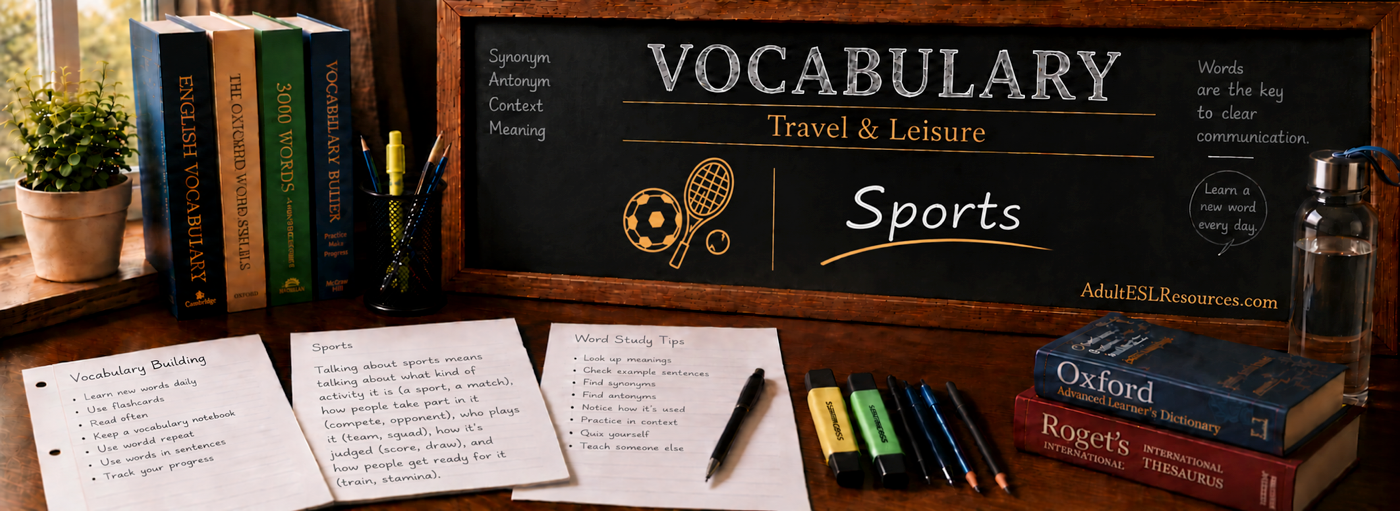
Sports Vocabulary
Part of the Travel & Leisure vocabulary group in Teacher-In-A-Box, this lesson explores the vocabulary used to describe types of sports, playing and competing, teams and positions, scoring and results, and fitness and training — language useful for talking about almost any sport, whatever it’s called or however it’s played.
Connected vocabulary, not a glossary
Sports vocabulary works as a system.
Talking about sports means talking about what kind of activity it is (a sport, a match), how people take part in it (compete, opponent), who plays it (team, squad), how it’s judged (score, draw), and how people get ready for it (train, stamina).
This lesson groups vocabulary by what it’s used to describe — types of sports, playing and competing, teams and positions, scoring and results, and fitness and training — and shows how the words in each area relate to and differ from one another. The names and rules for specific sports vary a great deal between countries — what much of the world calls football, for example, is often called soccer in the United States — so this lesson focuses on vocabulary that applies to sports in general rather than any one sport’s rules.
You will leave this lesson able to describe sports and competition more precisely, no matter which sport you’re talking about.
1. Types of sports
Different words describe a sport itself versus a single instance of playing it.
match — a single contest between two players or teams in a sport: “They watched the match together.”
team sport — a sport played by two or more teams against each other: “Basketball is a popular team sport.”
individual sport — a sport in which a person competes alone rather than as part of a team: “Swimming is usually an individual sport.”
sport vs. game
sport / game — “sport” usually refers to the whole activity and its rules, while “game” often refers to one instance of playing it, though the two overlap in everyday use: “Football is a sport; last night’s game went into extra time.”
2. Playing and competing
Taking part in a sport has its own everyday vocabulary.
play — to take part in a sport or game: “They play tennis every weekend.”
compete — to take part in a contest against others: “She competes at a national level.”
teammate — a person on the same team as another: “He passed the ball to his teammate.”
opponent vs. rival
opponent / rival — an opponent is whoever a person or team plays against in a particular match; a rival is a long-standing competitor someone regularly competes against: “Her opponent today happened to also be her biggest rival.”
3. Teams and positions
Vocabulary for how a team is organized.
Position names and team structures vary a great deal from sport to sport and country to country, so this lesson focuses on the general vocabulary rather than any one sport’s specific positions.
captain — the player chosen to lead a team: “She was named team captain this season.”
position — the specific role a player has during a game: “He usually plays in a defensive position.”
substitute — a player who replaces another player during a game: “The coach sent on a substitute in the second half.”
team vs. squad
team / squad — team is the general word for a group competing together. Squad can refer to a larger group of players selected or available for a team, although its exact use varies between sports and varieties of English.
4. Scoring and results
Vocabulary for how a game is judged and how it ends.
score — the number of points, goals, or runs a player or team has in a game: “The score was tied at halftime.”
win — to finish first or achieve victory in a contest: “They won their last three games.”
beat — to defeat an opponent in a game: “They beat their rivals in the final.”
draw vs. tie
draw / tie — both describe a game that ends with an equal score; “draw” is more common in British English, “tie” in American English: “The match ended in a two-two draw.”
5. Fitness and training
Vocabulary for getting ready to play.
train — to prepare for a sport through regular practice and exercise: “She trains five days a week.”
warm up — to prepare the body with light exercise before more intense activity: “Always warm up before a match.”
stamina — the physical or mental energy to keep going over a long period: “Marathon runners need a lot of stamina.”
coach — a person who trains and instructs athletes or a team: “Their coach called a timeout.”
Vocabulary in context
See the vocabulary working together.
Here is a short passage using several words from this lesson together.
By halftime, the score was level, and neither team’s coach seemed ready to make a substitution. The two captains, old rivals from years of competing against each other, kept the game close until the final whistle, when it ended in a draw.
Unpacking what this vocabulary communicates:
score was level → the two sides had an equal number of points at that point in the game.
coach…substitution → part of how a team is managed during a match.
old rivals → a long-standing competitive relationship, not just today’s opposing player.
ended in a draw → the final score stayed equal for both sides.
The passage doesn’t name a specific sport, league, or set of rules, so the vocabulary can be applied to almost any competitive sport.
Don’t confuse these
Choosing the right word changes what a sentence communicates.
sport / game
A sport usually refers to the whole activity and its rules; a game often refers to one instance of playing it.
opponent / rival
An opponent is whoever a person plays against in a particular match; a rival is a long-standing competitor faced again and again.
team / squad
Team is the general word for a group competing together; squad can refer to a larger group of players selected or available for a team, though usage varies between sports and varieties of English.
draw / tie
Both describe a game with an equal final score — “draw” is more common in British English, “tie” in American English.
Natural word partnerships
These combinations are worth learning as fixed units.
For the general idea behind combinations like these, see:
Common errors
Mistakes are useful when you understand why they happen.
I do football on weekends.
I play football on weekends.
Most sports use “play,” while “do” is more typical for activities without a ball, like yoga.
We won of the match.
We won the match.
“Win” is followed directly by its object — no “of” is needed.
He is good in sports.
He is good at sports.
The fixed expression is “good at,” not “good in.”
The team lost against their rival.
The team lost to their rival.
The natural pattern is “lose to” someone, not “lose against.”
I am training since two months.
I have been training for two months.
Use present perfect continuous with “for” plus a length of time, not “since.”
Your turn
Choose the word that fits.
These activities are part of the learning process. There are no scores, no grades and no limit on how many times you may try.
“Refers to the whole activity and its rules, rather than one instance of playing it.” Which word best fits?
Which word refers to the activity overall, rather than one instance of it?
“A long-standing competitor someone regularly competes against, not just today’s opposing player.” Which word best fits?
Which word suggests a repeated, long-standing competition?
“Can refer to a larger group of players selected or available for a team, though its exact use varies between sports.” Which word best fits?
Which word can refer to a larger, more inclusive group of players?
Try it another way
Complete the sentences.
Type the word that fits each gap.
Notice the difference
Rewrite each sentence using the correct word.
I do football on weekends.
We won of the match.
Alternate practice
Use the vocabulary productively, not just recognise it.
Complete the summary
Fill each gap with one word from this lesson: level, substitution, rivals, draw.
“By halftime, the score was ___, and neither team’s coach seemed ready to make a ___. The two captains, old ___ from years of competing against each other, kept the game close until it ended in a ___.”
Sort into groups
Sort these words into the area they belong to (Types of Sports / Playing & Competing / Teams & Positions / Scoring & Results / Fitness & Training):
Describe a situation
In two or three sentences, describe a fictional sports situation using at least four words from this lesson.
Quick review
Five areas, connected by the everyday experience of sports.
Types of sports — sport vs game, plus match, team sport, and individual sport.
Playing and competing — opponent vs rival, plus play, compete, and teammate.
Teams and positions — team vs squad, plus captain, position, and substitute.
Scoring and results — draw vs tie, plus score, win, lose, and beat.
Fitness and training — train, exercise, warm up, stamina, and coach.
Watch for — sport vs game, opponent vs rival, team vs squad, draw vs tie.
Remember
The names and rules for specific sports vary widely between countries, but the vocabulary for talking about them stays widely useful.
What a sport is called and exactly how it’s played differs from place to place, but vocabulary such as opponent, squad and draw is useful across almost any competitive sport.
Related vocabulary
Explore related areas of vocabulary.
Explore the rest of the Travel & Leisure vocabulary group below.