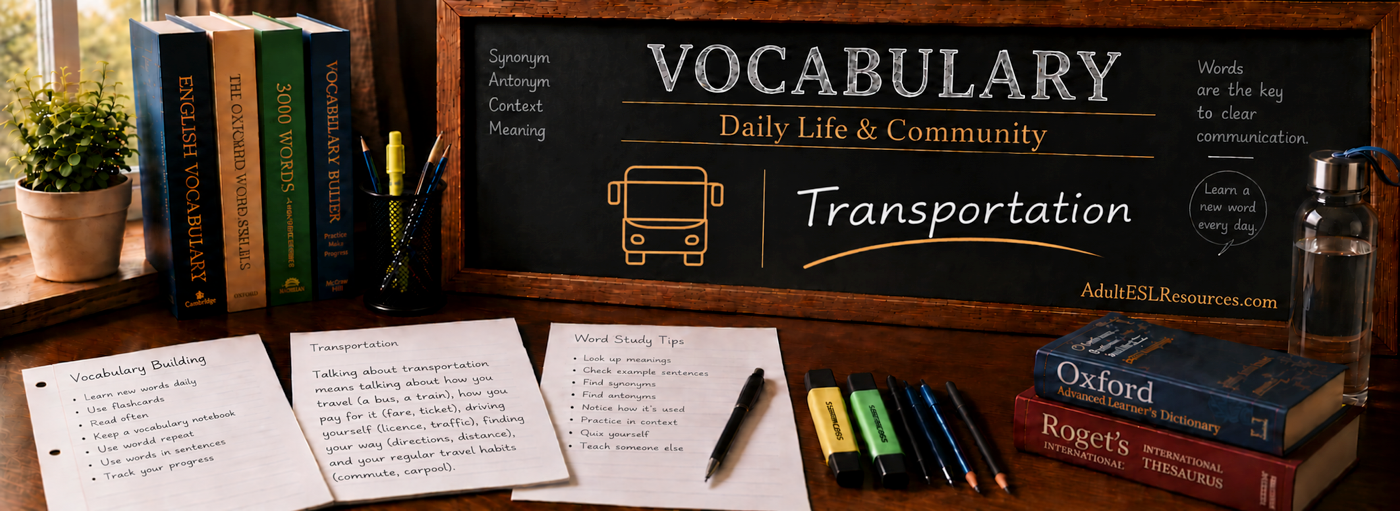
Transportation Vocabulary
Part of the Daily Life & Community vocabulary group in Teacher-In-A-Box, this lesson explores the vocabulary used to describe types of transportation, public transportation, driving, traffic and directions, and travel habits — language useful in almost any country, even though the specific terms and rules vary from place to place.
Connected vocabulary, not a glossary
Transportation vocabulary works as a system.
Talking about transportation means talking about how you travel (a bus, a train), how you pay for it (fare, ticket), driving yourself (licence, traffic), finding your way (directions, distance), and your regular travel habits (commute, carpool).
This lesson groups vocabulary by what it’s used to describe — types of transportation, public transportation, driving, traffic and directions, and travel habits — and shows how the words in each area relate to and differ from one another. The names for transportation systems and the rules for driving both vary between countries and even between cities, so this lesson focuses on vocabulary you can use to talk about getting around anywhere, rather than any one country’s system.
You will leave this lesson able to describe how you get around more precisely, wherever you happen to be travelling.
1. Types of transportation
Different words describe different ways of getting around.
bike — short for bicycle, also used for motorbike depending on context: “He rides his bike to work most days.”
taxi — a car with a driver that you pay to take you somewhere, also called a cab: “She took a taxi to the airport.”
subway vs. underground vs. metro
subway, underground and metro are common names for urban rapid-transit rail systems; the preferred term depends on the country or city. Subway is common in American English, underground is strongly associated with British English, and metro is widely used internationally: “They took the subway across town.”
2. Public transportation
Using public transportation has its own everyday vocabulary.
route — the path a bus, train, or other service regularly follows: “This route stops near the museum.”
schedule — the planned times a service arrives and departs, also called a timetable: “Check the schedule before you leave.”
transfer — changing from one bus or train to another to complete a journey: “She had to transfer to a different line halfway through.”
platform — the area where passengers wait for and board a train: “The train left from platform three.”
fare vs. ticket
fare — the price you pay to travel: “The fare went up this year.”
ticket — the physical or digital proof of payment for that fare: “He showed his ticket to the driver.”
3. Driving
Driving vocabulary describes the vehicle, the rules, and the fuel.
The driving age, licensing requirements, and rules of the road all vary between countries, so this lesson teaches the words rather than any one country’s driving rules.
driving licence / driver’s license — the official document showing that someone is permitted to drive. Licence is the usual British-English noun spelling; license is the American-English spelling: “She got her driving licence last year.”
parking — leaving a vehicle somewhere for a period of time: “Parking is difficult in the city centre.”
petrol vs. gas
petrol / gas (short for “gasoline”) — both describe the fuel used by most cars; “petrol” is more common in British English, “gas” or “gasoline” in American English: “They stopped to fill up on petrol.”
4. Traffic and directions
Vocabulary for describing how busy the roads are, and how to find your way.
traffic jam — a long line of vehicles moving very slowly or not at all: “They were stuck in a traffic jam for an hour.”
rush hour — the busiest time of day for traffic, usually around when people travel to and from work: “The roads are always busy during rush hour.”
intersection — a place where two or more roads meet or cross, also called a junction in some places: “Turn left at the next intersection.”
5. Travel habits
Vocabulary for describing how people travel regularly, not just once.
carpool — to share a car journey with others, usually travelling to similar places: “They carpool to work to save on parking.”
hitchhike — to travel by asking for free rides from strangers: “He hitchhiked across the country one summer.”
commute vs. travel
commute — to regularly travel between home and work or school: “She commutes an hour each way.”
travel — the general word for moving from one place to another, for any reason: “They love to travel during the summer.”
Vocabulary in context
See the vocabulary working together.
Here is a short passage using several words from this lesson together.
She missed her usual bus, so she checked the schedule for the next one. When it finally came, she bought a ticket and found a seat. Further along the route, they hit a traffic jam near a busy intersection, so the commute took much longer than usual.
Unpacking what this vocabulary communicates:
checked the schedule → looking up planned arrival and departure times.
bought a ticket → the proof of payment for the fare.
traffic jam near a busy intersection → describes why the journey slowed down.
the commute took much longer → this was part of her regular home-to-work travel.
The passage doesn’t depend on a specific city, country, or transportation system, so the vocabulary can be applied across many travel contexts.
Don’t confuse these
Choosing the right word changes what a sentence communicates.
subway / underground / metro
All three are common names for urban rapid-transit rail systems — the word used depends mainly on the country or city.
fare / ticket
A fare is the price you pay to travel; a ticket is the proof of that payment.
petrol / gas
Both describe fuel for a car — “petrol” is more common in British English, “gas” in American English.
commute / travel
A commute is regular travel between home and work or school; travel is the general word for moving between places, for any reason.
Natural word partnerships
These combinations are worth learning as fixed units.
For the general idea behind combinations like these, see:
Common errors
Mistakes are useful when you understand why they happen.
I go to school by foot.
I go to school on foot.
The fixed expression is “on foot,” not “by foot.”
I waited for the bus at the platform.
I waited for the bus at the bus stop.
“Platform” is used for trains; buses use a “stop.”
I take a lot of traffic on my way to work.
I sit in a lot of traffic on my way to work.
The natural collocation is “sit in traffic” or “get stuck in traffic.”
She catched the bus just in time.
She caught the bus just in time.
“Catch” has an irregular past tense: “caught,” not “catched.”
I need to make a ticket for the train.
I need to buy a ticket for the train.
The natural collocation is “buy a ticket,” not “make a ticket.”
Your turn
Choose the word that fits.
These activities are part of the learning process. There are no scores, no grades and no limit on how many times you may try.
“The price you pay to travel.” Which word best fits?
Is this the price, or the proof of having paid it?
In American English, fuel for a car is usually called:
Which term is more common in American English?
“Regular travel between home and work or school.” Which word best fits?
Is this a regular home-to-work journey, or travel in general?
Try it another way
Complete the sentences.
Type the word that fits each gap.
Notice the difference
Rewrite each sentence using the correct word.
I go to school by foot.
I need to make a ticket for the train.
Alternate practice
Use the vocabulary productively, not just recognise it.
Complete the summary
Fill each gap with one word from this lesson: schedule, ticket, route, traffic jam, commute.
“She checked the ___ for the next bus, then bought a ___. Further along the ___, they got stuck in a ___, so the ___ took much longer than usual.”
Sort into groups
Sort these words into the area they belong to (Types of Transportation / Public Transportation / Driving / Traffic & Directions / Travel Habits):
Describe a situation
In two or three sentences, describe a fictional transportation situation using at least four words from this lesson.
Quick review
Five areas, connected by the everyday experience of getting around.
Types of transportation — subway vs underground vs metro, plus car, bus, train, bike, and taxi.
Public transportation — fare vs ticket, plus route, schedule, transfer, and platform.
Driving — petrol vs gas, plus drive, licence, traffic, and parking.
Traffic and directions — traffic jam, rush hour, directions, distance, and intersection.
Travel habits — commute vs travel, plus carpool, walk, cycle, and hitchhike.
Watch for — subway vs underground vs metro, fare vs ticket, petrol vs gas, commute vs travel.
Remember
Transportation systems and driving rules change from place to place, while much of the core vocabulary remains widely useful.
System names, fuel terminology, and driving rules vary between countries, but vocabulary such as fare, commute and traffic jam is useful across many transportation contexts.
Related vocabulary