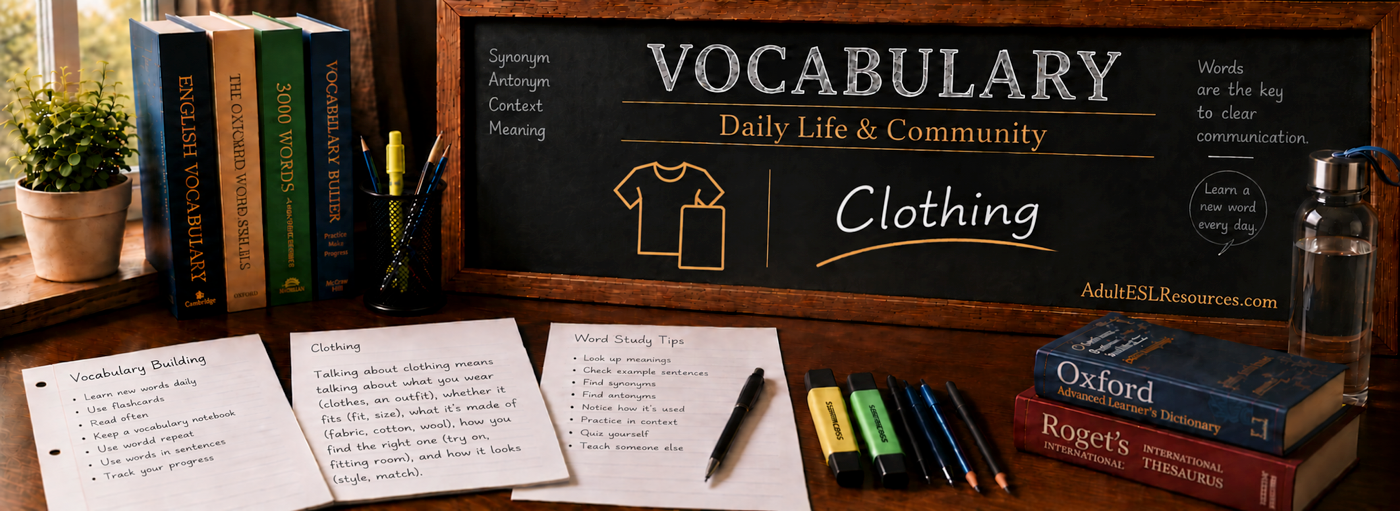
Clothing Vocabulary
Part of the Daily Life & Community vocabulary group in Teacher-In-A-Box, this lesson explores the vocabulary used to describe clothing basics, fit and sizing, fabrics and materials, buying and trying on, and style and appearance — language useful in almost any country, even though sizing systems and fashion trends vary from place to place.
Connected vocabulary, not a glossary
Clothing vocabulary works as a system.
Talking about clothing means talking about what you wear (clothes, an outfit), whether it fits (fit, size), what it’s made of (fabric, cotton, wool), how you find the right one (try on, fitting room), and how it looks (style, match).
This lesson groups vocabulary by what it’s used to describe — clothing basics, fit and sizing, fabrics and materials, buying and trying on, and style and appearance — and shows how the words in each area relate to and differ from one another. Sizing systems, fabric names, and fashion trends all vary between countries, so this lesson focuses on vocabulary you can use to talk about clothing anywhere, rather than any one country’s sizing or style.
You will leave this lesson able to describe clothing more precisely, wherever you happen to be shopping or dressing.
1. Clothing basics
Clothes, clothing, and outfit describe related but different ideas.
garment — a more formal word for a single item of clothing: “Check the label on any garment before washing it.”
wardrobe — all of the clothes a person owns, or the piece of furniture used to store them: “She added a new coat to her wardrobe.”
clothes vs. clothing
clothes — a plural-only noun for the items themselves: “She packed some clothes for the trip.”
clothing — an uncountable, more general word, often used in formal or written contexts: “The store sells clothing for all ages.” outfit — a complete set of clothes worn together for a particular occasion: “He wore a new outfit to the interview.”
2. Fit and sizing
Fit describes whether clothing suits the wearer’s body, not just its label.
Sizing systems and the numbers or letters used for them vary between countries and even between brands, so this lesson focuses on the vocabulary rather than any one sizing system.
tight — fitting closely, with little room to move: “These shoes feel a bit tight.”
loose — fitting with plenty of extra room: “He prefers loose trousers for comfort.”
snug — fitting closely but comfortably, not too tight: “The sweater was snug but not restrictive.”
fit vs. size
size — the labelled measurement of an item of clothing: “I usually wear a medium size.”
fit — whether that size actually suits your body, which can vary even within the same labelled size: “The size was right, but it didn’t fit well around the shoulders.”
3. Fabrics and materials
What clothing is made of affects how it feels, looks, and lasts.
fabric / material — both describe what clothing is made of; “fabric” usually refers to woven or knitted cloth specifically, while “material” is broader and can include leather or synthetic fibers too: “The jacket is made from a waterproof material.”
cotton and wool are natural fabrics, from plants and animal fibre; polyester is a synthetic (human-made) fabric; leather is made from animal hide.
natural vs. synthetic materials
natural material — comes from a plant or animal source, such as cotton or wool: “He prefers natural fabrics like cotton.”
synthetic material — manufactured rather than found in nature, such as polyester: “The jacket is made from a synthetic material that resists water.”
4. Buying and trying on
Trying clothing on is its own small vocabulary set.
For the general vocabulary of paying, discounts, and returns, see the Shopping lesson — this section focuses on the vocabulary specific to trying clothing on.
try on — to put on an item of clothing to see if it fits or suits you, usually before buying it: “She tried on three dresses before choosing one.”
fitting room — a small private room in a shop for trying on clothes; changing room is also commonly used in some varieties of English: “He took the shirt into the fitting room.”
alter — to change a garment slightly so it fits better: “She had the trousers altered to be shorter.”
tailor — a person who makes or alters clothing professionally: “He took the suit to a tailor for adjustments.”
5. Style and appearance
Style vocabulary describes how clothing looks and works together.
trendy — currently popular or fashionable: “Those sneakers are really trendy right now.”
casual / formal — describe how relaxed or dressy an outfit is, and what occasion it suits: “Wear something casual for the picnic, but formal for the ceremony.”
match vs. suit
match — to look good together, often because of similar color or style: “Her shoes match her bag.”
suit — to look good on a particular person, or to be appropriate for an occasion: “That color really suits you.”
Vocabulary in context
See the vocabulary working together.
Here is a short passage using several words from this lesson together.
She tried on a jacket in the fitting room. The size was right, but it felt a little tight around the shoulders, so she asked whether it could be altered. She liked how the fabric felt, and thought the color matched her shoes well.
Unpacking what this vocabulary communicates:
tried on…in the fitting room → checking fit before buying.
size was right, but…tight → shows that size and fit aren’t the same thing.
altered → a small change to improve the fit.
matched her shoes → describes how the color worked with another item.
The passage doesn’t depend on a specific size number or currency, so the vocabulary can be used across different sizing systems.
Don’t confuse these
Choosing the right word changes what a sentence communicates.
clothes / clothing
Clothes is plural-only and refers to the items themselves; clothing is uncountable and more general or formal.
fit / size
Size is the labelled measurement; fit is whether that size actually suits your body.
natural / synthetic
A natural material comes from a plant or animal, like cotton or wool; a synthetic material is manufactured, like polyester.
match / suit
Match describes items looking good together; suit describes something looking good on a particular person or occasion.
Natural word partnerships
These combinations are worth learning as fixed units.
For the general idea behind combinations like these, see:
Common errors
Mistakes are useful when you understand why they happen.
I bought a clothes yesterday.
I bought some clothes yesterday.
“Clothes” is a plural-only noun — it never takes “a” and has no singular form.
This shirt fits me small.
This shirt is too small for me.
“Fit” describes whether the size is right, not the size itself.
I’m putting my jacket every morning.
I put on my jacket every morning.
The phrasal verb for dressing is “put on,” not just “put.”
This dress makes me match with my shoes.
This dress matches my shoes.
“Match” is used directly as a verb — no “makes me” is needed.
I need to try the dress before buying it.
I need to try on the dress before buying it.
For clothing, the phrasal verb “try on” is needed, not just “try.”
Your turn
Choose the word that fits.
These activities are part of the learning process. There are no scores, no grades and no limit on how many times you may try.
“A complete set of clothes worn together for a particular occasion.” Which word best fits?
Is this one occasion’s set of clothes, or everything a person owns?
“Whether an item’s shape and size suit the wearer’s body.” Which word best fits?
Is this the labelled measurement, or how it actually feels on the body?
Wool comes from sheep, so it’s considered a ___ material.
Does wool come from a plant or animal, or is it manufactured?
Try it another way
Complete the sentences.
Type the word that fits each gap.
Notice the difference
Rewrite each sentence using the correct word.
I bought a clothes yesterday.
I’m putting my jacket every morning.
Alternate practice
Use the vocabulary productively, not just recognise it.
Complete the summary
Fill each gap with one word from this lesson: fitting room, tight, altered, fabric, matched.
“He tried on the jacket in the ___. It felt a little ___, so he asked if it could be ___. He liked how the ___ felt, and thought the color ___ his shoes.”
Sort into groups
Sort these words into the area they belong to (Clothing Basics / Fit & Sizing / Fabrics & Materials / Buying & Trying On / Style & Appearance):
Describe a situation
In two or three sentences, describe a fictional clothes-shopping situation using at least four words from this lesson.
Quick review
Five areas, connected by the everyday experience of getting dressed.
Clothing basics — clothes vs clothing, plus outfit, garment, and wardrobe.
Fit and sizing — fit vs size, plus tight, loose, and snug.
Fabrics and materials — natural vs synthetic, plus fabric, cotton, wool, polyester, and leather.
Buying and trying on — try on, fitting room, alter, and tailor.
Style and appearance — match vs suit, plus style, fashion, trendy, casual, and formal.
Watch for — clothes vs clothing, fit vs size, natural vs synthetic, match vs suit.
Remember
Sizing systems and fashions change from place to place, while much of the core vocabulary remains widely useful.
Sizing systems, fabric terminology, and fashion trends vary between countries, but words such as fit, fabric and trendy are useful across many clothing contexts.
Related vocabulary