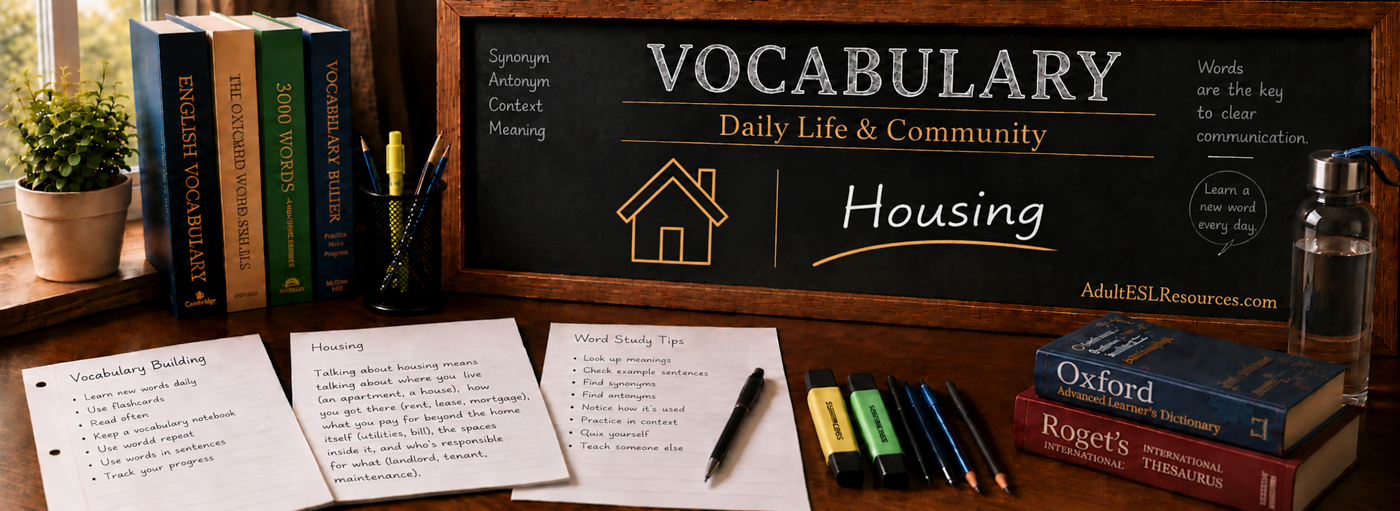
Housing Vocabulary
Part of the Daily Life & Community vocabulary group in Teacher-In-A-Box, this lesson explores the vocabulary used to describe types of homes, renting and buying, bills and utilities, rooms and spaces, and household responsibilities — language useful in almost any country, even though housing customs and rules vary from place to place.
Connected vocabulary, not a glossary
Housing vocabulary works as a system.
Talking about housing means talking about where you live (an apartment, a house), how you got there (rent, lease, mortgage), what you pay for beyond the home itself (utilities, bill), the spaces inside it, and who’s responsible for what (landlord, tenant, maintenance).
This lesson groups vocabulary by what it’s used to describe — types of housing, renting and buying, bills and utilities, rooms and spaces, and household responsibilities — and shows how the words in each area relate to and differ from one another. Renting and buying conventions, landlord and tenant responsibilities, and housing laws all vary between countries, so this lesson focuses on vocabulary you can use to talk about housing anywhere, rather than any one country’s system.
You will leave this lesson able to describe housing situations more precisely, wherever you happen to be living.
1. Types of housing
Different words describe different kinds of homes.
studio — a small home with one main room that combines the living area and bedroom: “He rented a studio near the university.”
condo — an individually owned unit within a larger building, short for “condominium”: “They bought a condo downtown.”
cottage — a small house, often in the countryside: “They spent the summer at a cottage by the lake.”
apartment vs. flat
apartment / flat — both describe a home that’s part of a larger building; “apartment” is more common in American English, “flat” in British English, though both are widely understood: “They live in a flat on the third floor.”
2. Renting and buying
Renting and buying a home each come with their own vocabulary.
Exactly how renting and buying work, and what’s customary, varies between countries, so this lesson teaches the words rather than any one country’s process.
tenant — a person who rents and lives in a property: “The tenant reported the leak right away.”
landlord — a person or company that owns a property and rents it to someone else: “The landlord arranged for the repair.”
mortgage — a loan used to buy property, usually repaid over many years: “They took out a mortgage to buy their first home.”
deposit — an amount of money paid in advance, often held as security and returned later if conditions are met: “She paid a deposit before moving in.”
rent vs. lease
rent (verb) — to pay to use a property for a period of time: “They rent an apartment near the city centre.” (noun) — the amount paid regularly for this: “The rent is due on the first of the month.”
lease — a formal agreement setting out the terms of a rental; the length and legal form of a lease vary between housing systems: “They signed a one-year lease.”
3. Bills and utilities
Utilities are the essential services a home depends on.
utilities — the basic services a home needs to run, such as electricity, gas, and water: “Utilities aren’t included in the rent.”
bill — a statement of money owed for a service, usually sent regularly: “The electricity bill was higher this month.” Which utilities are included in rent, and how bills are split between housemates, varies a great deal from place to place.
4. Rooms and spaces
Homes are divided into rooms with their own names and functions.
living room — the main room used for relaxing or spending time together, also called a lounge or sitting room in some places: “They watched a film in the living room.”
furnished vs. unfurnished
furnished — already containing furniture such as a bed, table, or sofa: “The apartment was fully furnished when they moved in.”
unfurnished — with no furniture included: “An unfurnished flat is usually cheaper to rent.”
5. Household responsibilities
Maintenance and repair keep a home in good condition.
Who is responsible for what — a landlord or a tenant — depends on the agreement and the local rules, so this lesson focuses on the vocabulary rather than any one set of responsibilities.
notice — advance warning that something will happen, such as ending a lease: “She gave a month’s notice before moving out.”
renew — to extend an agreement for a further period: “They decided to renew the lease for another year.”
maintenance vs. repair
maintenance — ongoing care that keeps something working well: “Regular maintenance keeps the heating system running smoothly.”
repair — fixing something that has already broken: “They needed a repair after the pipe burst.”
Vocabulary in context
See the vocabulary working together.
Here is a short passage using several words from this lesson together.
She signed a lease on a furnished apartment near the city centre. The rent didn’t include utilities, so she split the electricity and water bills with her roommate. A few months later, she called the landlord about a leak, and it was repaired within a few days.
Unpacking what this vocabulary communicates:
signed a lease on a furnished apartment → the agreement was formal, and furniture was already included.
rent didn’t include utilities → the basic services were billed separately.
called the landlord…it was repaired → the tenant contacted the landlord about the problem, and the repair was arranged.
The passage doesn’t depend on a specific country, currency, or set of tenancy laws, so the vocabulary can be applied across many housing contexts.
Don’t confuse these
Choosing the right word changes what a sentence communicates.
apartment / flat
Apartment and flat both describe a home within a larger building — the choice is mostly a difference between American and British English.
rent / lease
Rent is the ongoing act of paying to use a property (or the payment itself); a lease is the formal agreement that sets out the terms.
furnished / unfurnished
A furnished home already includes furniture; an unfurnished one does not.
maintenance / repair
Maintenance is ongoing care to prevent problems; a repair fixes something that has already broken.
Natural word partnerships
These combinations are worth learning as fixed units.
For the general idea behind combinations like these, see:
Common errors
Mistakes are useful when you understand why they happen.
This apartment has three rooms. (meaning bedrooms)
This apartment has three bedrooms.
“Room” usually means any room in the home — say “bedroom” directly if that’s what you mean.
I pay the rent for my landlord.
I pay rent to my landlord.
You pay rent to someone, not for someone.
I did a lease last year.
I signed a lease last year.
The natural collocation is “sign a lease,” not “do a lease.”
The apartment has many furnitures.
The apartment has a lot of furniture.
“Furniture” is uncountable — it has no plural form.
I called to my landlord about the leak.
I called my landlord about the leak.
“Call” takes a direct object — no preposition needed.
Your turn
Choose the word that fits.
These activities are part of the learning process. There are no scores, no grades and no limit on how many times you may try.
“A loan used to buy property, repaid over many years.” Which word best fits?
Is this a loan for buying, or money paid upfront as security?
“A home that already includes furniture such as a bed and a table.” Which word best fits?
Does this home include furniture, or not?
“Ongoing care that keeps something working well, before it breaks.” Which word best fits?
Is this ongoing prevention, or fixing something already broken?
Try it another way
Complete the sentences.
Type the word that fits each gap.
Notice the difference
Rewrite each sentence using the correct word.
This apartment has three rooms. (meaning bedrooms)
I did a lease last year.
Alternate practice
Use the vocabulary productively, not just recognise it.
Complete the summary
Fill each gap with one word from this lesson: lease, furnished, utilities, landlord, repaired.
“She signed a ___ on a ___ apartment. The rent didn’t include ___, so she paid those separately. When something broke, she called the ___, and it was ___ within a few days.”
Sort into groups
Sort these words into the area they belong to (Types of Housing / Renting & Buying / Bills & Utilities / Rooms & Spaces / Responsibilities):
Describe a situation
In two or three sentences, describe a fictional housing situation using at least four words from this lesson.
Quick review
Five areas, connected by the everyday experience of home.
Types of housing — apartment vs flat, plus house, studio, condo, and cottage.
Renting and buying — rent vs lease, plus tenant, landlord, mortgage, and deposit.
Bills and utilities — utilities, electricity, gas, water, internet, and bill.
Rooms and spaces — furnished vs unfurnished, plus bedroom, living room, kitchen, and bathroom.
Household responsibilities — maintenance vs repair, plus responsibility, notice, and renew.
Watch for — apartment vs flat, rent vs lease, furnished vs unfurnished, maintenance vs repair.
Remember
Housing customs and rules change from place to place, while much of the core vocabulary remains widely useful.
Renting conventions, landlord and tenant responsibilities, and housing laws vary between countries, but vocabulary such as lease, utilities and maintenance is useful when discussing housing in many different systems.
Related vocabulary