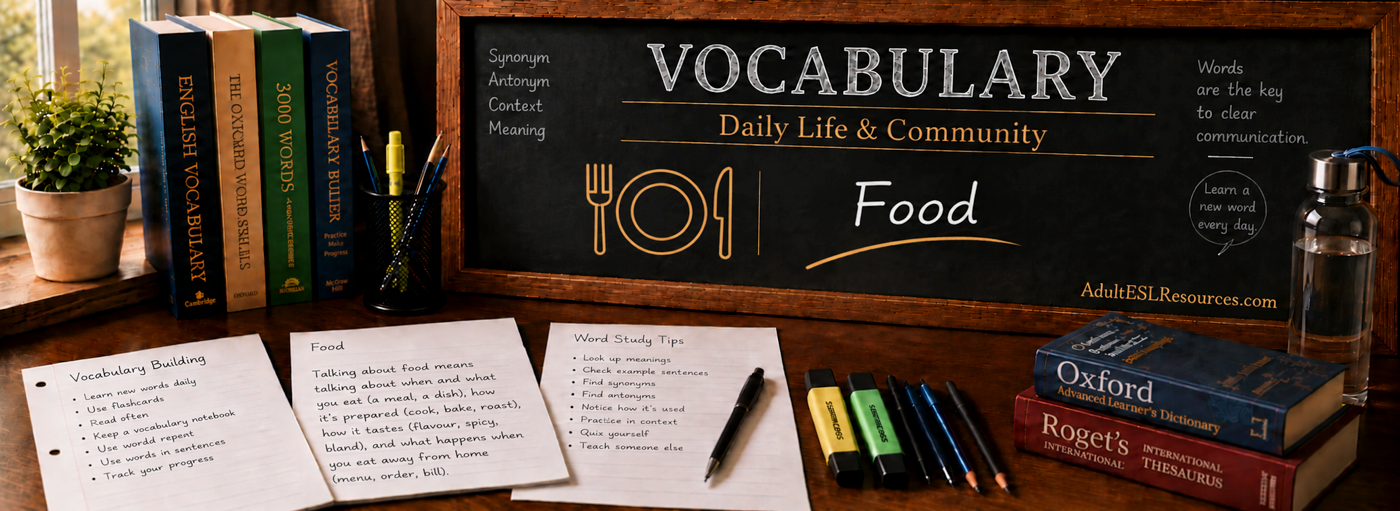
Food Vocabulary
Part of the Daily Life & Community vocabulary group in Teacher-In-A-Box, this lesson explores the vocabulary used to describe meals and eating, cooking and preparation, taste, dietary needs, and eating out — language useful in almost any country, even though dishes, customs, and dining habits vary from place to place.
Connected vocabulary, not a glossary
Food vocabulary works as a system.
Talking about food means talking about when and what you eat (a meal, a dish), how it’s prepared (cook, bake, roast), how it tastes (flavor, spicy, bland), and what happens when you eat away from home (menu, order, bill).
This lesson groups vocabulary by what it’s used to describe — meals and eating, cooking and preparation, taste and description, dietary needs, and eating out — and shows how the words in each area relate to and differ from one another. Specific dishes, meal customs, and dining habits vary widely between countries and cultures, so this lesson focuses on vocabulary you can use to talk about food anywhere, rather than any one country’s cuisine or customs.
You will leave this lesson able to describe food and eating experiences more precisely, wherever you happen to be eating.
1. Meals and eating
A meal is made up of one or more dishes, eaten at a particular time of day.
snack — a smaller amount of food eaten between meals: “She had a snack to hold her over until dinner.”
course — one part of a meal served in sequence, such as a starter or a dessert; not every meal includes multiple courses: “The meal had three courses.”
leftovers — food that remains after a meal, often eaten later: “He had the leftovers for lunch the next day.”
meal vs. dish
meal — the whole occasion of eating, usually at a set time of day: “Dinner was a simple meal that evening.”
dish — one specific type of food, prepared in a particular way; a meal can include one dish or several: “That dish is one of her favourites.”
2. Cooking and preparation
Different cooking methods use different verbs.
cook — the general verb for preparing food using heat: “He cooks dinner most evenings.”
bake / roast — both describe cooking in an oven; “bake” is usual for bread, cakes, and pastries, “roast” for meat and vegetables: “She baked a loaf of bread and roasted the vegetables.”
boil / fry / grill — cooking in hot water, in hot oil, and over or under direct heat: “He boiled the pasta and grilled the chicken.”
recipe — a set of instructions for preparing a dish, listing its ingredients: “The recipe called for three ingredients she didn’t have.”
3. Taste and description
A small set of adjectives covers most everyday descriptions of food.
spicy — describes heat from ingredients like chili or pepper: “The sauce was too spicy for her.”
savory — describes a flavor that isn’t sweet, often salty or rich: “He prefers savory breakfasts to sweet ones.”
bland — describes food with very little flavor at all: “The soup tasted bland without any seasoning.” What counts as spicy or bland can vary a great deal from person to person and place to place.
taste vs. flavor
taste — both the sense used to experience food and the general experience itself: “This soup tastes good.”
flavor — closer to a specific quality within that taste: “There’s a hint of ginger flavor in this dish.”
4. Dietary needs and preferences
Diet, allergy, and intolerance describe different reasons for avoiding certain foods.
How restaurants and food labels handle this information varies between countries, so this lesson teaches the words rather than any one set of rules.
diet — the range of food a person regularly eats, whether by habit, health need, or choice: “She’s been trying to eat a more balanced diet.”
vegetarian — a diet that avoids meat and fish: “He’s been vegetarian for several years.”
vegan — a diet that avoids all animal products, including dairy and eggs: “The café added a vegan option to the menu.”
allergy vs. intolerance
allergy — an immune-system reaction to a food, which can sometimes be serious: “He carries medication for his allergy.”
intolerance — a negative reaction to a food that does not involve the same allergic immune response: “She has an intolerance to dairy.”
5. Eating out
Eating at a restaurant has its own everyday vocabulary.
menu — a list of the dishes available: “They looked at the menu before deciding.”
order — to tell the restaurant what you’d like to eat: “She ordered the same dish as last time.”
bill vs. tip
bill — the amount owed for the meal itself, also called a check in some places: “They asked for the bill at the end of the meal.”
tip — extra money given to service staff, on top of the bill; whether it’s expected, how much, and whether it’s already included all vary between countries: “He left a tip before they left.”
Vocabulary in context
See the vocabulary working together.
Here is a short passage using several words from this lesson together.
We looked at the menu and I ordered a spicy dish, while my friend asked about an ingredient because of her allergy. The food had a lot of flavor, and we finished the meal with a small dessert. When the bill came, we split it and left a tip before we left.
Unpacking what this vocabulary communicates:
looked at the menu and…ordered → the start of the everyday restaurant sequence.
asked about an ingredient because of her allergy → treated as a safety question, not a preference.
a lot of flavor → describes the dish’s taste specifically.
the bill…left a tip → vocabulary used at the end of a restaurant meal in a context where tipping is customary.
The passage doesn’t depend on a specific dish, cuisine, or country, so the vocabulary can be applied across many different food and dining contexts.
Don’t confuse these
Choosing the right word changes what a sentence communicates.
meal / dish
A meal is the whole eating occasion; a dish is one specific food that might be part of it.
taste / flavor
Taste is the general experience or sense; flavor usually points to a more specific quality within that taste.
allergy / intolerance
An allergy is an immune-system reaction that can sometimes be serious; an intolerance is a negative reaction to a food that isn’t an allergy.
bill / tip
The bill is the amount owed for the meal; a tip is extra money given on top of it, where that custom applies.
Natural word partnerships
These combinations are worth learning as fixed units.
For the general idea behind combinations like these, see:
Common errors
Mistakes are useful when you understand why they happen.
I ate a breakfast this morning.
I ate breakfast this morning.
Meals used in a general sense (breakfast, lunch, dinner) don’t take an article.
Can I have a bread?
Can I have some bread? / a piece of bread?
“Bread” is uncountable — use “some bread” or count a specific piece or loaf.
This soup tastes well.
This soup tastes good.
After “taste,” use an adjective (good, spicy, sweet), not an adverb.
I have hunger.
I am hungry.
Use the adjective “hungry” with “be,” not the noun “hunger.”
He gave a tip for the waiter.
He left a tip for the waiter. / He left the waiter a tip.
“Leave a tip” is the natural collocation.
Your turn
Choose the word that fits.
These activities are part of the learning process. There are no scores, no grades and no limit on how many times you may try.
“Food with very little flavor at all.” Which word best fits?
Is this about a lack of flavor, or a salty, rich one?
“A negative reaction to a food that is not an allergy.” Which word best fits?
Does this involve the immune system, or not?
“The list of dishes you can order at a restaurant.” Which word best fits?
Is this what you look at before ordering, or what you pay at the end?
Try it another way
Complete the sentences.
Type the word that fits each gap.
Notice the difference
Rewrite each sentence using the correct word.
I ate a breakfast this morning.
This soup tastes well.
Alternate practice
Use the vocabulary productively, not just recognise it.
Complete the summary
Fill each gap with one word from this lesson: menu, ordered, flavor, allergy, bill.
“Before dinner, she looked at the ___, then ___ a dish with a lot of ___. Her friend asked about an ingredient because of an ___. At the end of the meal, they asked for the ___.”
Sort into groups
Sort these words into the area they belong to (Meals & Eating / Cooking & Preparation / Taste & Description / Dietary Needs / Eating Out):
Describe a situation
In two or three sentences, describe a fictional meal or eating-out situation using at least four words from this lesson.
Quick review
Five areas, connected by the everyday act of eating.
Meals and eating — meal vs dish, plus breakfast, lunch, dinner, snack, and leftovers.
Cooking and preparation — cook, bake, boil, fry, roast, grill, recipe, and ingredient.
Taste and description — taste vs flavor, plus spicy, savory, sweet, sour, bitter, and bland.
Dietary needs — diet, allergy vs intolerance, vegetarian, and vegan.
Eating out — restaurant, menu, order, bill, and tip.
Watch for — meal vs dish, taste vs flavor, allergy vs intolerance, bill vs tip.
Remember
Dishes, customs, and dining habits change from place to place, while much of the core vocabulary remains widely useful.
Cuisines, meal times, restaurant customs, and tipping practices vary between countries, but words such as flavor, allergy and bill are useful in many food and dining contexts.
Related vocabulary