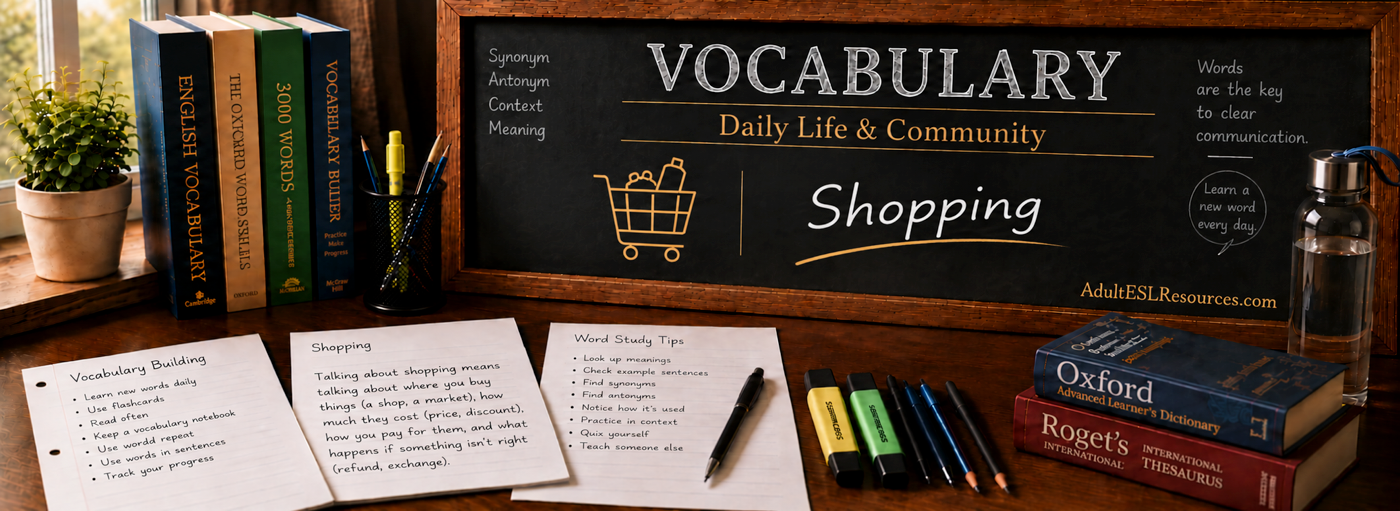
Shopping Vocabulary
Part of the Daily Life & Community vocabulary group in Teacher-In-A-Box, this lesson explores the vocabulary used to describe shops, buying and paying, discounts, and returns — language useful in almost any country, even though shopping customs and policies vary from place to place.
Connected vocabulary, not a glossary
Shopping vocabulary works as a system.
Talking about shopping means talking about where you buy things (a shop, a market), how much they cost (price, discount), how you pay for them, and what happens if something isn’t right (refund, exchange).
This lesson groups vocabulary by what it’s used to describe — shops and retail, buying and paying, discounts and deals, returns, and shopping habits — and shows how the words in each area relate to and differ from one another. Exact prices, payment methods, and return policies vary between stores and countries, so this lesson focuses on the vocabulary rather than any one store’s rules.
You will leave this lesson able to describe shopping experiences more precisely, wherever you happen to be shopping.
1. Shops and retail
Different words describe different kinds of places to shop.
retailer — a business that sells goods directly to customers, rather than to other businesses: “The retailer has locations in several cities.”
chain — a group of shops owned by the same company, found in multiple locations: “It’s part of a large international chain.”
department store — a large store divided into sections, each selling a different type of product: “You can find furniture and clothing in the same department store.”
shop vs. store vs. market
Three related words for places where people buy things.
shop / store — both describe a place selling goods; “shop” is more common in British English, “store” in American English, though both are widely understood: “I need to stop at the shop on the way home.”
market — a place where multiple independent sellers offer goods, often outdoors or in stalls: “The local market sells fresh produce every weekend.”
2. Buying and paying
The vocabulary of the transaction itself.
purchase (verb/noun) — a more formal word for “buy” or “something bought”: “Keep the receipt for any purchase over a certain amount.”
receipt — a printed or digital record showing what was bought and how much was paid: “She kept the receipt in case she needed to return the item.”
payment method — the way someone pays for something, such as cash or card; the exact options accepted vary between stores and countries: “Not every shop accepts every payment method.”
afford — to have enough money for something: “They couldn’t afford the more expensive option.”
price vs. cost vs. value
price — the specific amount asked for an item: “The price was higher than she expected.”
cost — the amount something requires, often used more broadly than “price” (including time, effort, or money): “The cost of the repair included both parts and labour.”
value — how worthwhile something is for its price, not simply how expensive it is: “It was expensive, but good value for what you got.”
3. Discounts and deals
Several words describe a lower-than-usual price, each slightly differently.
bargain — an item bought for less than its usual or expected value: “She found a real bargain at the market.”
deal — an arrangement or offer that’s considered favourable to the buyer: “They offered a good deal if you bought two.”
discount vs. sale vs. clearance
discount — a general reduction from the usual price, for any reason: “Students get a discount with valid identification.”
sale — a temporary period during which prices are reduced, often across many items: “The store is having a sale this weekend.”
clearance — a sale intended to remove remaining stock, often permanently, usually at the lowest prices: “Everything in the clearance section is final sale.”
4. Returns and consumer vocabulary
Return and refund policies vary — the vocabulary for discussing them doesn’t.
Every store sets its own policy, and rules vary between countries, so this lesson teaches the words rather than any one set of rules.
warranty — a promise from a seller or manufacturer to repair or replace a product within a certain period: “The warranty covers manufacturing faults for one year.”
policy — a store’s own rules about something, such as returns: “Ask about the store’s return policy before you buy.”
consumer — a general word for a person who buys goods or services: “The programme aims to inform consumers about their options.”
refund vs. exchange
refund — getting your money back for a returned item: “She asked for a refund instead of a replacement.”
exchange — swapping an item for a different one, such as a different size or colour: “He exchanged the shirt for a larger size.”
5. Shopping habits
Vocabulary for describing how people shop, not just what they buy.
browse — to look through items without necessarily intending to buy: “She likes to browse before deciding on anything.”
window shop — to look at items in shop windows or online without buying: “They went window shopping on their day off.”
impulse buy — something bought suddenly, without planning: “The chocolate bar by the till was an impulse buy.”
bargain hunter — someone who actively looks for the best possible price: “He’s a real bargain hunter, always comparing prices.”
Vocabulary in context
See the vocabulary working together.
Here is a short passage using several words from this lesson together.
She browsed a few shops before finding a jacket she liked at a good price. It wasn’t on sale, but the retailer offered a small discount for signing up to their newsletter. She kept the receipt, just in case she needed to exchange it for a different size later.
Unpacking what this vocabulary communicates:
browsed a few shops → looked around without committing to buy anything yet.
wasn’t on sale, but…offered a small discount → a discount and a sale are related but not identical.
kept the receipt → a practical habit connected to the possibility of a later exchange.
exchange it for a different size → swapping for a different version of the same item, not asking for money back.
The passage doesn’t depend on a specific price, currency, or store policy, so the vocabulary can be applied across many different shopping contexts.
Don’t confuse these
Choosing the right word changes what a sentence communicates.
shop / store / market
Shop and store both name a place that sells goods; a market is a place with several independent sellers, often in stalls.
price / cost / value
Price is the amount asked; cost is broader (money, time, or effort); value is how worthwhile something is for its price.
discount / sale / clearance
A discount is any reduction; a sale is a temporary period of reduced prices; a clearance is a sale meant to remove remaining stock for good.
refund / exchange
A refund gives you your money back; an exchange swaps the item for a different one.
Natural word partnerships
These combinations are worth learning as fixed units.
For the general idea behind combinations like these, see:
Common errors
Mistakes are useful when you understand why they happen.
I made shopping yesterday.
I went shopping yesterday.
The fixed expression is “go shopping,” not “make shopping.”
The shoes are in sale.
The shoes are on sale.
The fixed preposition is “on sale,” not “in sale.”
I can’t afford for this jacket.
I can’t afford this jacket.
“Afford” is followed directly by an object — no preposition is needed.
The store refunded me the money back.
The store refunded the money. / The store gave me a refund.
“Refund” already means giving money back, so adding “back” is redundant.
I bought a good at the market.
I bought an item at the market.
“Goods” is normally used in the plural to mean products in general — it’s not used as a singular countable noun for one item.
Your turn
Choose the word that fits.
These activities are part of the learning process. There are no scores, no grades and no limit on how many times you may try.
“Remaining stock is sold at reduced prices, often permanently, to clear it out.” Which word best fits?
Is this a temporary period of lower prices, or an effort to remove stock permanently?
“Getting your money back for a returned item.” Which word best fits?
Does this involve getting money back, or swapping for a different item?
“A place with several independent sellers, often in outdoor stalls.” Which word best fits?
Does this describe several independent sellers, or one large store divided into sections?
Try it another way
Complete the sentences.
Type the word that fits each gap.
Notice the difference
Rewrite each sentence using the correct word.
I made shopping yesterday.
The shoes are in sale.
Alternate practice
Use the vocabulary productively, not just recognise it.
Complete the summary
Fill each gap with one word from this lesson: browsed, discount, receipt, exchange, afford.
“He ___ a few shops before finding a jacket he could ___. The store offered a small ___ for new customers, so he kept the ___ in case he later needed to ___ it for a different size.”
Sort into groups
Sort these words into the area they belong to (Shops & Retail / Buying & Paying / Discounts & Deals / Returns):
Describe a situation
In two or three sentences, describe a fictional shopping situation using at least four words from this lesson.
Quick review
Five areas, connected by the everyday act of buying.
Shops and retail — shop vs store vs market, retailer, and chain.
Buying and paying — purchase, price vs cost vs value, receipt, and afford.
Discounts and deals — discount vs sale vs clearance, bargain, and deal.
Returns — refund vs exchange, warranty, and policy.
Shopping habits — browse, window shop, impulse buy, and bargain hunter.
Watch for — shop vs store vs market, discount vs sale vs clearance, refund vs exchange.
Remember
Shopping practices vary, but the core vocabulary remains widely useful.
Prices, payment methods, return policies, and retail customs vary between stores and countries, but vocabulary such as discount, refund and bargain is useful across many shopping contexts.
Related vocabulary