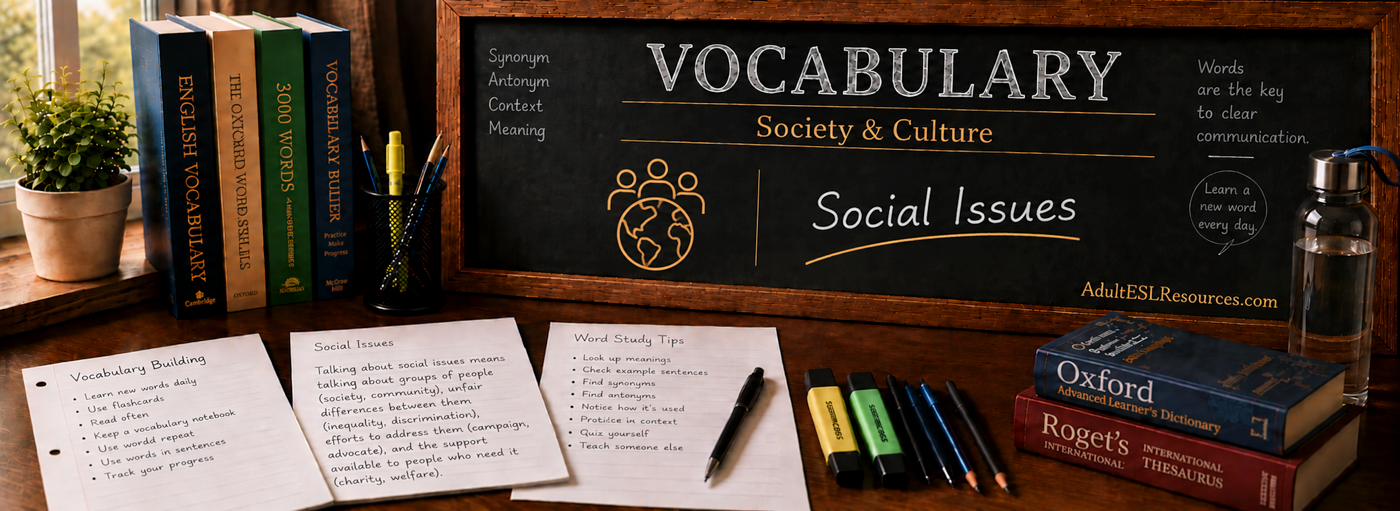
Social Issues Vocabulary
Part of the Society & Culture vocabulary group in Teacher-In-A-Box, this lesson explores the vocabulary used to describe communities, inequality, social change, and support — in a neutral, descriptive way, using generic situations rather than any specific policy or movement.
Connected vocabulary, not a glossary
Social issues vocabulary works as a system.
Talking about social issues means talking about groups of people (society, community), unfair differences between them (inequality, discrimination), efforts to address them (campaign, advocate), and the support available to people who need it (charity, welfare).
This lesson is not about any specific policy, movement, or organisation. It groups vocabulary by what it’s used to describe — society and community, inequality and disadvantage, social change, discrimination and inclusion, and community support — and shows how the words in each area relate to and differ from one another.
You will leave this lesson able to describe and discuss social topics more precisely, whatever your own views happen to be.
1. Society and community
Describing groups of people, from the very large to the very local.
population — all the people living in a particular place: “The city’s population has grown quickly.”
demographic — a section of the population defined by shared characteristics, such as age or income: “The survey targeted a younger demographic.”
diverse — including people or things of many different kinds: “The neighbourhood is culturally diverse.”
society vs. community
society — people in general, considered as a large, organised group with shared systems and institutions: “Education benefits society as a whole.”
community — a smaller, more specific group of people, often connected by location, interest, or identity: “The local community organised a clean-up event.”
2. Inequality and disadvantage
Vocabulary for describing unequal access to resources and opportunities.
disadvantage — a condition that makes something harder to achieve, often due to circumstances outside a person’s control: “Growing up without reliable transport can be a disadvantage.”
marginalized — pushed to the edges of society, with less power, voice, or access than others: “The programme supports marginalized groups in the area.”
access — the ability to obtain, use, or reach something, such as a service: “Not everyone has equal access to healthcare.”
poverty vs. inequality
poverty — a lack of enough money or resources to meet basic needs: “Many families in the region live in poverty.”
inequality — an unequal distribution of resources, opportunities, or outcomes between groups, which can exist even where nobody is in poverty: “Researchers study inequality between different regions.”
3. Social change and activism
Vocabulary for describing organised efforts to change something.
movement — a group of people working together over time toward a shared social goal: “The movement grew steadily over several years.”
advocate (verb) — to publicly support a cause or course of action; (noun) — a person who does this: “She advocates for better public transport.” / “He is a well-known advocate for the community.”
raise awareness — to help more people become informed about an issue: “The event aimed to raise awareness about food insecurity.”
protest vs. campaign
protest — a specific public act of objection, often a single event: “A protest was held outside the building.”
campaign — an organised, longer-term effort involving several activities aimed at a specific goal: “The campaign lasted almost a year.”
4. Discrimination and inclusion
Distinguishing an unfair belief from an unfair action.
stereotype — an oversimplified, widely-held idea about a group of people: “The film challenged a common stereotype.”
inclusive — designed so that everyone, including people who are often left out, can take part: “The school introduced a more inclusive policy.”
tolerance — willingness to accept beliefs or behaviour that are different from your own: “The programme aims to encourage tolerance between different groups.”
prejudice vs. discrimination
prejudice — an unfair or unfounded attitude or belief about a person or group: “The training addressed unconscious prejudice.”
discrimination — unfair treatment of people based on characteristics or group membership: “The organisation was accused of discriminating against people because of their age.”
5. Community and support
Vocabulary for describing help and support systems.
welfare — the general health, happiness, and wellbeing of a person or group, or the support systems that help provide it: “The programme focuses on child welfare.”
volunteer (noun/verb) — a person who offers to help without being paid, or the act of doing so: “She volunteers at the local shelter every weekend.”
charity vs. nonprofit vs. NGO
charity — an organisation established to support a charitable or public-benefit purpose, often funded partly or largely by donations: “The charity provides meals for people in need.”
nonprofit — a broad term for an organisation not run to distribute profit to private owners; exact legal definitions vary by country: “The nonprofit runs several community programmes.”
NGO (non-governmental organisation) — generally independent of government, often working on social, humanitarian, environmental, development, or similar issues: “Several NGOs responded to the situation.”
The exact legal meaning of charity, nonprofit and NGO varies between countries.
Vocabulary in context
See the vocabulary working together.
Here is a short, neutral passage using several words from this lesson together.
After noticing many families in their community struggling with food insecurity, a group of volunteers formed a small nonprofit. They launched a campaign to raise awareness of the issue and worked with local businesses to reduce food waste. Advocates involved in the project said it showed how a community can respond to inequality at a local level.
Unpacking what this vocabulary communicates:
a group of volunteers formed a small nonprofit → ordinary people organised themselves, without necessarily being political.
launched a campaign to raise awareness → a sustained effort to inform people, not a single event.
advocates involved in the project → people publicly supporting the cause, described neutrally.
respond to inequality at a local level → the passage stays general, describing a pattern rather than blaming any policy or group.
The passage focuses on a positive, community-level response — this vocabulary applies equally to describing challenges and to describing how people work to address them.
Don’t confuse these
Choosing the right word changes what a sentence communicates.
society / community
Society describes people in general, as a large, organised whole; a community is a smaller, more specific group.
poverty / inequality
Poverty is a lack of resources to meet basic needs; inequality is an unequal distribution between groups, which can exist independently of poverty.
prejudice / discrimination
Prejudice is an unfair belief; discrimination is the unfair action based on it.
protest / campaign
A protest is usually one public event; a campaign is a longer, organised effort made up of several activities.
charity / nonprofit / NGO
A charity supports a charitable purpose, often through donations; a nonprofit is any organisation not run to distribute profit to private owners; an NGO is typically independent of government and often international. Exact legal definitions vary between countries.
Natural word partnerships
These combinations are worth learning as fixed units.
For the general idea behind combinations like these, see:
Common errors
Mistakes are useful when you understand why they happen.
She was discriminating people because of their age.
She was discriminating against people because of their age.
The fixed preposition is “discriminate against.”
Many people live under poverty in that region.
Many people live in poverty in that region.
The fixed expression is “live in poverty,” not “under poverty.”
The campaign raised awareness for homelessness.
The campaign raised awareness of homelessness.
The fixed preposition is “raise awareness of/about,” not “for.”
There are many povertys in different countries.
There is a lot of poverty in different countries.
“Poverty” is uncountable — it has no plural form.
He volunteers in a charity every weekend.
He volunteers at a charity every weekend.
The fixed preposition is “volunteer at” an organisation.
Your turn
Choose the word that fits.
These activities are part of the learning process. There are no scores, no grades and no limit on how many times you may try.
“An unfair belief about a group of people, before any action is taken.” Which word best fits?
Is this describing a belief, or an action based on that belief?
“A lack of enough money or resources to meet basic needs.” Which word best fits?
Is this describing a lack of resources, or a difference between groups?
“An organised, longer-term effort made up of several activities aimed at a specific goal.” Which word best fits?
Is this describing a single event, or a longer, organised effort?
Try it another way
Complete the sentences.
Type the word that fits each gap.
Notice the difference
Rewrite each sentence using the correct word.
She was discriminating people because of their age.
There are many povertys in different countries.
Alternate practice
Use the vocabulary productively, not just recognise it.
Complete the summary
Fill each gap with one word from this lesson: campaign, marginalized, volunteers, inclusive, discrimination.
“A group of ___ launched a ___ to support ___ members of their community. They worked with local leaders to make services more ___ and to reduce ___ against long-term residents.”
Sort into groups
Sort these words into the area they belong to (Society & Community / Inequality & Disadvantage / Social Change & Activism / Discrimination & Inclusion / Community & Support):
Describe a situation
In two or three sentences, describe how a community might respond to a challenge it’s facing, using at least four words from this lesson.
Quick review
Five areas, connected by community, fairness, and support.
Society and community — society vs community, population, and demographic.
Inequality and disadvantage — poverty vs inequality, disadvantage, and access.
Social change and activism — protest vs campaign, movement, and advocate.
Discrimination and inclusion — prejudice vs discrimination, stereotype, and tolerance.
Community and support — charity vs nonprofit vs NGO, welfare, and volunteer.
Watch for — poverty vs inequality, prejudice vs discrimination, protest vs campaign.
Remember
Social issues vocabulary describes patterns in society, not a position on any policy.
Words like inequality, discrimination, campaign and marginalized help you discuss social topics thoughtfully and precisely — understanding them doesn’t require agreeing on the causes of, or solutions to, any particular issue.
Related vocabulary
Explore related areas of vocabulary.
Explore the rest of the Society & Culture vocabulary group below.