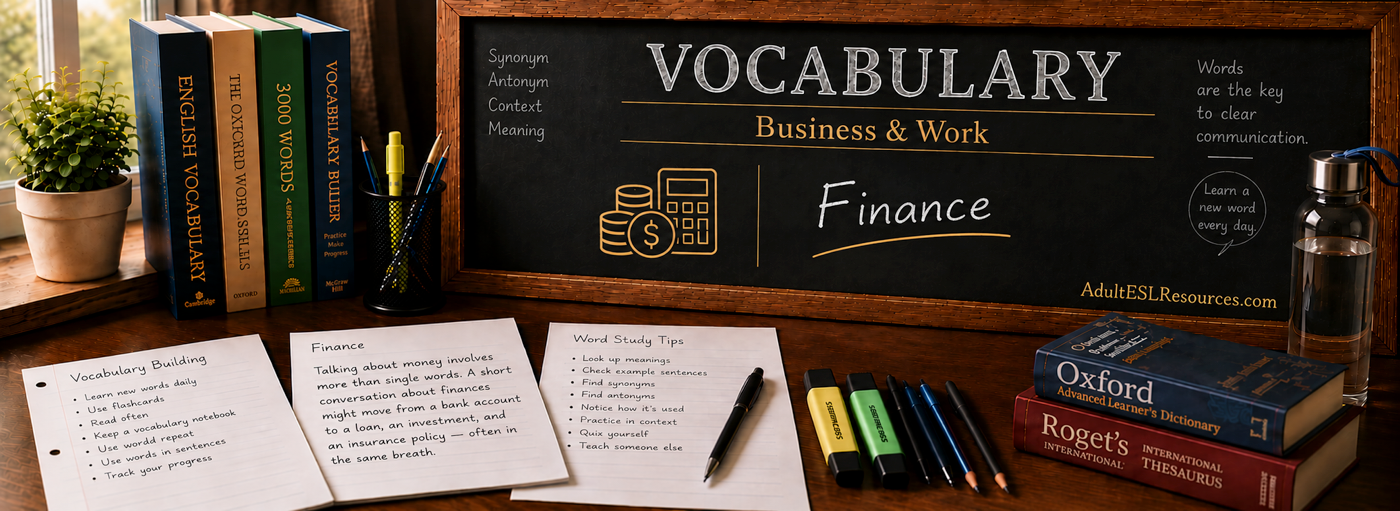
Finance Vocabulary
Part of the Business & Work vocabulary group in Teacher-In-A-Box, this lesson explores the words used to manage everyday money, borrow and save, and grow and protect what you have — banking, saving, borrowing, investing and insurance.
Connected vocabulary, not a glossary
Finance vocabulary works as a system.
Talking about money involves more than single words. A short conversation about finances might move from a bank account to a loan, an investment, and an insurance policy — often in the same breath.
This lesson is not a list of financial terms to memorise in isolation. Instead, it groups vocabulary into the areas of financial life it actually describes — everyday banking, saving, borrowing, investing, and protecting money — and shows how the words in each area relate to and differ from one another.
You will leave this lesson able to talk about your own finances more precisely, and to notice the small but important differences between words that often get confused.
1. Banking and everyday money
Money moves in and out of an account.
Everyday banking vocabulary describes that movement.
balance — the amount of money currently in an account: “Check your balance before making a large payment.”
deposit — to put money into an account; withdraw — to take money out of one: “She deposited her salary and later withdrew cash for the weekend.”
transfer — to move money from one account to another: “He transferred €200 to his sister.”
overdraft — an arrangement allowing an account balance to go below zero, up to an agreed limit: “I went into my overdraft this month.”
direct debit vs. standing order
Both are automatic payments, but the difference lies in who controls the amount.
direct debit — an automatic payment where the company being paid can vary the amount (common for bills that change, like electricity): “My electricity bill is paid by direct debit.”
standing order — an automatic payment for a fixed amount, set up and controlled by the account holder (common for rent): “I set up a standing order to pay my rent on the first of the month.”
2. Saving and spending
What you don’t spend, you save.
These words describe the everyday choices behind personal finance.
save — to keep money rather than spend it: “I try to save a little each month.”
save up — to save money over time for a specific goal: “They’re saving up for a house.”
budget (noun) — a plan for how much money will be spent and on what; (verb) — to plan spending carefully: “We set a monthly budget for groceries.”
afford — to have enough money for something: “I can’t afford a new phone right now.”
Natural combinations worth learning as fixed units:
For the general idea behind combinations like these, see:
3. Borrowing and debt
Borrowed money comes with a cost.
Borrowing vocabulary describes the money you owe, and the terms attached to it.
credit — permission or ability to borrow money, often used to buy something now and pay later: “He bought the sofa on credit.”
debt — money that is owed: “She’s still paying off her student debt.”
interest — the extra amount charged for borrowing money, usually a percentage of the loan: “The loan has an interest rate of 6%.”
instalment — one of several regular payments used to repay a loan over time: “He pays the loan back in monthly instalments.”
credit score — a number that reflects how reliably someone repays money they borrow: “A good credit score makes it easier to get approved for a loan.”
loan vs. mortgage
A mortgage is a specific type of loan, not a separate, unrelated word.
loan — a general term for money borrowed and repaid over time, for any purpose: “He took out a loan to buy a car.”
mortgage — a loan specifically used to buy property, secured against that property: “They took out a 25-year mortgage on their new flat.”
4. Investing
Investing accepts risk in exchange for potential growth.
This is what separates investing from simply saving.
return — the gain or loss on an investment, often expressed as a percentage: “The fund gave a return of 7% last year.”
risk — the chance that an investment could lose value: “Shares are generally riskier than a savings account.”
shares / stocks — small units of ownership in a company that can be bought and sold: “She bought shares in a technology company.”
portfolio — the full collection of investments a person or fund holds: “His portfolio includes shares, bonds, and property.”
diversify — to spread money across different types of investment to reduce risk: “Financial advisers usually recommend diversifying rather than investing in one company.”
A distinction worth learning carefully
Saving and investing are not the same choice.
Both involve setting money aside, but for different reasons and with different levels of risk.
save
Keep money safe and easily accessible, usually in a bank account, accepting a low or no return in exchange for security.
“I’m saving for an emergency fund, so it needs to stay easy to access.”
invest
Put money into something — shares, property, a fund — with the aim of growing it over time, while accepting the risk that it could also lose value.
“I’m investing for retirement, so I can accept some risk over a long time period.”
5. Protecting money
Insurance exchanges a small regular cost for protection against a large one.
premium — the amount you regularly pay for insurance: “Her car insurance premium increased this year.”
policy — the actual insurance agreement, including what it covers: “Read your policy carefully to see what’s included.”
cover — the protection an insurance policy provides: “This policy provides cover for accidental damage.”
claim — a request for the insurance company to pay for a loss or damage: “After the flood, they made a claim on their home insurance.”
Vocabulary in context
See the vocabulary working together.
Here is a short, realistic passage using several words from this lesson together.
After saving for two years, Elena had enough for a deposit on a mortgage. She still pays into a pension fund each month, investing for the future, and keeps a small emergency fund in a separate savings account in case of unexpected expenses. Her car insurance premium is paid by direct debit, and she’s never had to make a claim.
Unpacking what this vocabulary communicates:
saving for two years → building up money over time toward a specific goal, rather than spending it.
a deposit on a mortgage → an upfront sum paid toward a property loan, distinct from the mortgage repayments that follow.
investing for the future → accepting some risk in exchange for the possibility of growth over a long period.
an emergency fund → savings kept accessible, not invested, precisely because they may be needed quickly.
premium paid by direct debit → a regular insurance cost taken automatically, distinct from a claim, which only happens if something goes wrong.
Don’t confuse these
Choosing the right word changes what a sentence communicates.
save / invest
Ask: does this money need to stay safe and accessible (save), or is it being put at some risk for potential growth (invest)?
loan / mortgage
Every mortgage is a loan, but not every loan is a mortgage — ask whether the money is specifically for buying property.
credit / debt
Credit is the ability to borrow; debt is the money actually owed once that credit has been used.
deposit / withdraw
Ask which direction the money is moving: into the account (deposit) or out of it (withdraw).
direct debit / standing order
Ask who controls the amount: the company being paid (direct debit) or the account holder (standing order).
premium / claim
A premium is paid regularly, in advance; a claim is made afterwards, only if something goes wrong.
borrow / lend
As in general economics vocabulary, the person receiving money borrows it; the person or bank providing it lends it.
Natural word partnerships
These combinations are worth learning as fixed units.
Common errors
Mistakes are useful when you understand why they happen.
I did a loan from the bank.
I took out a loan from the bank.
Loans are “taken out,” not “done.”
The bank borrowed me €5,000.
The bank lent me €5,000.
The bank is providing the money, so the bank lends; the customer borrows.
I want to invest my money in a savings account.
I want to save my money in a savings account.
A savings account is for saving, not investing — it’s designed to keep money safe and accessible, not to grow it through risk.
My salary is direct debited into my account.
My salary is paid directly into my account.
A direct debit is an outgoing automatic payment, not an incoming salary payment.
I made an insurance for my car.
I took out insurance for my car.
Insurance, like a loan, is “taken out.”
I withdrew money in my account.
I withdrew money from my account.
Money is withdrawn from an account, not “in” it.
My credit score is very tall.
My credit score is very high.
Numerical scores are described as high or low, not tall or short.
He has a big debt with the bank.
He owes the bank a lot of money.
“A big debt with” is unnatural; use owe, or describe the debt as large rather than “with” the bank.
Your turn
Choose the word that fits.
These activities are part of the learning process. There are no scores, no grades and no limit on how many times you may try.
Amir wants to keep his emergency money completely safe and available at short notice. What should he do with it?
Think about whether this money needs to stay safe and accessible, or whether it can take on risk.
A couple borrow money specifically to buy a house, secured against that house. What is this loan called?
Which word names a loan specifically used to buy property?
Priya sets up an automatic payment of a fixed €600 for her rent, which she controls herself. What is this called?
Who controls the amount here — Priya, or the company being paid?
After a storm damaged her roof, Elena contacted her insurance company to ask them to pay for the repair. What did she make?
This word describes asking the insurer to pay after something goes wrong.
Try it another way
Complete the sentences.
Type the word that fits each gap.
Notice the difference
Rewrite each sentence using the correct word.
I want to invest my money in a savings account.
My salary is direct debited into my account.
Alternate practice
Use the vocabulary productively, not just recognise it.
Complete the summary
Fill each gap with one word from this lesson: budget, save, mortgage, invest, insurance.
“After sticking to a strict ___ for a year, they had enough to ___ for a deposit. They took out a ___ on their first flat, started to ___ a small amount each month for retirement, and bought home ___ in case anything went wrong.”
Sort into groups
Sort these words into the area of financial life they belong to (Banking / Saving & Spending / Borrowing & Debt / Investing / Insurance):
Describe a situation
In two or three sentences, describe a simple financial decision using at least four words from this lesson — for example, someone deciding between paying off debt and starting to invest.
Quick review
Five areas, connected by relationships and distinctions.
Banking & everyday money — deposit vs withdraw, direct debit vs standing order.
Saving & spending — budget, afford, and living within your means.
Borrowing & debt — loan vs mortgage, credit vs debt, and repaying in instalments.
Investing — risk vs return, and building a diversified portfolio.
Protecting money — paying a premium for cover, and making a claim when needed.
Watch for — save vs invest, premium vs claim, borrow vs lend.
Remember
Finance vocabulary rarely exists in isolation.
Words such as save, invest, loan, debt and insurance become easier to use correctly when related terms are learned together — the choices they represent, and the distinctions between them, are part of understanding how financial language actually works.
Related vocabulary
Explore related areas of vocabulary.
More Business & Work vocabulary — including Job Interviews, Workplace Communication and Marketing — is planned for this section.