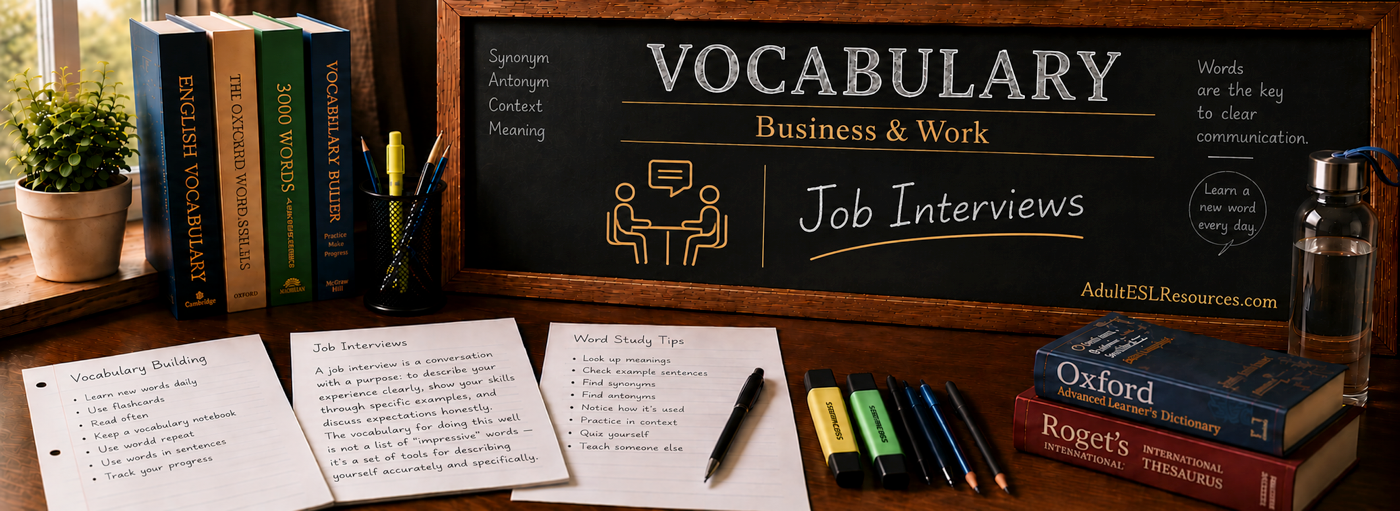
Job Interviews Vocabulary
Part of the Business & Work vocabulary group in Teacher-In-A-Box, this lesson explores the vocabulary used to talk about your experience, your skills, and your expectations in a job interview — and how to answer confidently without sounding rehearsed.
Connected vocabulary, not a glossary
Interview vocabulary works as a system.
A job interview is a conversation with a purpose: to describe your experience clearly, show your skills through specific examples, and discuss expectations honestly. The vocabulary for doing this well is not a list of “impressive” words — it’s a set of tools for describing yourself accurately and specifically.
This lesson groups that vocabulary by what you actually need to do in an interview — talk about experience, describe skills, structure an answer, and discuss salary and logistics — and shows how these tools work together in a real answer.
You will leave this lesson able to talk about your own background more precisely, and to notice the small differences between words that often get confused.
1. Talking about your experience
Experience is described specifically, not vaguely.
These words describe what you have done, and where.
background — your overall history of education and work: “My background is in customer service.”
previous role — the job you had before this one: “In my previous role, I managed a small team.”
responsibilities — the tasks that were part of your job: “My responsibilities included training new staff.”
achievements — specific things you accomplished, ideally with a result: “One of my achievements was reducing customer complaints by 20%.”
experience vs. qualifications
Interviewers often ask about both, but they are not the same thing.
experience — what you have actually done in practice, usually measured in time or specific tasks: “I have five years of experience in retail management.”
qualifications — official certificates, degrees, or training you have completed: “My qualifications include a diploma in business administration.”
2. Describing skills and qualities
A skill is something you can do; a quality is a way you tend to be.
hard skill — a specific, teachable ability, often technical: “Data analysis is one of my hard skills.”
soft skill — a way of working with others or handling situations: “Communication is one of my strongest soft skills.”
team player — someone who works well and cooperatively within a group: “My colleagues would describe me as a team player.”
proactive — taking action before being asked, rather than only reacting: “I try to be proactive about spotting problems early.”
Natural combinations worth learning as fixed units:
A distinction worth learning carefully
How you talk about a weakness matters as much as what it is.
Interviewers expect an honest weakness, framed constructively rather than as a flat confession.
strength
Something you are genuinely good at, ideally supported by a specific example rather than just a label.
“One of my strengths is staying calm under pressure — for example, when a deadline moved forward with no notice.”
weakness
A genuine area for development, usually paired with what you are doing about it, rather than left unresolved.
“I used to find it difficult to delegate tasks, so I’ve been working on giving colleagues clearer ownership and trusting them to manage their part of a project.”
3. Answering common question types
A structure turns a claim into evidence.
Many interview questions ask you to describe a specific past situation, not to describe yourself in general.
A behavioural question (also called a competency-based question) asks you to describe a real past example — often starting with “Tell me about a time when…” A common way to structure the answer is:
situation — the context: “A client complained about a late delivery.”
task — what needed to happen: “I needed to resolve it quickly, without losing the client.”
action — what you actually did: “I contacted the supplier directly and arranged a same-day replacement.”
result — the outcome: “The client ended up praising our responsiveness.”
4. Discussing salary and logistics
Practical details need precise vocabulary too.
salary expectations — the pay you hope or expect to receive: “What are your salary expectations for this role?”
package — salary combined with other benefits, such as insurance or holiday: “The full package includes health insurance and 25 days of holiday.”
notice period — the length of time you must work after resigning, before leaving a job: “My notice period is one month.”
availability — when you are free to start or attend: “My availability from next month is quite flexible.”
5. Interview etiquette and follow-up
The conversation doesn’t end when the interview does.
follow up — to contact someone again after an interview, usually to thank them or check on progress: “I followed up with a short thank-you email.”
references — people who can confirm your work history and character: “I can provide two professional references.”
accept / decline an offer — to say yes, or to say no, to a job offer: “After thinking it over, she decided to decline the offer.”
Vocabulary in context
See the vocabulary working together.
Here is a short, realistic exchange using several words from this lesson together.
Interviewer: Can you tell me about a time you handled a difficult situation at work?
Candidate: In my previous role, a client complained about a late delivery. I took the initiative to contact the supplier directly and coordinated a same-day replacement. The client ended up praising our responsiveness, and it became one of the achievements I’m proudest of.
Unpacking what this vocabulary communicates:
in my previous role → grounds the answer in specific, real experience rather than a general claim.
a client complained → the situation, setting up the problem to be solved.
took the initiative → demonstrates a proactive quality through action, not just by naming it.
the client ended up praising our responsiveness → the result — evidence that the action worked.
one of the achievements I’m proudest of → reframes the story as an achievement, tying the answer back to a common interview question.
Don’t confuse these
Choosing the right word changes what a sentence communicates.
experience / qualifications
Ask: is this about what you have actually done (experience), or an official certificate or degree you hold (qualifications)?
skill / quality
A skill is something you can do (data analysis, a language); a quality is a way you tend to be or work (patient, adaptable).
role / position / job title
Job title is the official name of the job; role and position both refer to the job itself, with role often emphasising what you actually do.
salary / package
Salary is the pay itself; package includes salary plus benefits such as insurance, bonuses, or holiday.
apply for / interview for
You apply for a job (submit an application); you are interviewed for it afterwards, if selected.
Natural word partnerships
These combinations are worth learning as fixed units.
For the general idea behind combinations like these, see:
Common errors
Mistakes are useful when you understand why they happen.
I have experience in marketing since five years.
I have five years of experience in marketing.
Duration goes with “experience” as “X years of experience,” not “since X years.”
My weakness is I am very perfectionist.
I can be a perfectionist at times, so I’ve been working on it.
“Perfectionist” is a noun, not an adjective, and a weakness answer usually pairs the issue with what you’re doing about it.
I am responsible of the team.
I am responsible for the team.
“Responsible” is followed by for, not of.
I did my responsibilities very well.
I carried out my responsibilities very well.
Responsibilities are “carried out” or “fulfilled,” not “done.”
I want a good package of salary.
I’m looking for a good salary package.
The natural word order is “salary package,” not “package of salary.”
I am very good in teamwork.
I am very good at teamwork. / I work well in a team.
“Good at” takes a skill or activity; “in a team” describes the setting, not what follows “good.”
Your turn
Choose the word that fits.
These activities are part of the learning process. There are no scores, no grades and no limit on how many times you may try.
“I completed a diploma in project management last year.” Which word best describes this?
Is this about time spent doing a job, or an official certificate?
In “the client ended up praising our responsiveness,” which part of a STAR-style answer is this?
Does this describe what happened before, during, or after the action?
A recruiter mentions the salary plus health insurance and 25 days of holiday together. What is this combination called?
Which word covers salary and benefits together, not just the pay itself?
Try it another way
Complete the sentences.
Type the word that fits each gap.
Notice the difference
Rewrite each sentence using the correct word or structure.
I have experience in marketing since five years.
I am responsible of the team.
Alternate practice
Use the vocabulary productively, not just recognise it.
Complete the summary
Fill each gap with one word from this lesson: experience, initiative, result, package, references.
“With three years of ___ in the role, she described a time she took the ___ to fix a client issue. The ___ was a thank-you note from the client. She also mentioned her salary ___ and offered two professional ___.”
Build a STAR answer
Choose a real or imagined work situation and write one sentence for each part: situation, task, action, result.
Rewrite for precision
Rewrite each sentence using more precise interview vocabulary:
“I am good with people and I work hard.”
“I did a lot of things in my last job.”
Describe a situation
In two or three sentences, describe how you would answer “Tell me about your greatest strength,” using at least three words from this lesson.
Quick review
Five areas, connected by structure and precision.
Talking about experience — experience vs qualifications, and describing a previous role specifically.
Describing skills and qualities — hard skill vs soft skill, and framing a weakness constructively.
Answering common question types — the situation → task → action → result structure.
Discussing salary and logistics — salary vs package, and notice period.
Interview etiquette and follow-up — following up, references, accepting or declining an offer.
Watch for — experience vs qualifications, skill vs quality, salary vs package.
Remember
An interview answer is only as strong as its evidence.
Words like experience, strength, initiative and result are most convincing when they are tied to a specific example — the vocabulary in this lesson is what turns a general claim about yourself into a concrete, believable answer.
Related vocabulary
Explore related areas of vocabulary.
More Business & Work vocabulary — including Workplace Communication and Marketing — is planned for this section.