Formal & Informal Expressions
Learn how to express the same idea differently depending on who you’re speaking to, what’s happening, and how formal the situation is.
Not better or worse — different
Different situations call for different language choices.
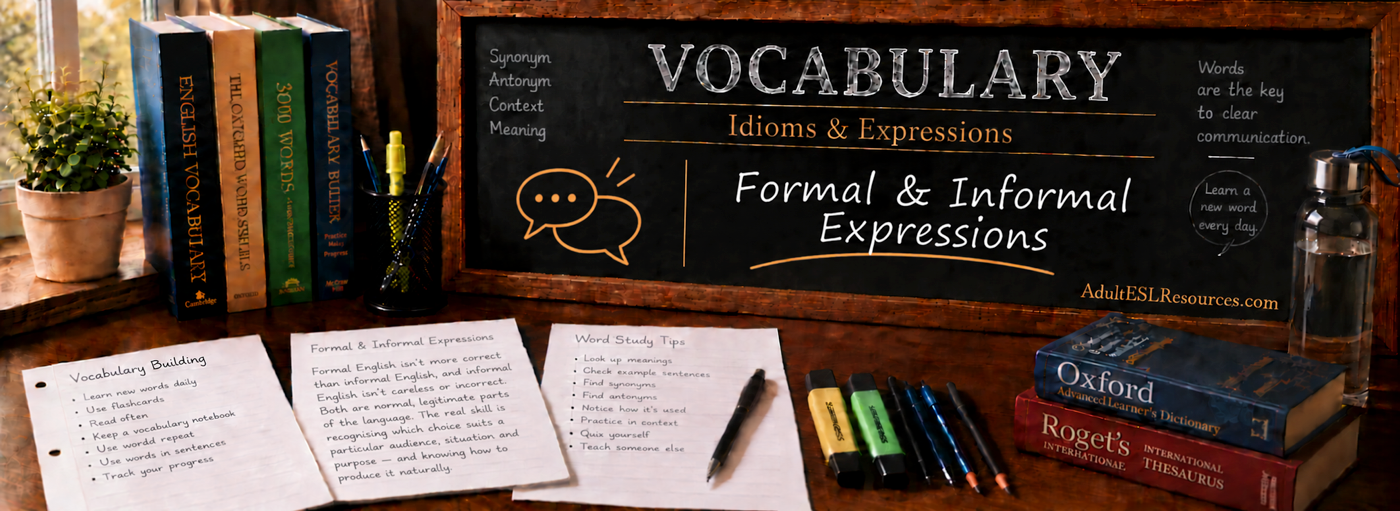
Formal English isn’t more correct than informal English, and informal English isn’t careless or incorrect. Both are normal, legitimate parts of the language. The real skill is recognising which choice suits a particular audience, situation and purpose — and knowing how to produce it naturally.
Register doesn’t work as a simple on/off switch, either. Between “formal” and “informal” sits a wide, very common middle ground: neutral English, which works comfortably in most everyday situations.
This lesson looks at how the same basic message can move across that range, and what actually changes when it does — not just the words, but the tone, the distance, and the relationship between speaker and listener.
More ways to explore idiomatic language
This page focuses on register and audience.
For a page focused on established word combinations, or for common idiomatic expressions, explore the pages below.
The central idea
Choosing your register is a four-part decision.
01
Audience
Who will actually receive this message — a close friend, a colleague, a stranger, an institution?
02
Situation
What’s happening, and what is this communication actually for?
03
Register
Given that audience and situation, what degree of formality genuinely fits?
04
Expression
Now choose the actual wording that matches that register naturally.
Formality is a continuum
Most ideas can be expressed at more than one point on the scale.
Rather than two fixed categories, it’s more useful to picture a scale: informal, moving through neutral, up to formal. The same person may use language from anywhere on this scale, depending entirely on the situation — not because they are “a formal person” or “an informal person”.
Informal
Hang on a sec.
Natural between friends or close colleagues.
Neutral
Just a moment, please.
Works comfortably in most everyday situations.
Formal
Could you please wait a moment?
Suits an unfamiliar audience or a more official situation.
Function: Making requests
Asking for something, at different points on the scale
Informal
Can you tell me…?
Direct and easy, natural with people you already know.
Neutral
Could you tell me…?
A little softer, appropriate for most everyday requests.
Formal
Could you please let me know…?
Suits a written request to someone you don’t know well.
These three don’t just differ in politeness — they also create different distance. “Can you tell me…?” feels close and immediate. “Could you please let me know…?” creates a small, respectful distance that fits a more formal relationship.
Function: Saying you don’t understand
Admitting confusion, at different points on the scale
Informal
I don’t get it.
Casual and direct, natural among friends.
Neutral
I don’t understand.
Plain and clear, appropriate almost anywhere.
Formal
I’m afraid I don’t fully understand.
Softens the admission, suited to a more formal or professional exchange.
Notice that the formal version doesn’t just sound more polished — “I’m afraid” softens the statement and makes it feel less blunt, while “fully” quietly suggests you’ve understood part of it. The underlying idea is related, but the tone genuinely shifts.
Function: Apologising
Saying sorry, at different points on the scale
Informal
My bad.
Casual and quick, common with friends over something minor.
Neutral
Sorry about that.
Works well in most everyday situations.
Formal
I apologise for the inconvenience.
Suits a written or professional apology, especially to someone affected by the issue.
Seriousness matters here as much as audience. “My bad” for a missed deadline that genuinely affected a client would sound dismissive, not just informal — the situation, not only the relationship, shapes which register fits.
Function: Making suggestions
Proposing an idea, at different points on the scale
Informal
Why don’t we just push the deadline?
Direct and casual, common in a relaxed team conversation.
Neutral
We could push the deadline.
Clear and simple, suitable for most everyday discussions.
Formal
Perhaps we might consider extending the deadline.
Suits a written proposal or a suggestion to someone senior or unfamiliar.
The formal version is also noticeably more tentative — “perhaps” and “might consider” leave more room for disagreement than “why don’t we just…?”, which already sounds fairly settled.
Function: Disagreeing
Expressing disagreement, at different points on the scale
Informal
Nah, I don’t think so.
Blunt and quick, natural between friends.
Neutral
I see it a bit differently.
Clear disagreement, without sounding harsh or overly formal.
Formal
I’m not sure I agree with that.
Softens the disagreement, suited to a professional or written discussion.
Directness drops as formality rises here, and that’s the point — the formal version is deliberately less blunt, so it can be used with someone you don’t know well without sounding confrontational.
Meaning and nuance
Formal and informal versions aren’t always perfect synonyms.
I don’t get it / I’m afraid I don’t fully understand
These communicate a broadly related idea, but not an identical one. “I don’t get it” is blunt and direct. “I’m afraid I don’t fully understand” is softer, more cautious, and leaves more room for the possibility that you’ve understood some of it. Choosing the formal version doesn’t just change the audience — it slightly changes what you’re claiming.
Can you tell me…? / Could you please let me know…?
Both are requests for information, but they create different distance. “Can you tell me…?” feels immediate and close. “Could you please let me know…?” is more indirect and creates a small, respectful gap between speaker and listener — useful with someone you don’t know, but oddly distant with a close friend.
Spoken and written English
Register depends on the situation, not the medium.
It’s tempting to assume that spoken English is informal and written English is formal, but that’s too simple. Both spoken and written communication can sit anywhere on the register scale.
Formal spoken English
A spoken presentation can use fully formal language, even though it’s never written down for the audience.
“We are pleased to announce a new partnership with the regional office.”
Informal written English
A quick message to a close friend is written, but often highly informal.
“omw, running 5 min late, sorry!”
Formality and politeness
Formal isn’t the same thing as polite.
The two are related, but they aren’t identical. An informal expression can be warm and polite. A formal sentence can still sound cold or inappropriate.
Informal but polite
Casual wording doesn’t stop a request from being considerate.
“Would you mind grabbing that for me?”
Formal but cold
Grammatically formal wording can still feel abrupt or unfriendly.
“Kindly refrain from further correspondence on this matter.”
Common problems
Mismatched register stands out, even when the grammar is correct.
Can u send me the file? (in a formal work email to a client)
Could you please send me the file?
Very informal wording in a formal request can come across as careless or even disrespectful, whatever the writer intended.
I would be most grateful if you could pass the salt. (at dinner with a close friend)
Could you pass the salt?
Unnecessarily formal language in a relaxed situation can sound distant, unnatural, or even sarcastic.
Dear Sir, wanna grab lunch sometime?
Hi, would you like to grab lunch sometime?
Mixing sharply different registers in the same short message reads as inconsistent, even though neither register is wrong on its own.
I do not understand. (used with a close friend, avoiding “I don’t get it” as though it were incorrect)
I don’t get it.
Informal English isn’t grammatically incorrect — avoiding it entirely, even among friends, can sound unnecessarily stiff.
Dear Respected Sir, I am hoping you are in the pink of health. (opening a routine work email)
Hi [Name], I hope you’re doing well.
Translating formality conventions directly from another language often produces English that sounds overly ceremonial rather than simply formal.
I require your assistance moving this weekend. (asking a friend for a casual favour)
Could you give me a hand moving this weekend?
Choosing a more formal-sounding word can quietly change the meaning — “require” sounds like a demand, not a favour between friends.
Kindly vacate the premises immediately. (to a friend who has overstayed a visit)
Hey, would you mind heading off soon? I need to get ready.
The formal version aims for politeness but reads as cold — with a friend, a warmer, informal request is the more genuinely polite choice.
Your turn
Practise choosing what’s appropriate, not just what’s correct.
These activities are part of the learning process. There are no scores, no grades and no limit on how many times you may try.
You’re emailing a professor to ask about a possible extension. Which is most appropriate?
The most appropriate option isn’t necessarily the most polite-sounding one, but the one that fits this specific relationship.
You’re texting a close friend who’s running a little late. Which is most natural?
Overly formal wording between friends can sound sarcastic or strange.
“Dear Hiring Manager, I hope this email finds you well. Anyway, lemme know if you need anything else, cheers!” Which part clashes with the rest of the message’s register?
Look for wording that sounds like speech rather than a formal email.
“I don’t get it” and “I’m afraid I don’t fully understand” — which statement is true?
Neither version is “wrong” — think about what actually changes between them.
Same message, different audience
Rewrite the same idea for a different situation.
Good language choice depends on the relationship and situation, not on one version being “better” English than another.
A meeting needs to be moved. To a friend or classmate, you’d say: “Can we move it to tomorrow?” Rewrite this as a more formal request to a supervisor.
To a friend, you’d say: “My bad, I totally forgot.” Rewrite this as a formal apology for a work email.
To a colleague you know well, you’d say: “Why don’t we just push the deadline?” Rewrite this as a suggestion to someone senior you don’t know well.
Quick review
Situation first. Register follows.
Audience — who will actually receive this message
Situation — what’s happening, and what the communication is for
Register — what degree of formality genuinely fits
Expression — the actual wording that matches that register naturally
Remember
Good English is not always formal English.
Good language choice means using wording that suits the meaning, audience, situation and purpose — not automatically reaching for the most formal option available.