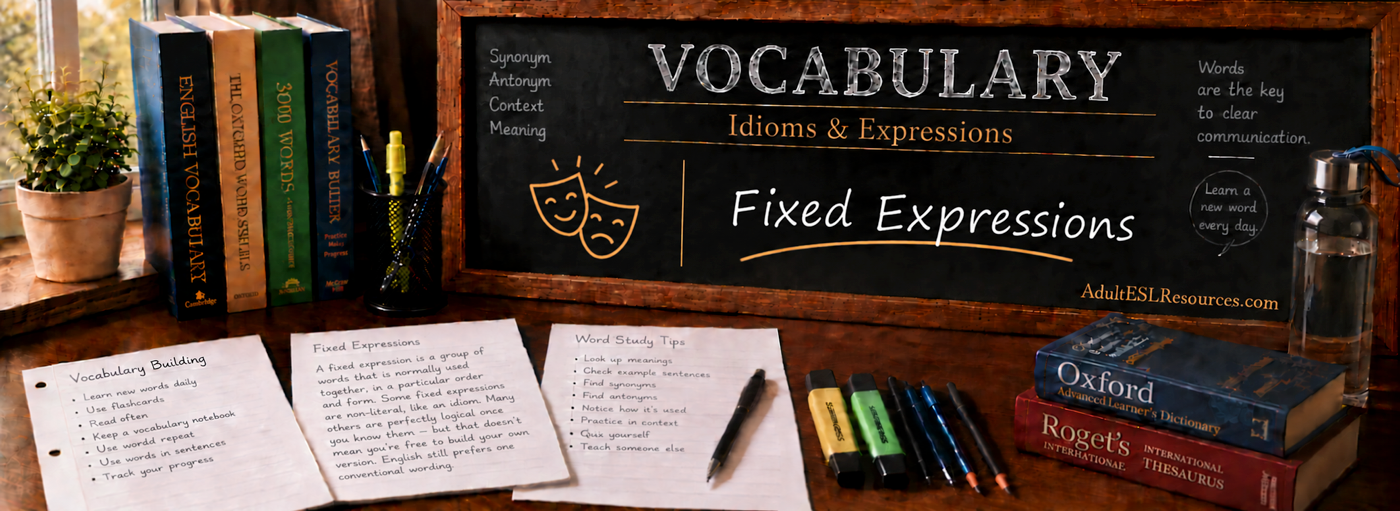
Fixed Expressions
Learn the established word combinations that English speakers use as complete units — and why changing even one small word can make an expression sound unnatural.
More than the sum of the words
Some word combinations are used in one established form.
A fixed expression is a group of words that is normally used together, in a particular order and form. Some fixed expressions are non-literal, like an idiom. Many others are perfectly logical once you know them — but that doesn’t mean you’re free to build your own version. English still prefers one conventional wording.
That means knowing the individual words is not always enough. Changing one apparently small word — a preposition, an article, the order of words — can make an expression sound unnatural, or change what it actually does in a conversation.
This lesson focuses on recognising these established expressions, understanding what each one actually does, and learning to produce them the way they are normally used.
More ways to explore idiomatic language
This page focuses on established wording.
For common idiomatic expressions, or for a page focused on register and formality, explore the pages below.
The central idea
Using a fixed expression naturally is a four-step process.
01
Recognise the expression
Notice that a group of words is being used as one established unit, not just as individual words.
02
Understand its function
Work out what the expression actually does — what job it performs in the conversation or sentence.
03
Notice what’s fixed
Some expressions allow no change at all. Others allow limited, predictable variation.
04
Use the established form
Produce the expression the way it is normally used, rather than rebuilding it from individual words.
Fixed doesn’t mean frozen
Some expressions allow no change. Others allow a limited slot.
“Fixed” doesn’t always mean that every word is locked in place. It’s more useful to think of two situations.
Completely fixed
by the way
No part of this expression can be changed. Changing any word destroys the established phrase entirely.
Semi-fixed, with a limited slot
as far as I know / as far as I can remember / as far as I’m concerned
The frame “as far as I ___” stays fixed, but a small, predictable set of verbs can fill the slot.
Either way, the important point is the same: you cannot freely substitute any grammatically possible word and assume the result will sound natural. Even a semi-fixed expression only allows the substitutions that are actually established — not any word that happens to fit grammatically.
Function: Adding or shifting information
Expressions that introduce something new or reshape what was just said
by the way
Function: introduce an additional point, often unrelated to what was just being discussed. Completely fixed — no variation.
“By the way, did you ever hear back from the landlord?”
as a matter of fact
Function: add a piece of information, often to confirm, correct, or slightly emphasise a point. Fixed form.
“As a matter of fact, I was just about to call you.”
in other words
Function: restate or reformulate what was just said, usually more simply or directly. Fixed form.
“The flight’s delayed by six hours — in other words, we’re not making the connection.”
How these differ
By the way and in other words can both appear between ideas, but they do completely different jobs. By the way introduces something additional or changes direction. In other words reformulates or explains what was just said — it doesn’t add anything new.
Function: Expressing knowledge or viewpoint
Expressions that show how certain, honest or personal a statement is
as far as I know
Function: give information while being clear you might not have the full picture. Semi-fixed — also “as far as I can remember”, “as far as I’m concerned”.
“As far as I know, the meeting is still on for Friday.”
as far as I’m concerned
Function: give a personal opinion or position, often signalling that others may see it differently. Semi-fixed, using the same frame as above.
“As far as I’m concerned, the project is finished.”
to be honest
Function: signal that you’re about to say something direct, personal, or possibly unwelcome. Fixed form.
“To be honest, I’m not sure this plan will work.”
it depends
Function: signal that a clear yes-or-no answer isn’t possible, because the outcome relies on something else. Fixed form; often followed by “on…”.
“Can we finish today? It depends on how the testing goes.”
no wonder
Function: react to information by showing that a result now makes sense or isn’t surprising. Fixed form.
“No wonder you’re tired — you only slept four hours.”
Function: Organising ideas
Expressions that guide the listener through a sequence of points
first of all
Function: introduce the first point in a sequence. Fixed form.
“First of all, thank you all for coming.”
on the other hand
Function: introduce a contrasting point or an alternative view. Fixed form.
“The apartment is cheaper. On the other hand, it’s much further from work.”
in any case
Function: move past the details already discussed, showing that a point stands regardless of them. Fixed form.
“We’re not sure if it’ll rain, but in any case, we should bring an umbrella.”
after all
Function: give a reason that supports a point already made, often reminding the listener of something. Fixed form.
“Let’s take a break — we’ve been working for three hours, after all.”
Function: Referring to time or temporary situations
Expressions that describe now, or a situation expected to change
at the moment
Function: describe what is happening right now. Fixed form.
“She’s not available at the moment.”
for the time being
Function: describe a temporary situation that is expected to change later. Fixed form.
“We’ll work from the smaller office for the time being.”
in the meantime
Function: describe what happens during the period before something else takes place. Fixed form.
“The new system arrives next month. In the meantime, please keep using the old one.”
How these differ
At the moment describes now. For the time being describes a temporary situation that is expected to change. In the meantime describes what happens during the period before something else happens. They can sound similar, but each points to a different relationship with time.
Function: Everyday social interaction
Expressions used in routine, everyday social exchanges
nice to meet you
Function: greet someone you are meeting for the first time. Fixed form.
“Nice to meet you — I’ve heard a lot about you.”
no problem
Function: respond to thanks, or reassure someone that a request was easy to fulfil. Fixed form.
“A: Thanks for waiting. B: No problem.”
never mind
Function: tell someone not to worry about something, or drop a point that no longer matters. Fixed form.
“Never mind, I found it myself.”
keep in touch
Function: express an intention to stay in contact, often when saying goodbye. Fixed form.
“It was great catching up — let’s keep in touch.”
long time no see
Function: greet someone you haven’t seen for a while. Fixed form, despite its unusual grammar.
“Hey, long time no see! How have you been?”
Comparisons
Expressions that look similar don’t always do the same job.
Adding new information
by the way
Introduces a new, often unrelated point into the conversation.
Restating what you said
in other words
Reformulates or explains something already said — it adds no new content.
Now
at the moment
Describes the present situation, with no promise that it will change.
A temporary situation
for the time being
Describes something in place now that is expected to change later.
Before something else happens
in the meantime
Describes the period leading up to a specific future event.
Common problems
Small changes to the wording rarely go unnoticed.
In the moment, we don’t have an answer.
At the moment, we don’t have an answer.
Changing the preposition changes an established expression into something that doesn’t work the same way.
On other hand, it’s quite expensive.
On the other hand, it’s quite expensive.
The small word “the” isn’t optional here — dropping it makes the expression sound incomplete.
We’ll manage with the smaller office for a time being.
We’ll manage with the smaller office for the time being.
Inserting an article that doesn’t belong is just as noticeable as leaving one out.
By the road, did you call him back?
By the way, did you call him back?
Translating a similar expression word-for-word from another language usually produces something that isn’t a recognised English expression at all.
In other words, I wanted to mention that the meeting has been moved to Friday.
By the way, I wanted to mention that the meeting has been moved to Friday.
This is new information, not a restatement of something already said — “by the way” fits the function; “in other words” doesn’t.
As far as I hope, the results will arrive tomorrow.
As far as I know, the results will arrive tomorrow.
The “as far as I ___” slot only accepts a small, established set of verbs — “hope” isn’t one of them, even though it fits grammatically.
A: I’m so sorry I’m late. B: No wonder!
A: I’m so sorry I’m late. B: No problem.
“No wonder” reacts to information by saying it isn’t surprising — it sounds like a criticism here, not a reassurance.
Your turn
Practise choosing the right expression for what it needs to do.
These activities are part of the learning process. There are no scores, no grades and no limit on how many times you may try.
You want to restate what you just said, more simply. Which expression fits?
Think about explaining the same idea again, in simpler words.
A situation is temporary and expected to change soon. Which expression fits best?
Compare it with “at the moment”, which simply describes now.
Which sentence contains a mistake?
One expression is missing a small but necessary word.
Someone apologises for arriving late. Which response fits the situation?
“No wonder” reacts to information — it isn’t a reassurance.
Try it another way
Complete each short exchange.
Type the missing word to finish the expression.
Notice the difference
Correct the altered fixed expression.
Rewrite each sentence using the established form.
In the moment, we don’t have an answer.
On other hand, it’s quite expensive.
A: I’m so sorry I’m late. B: No wonder!
Quick review
Recognise it. Understand it. Use it as it’s normally used.
Recognise the expression — notice a group of words being used as one established unit
Understand its function — work out what job it actually performs
Notice what’s fixed — some expressions allow no change, others allow a limited slot
Use the established form — produce it the way it’s normally used, not rebuilt from individual words
Remember
The wording is part of the meaning.
English contains established word combinations that are normally produced as complete or semi-fixed units. Their exact wording, meaning and function all matter — knowing the individual words is only the starting point.