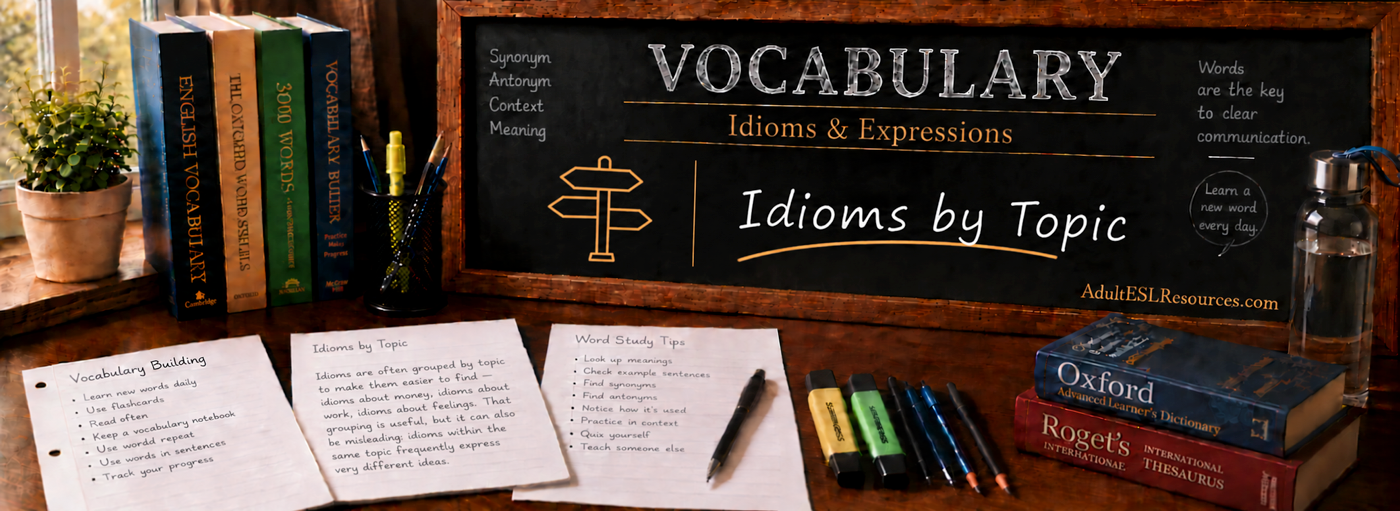
Idioms by Topic
Learn how to choose the right idiom for what you actually want to say — not just an idiom that happens to share the same subject.
Same subject, different meaning
Sharing a topic does not make idioms interchangeable.
Idioms are often grouped by topic to make them easier to find — idioms about money, idioms about work, idioms about feelings. That grouping is useful, but it can also be misleading: idioms within the same topic frequently express very different ideas.
Someone talking about money might mean that something is expensive, that they need to spend less, or that they barely have enough for essentials — and each of those ideas has its own idiom. Choosing the right one depends on the exact meaning you want to communicate, not simply the general subject.
This lesson looks at several everyday topics and, for each one, focuses on how the idioms connected to that topic actually differ from one another.
More ways to explore idioms
This page focuses on topic and situation.
For a substantial collection of common, everyday idioms, or a substantial collection of more sophisticated idioms for everyday life and university, explore the pages below.
The central idea
Choosing an idiom is a four-step decision.
The topic is only the starting point. From there, ask yourself the following.
01
Topic
What general subject am I discussing — money, work, feelings, communication?
02
Exact meaning
Within that topic, what specific idea do I actually want to express?
03
Situation
Does this particular expression fit the moment and the audience?
04
Natural use
Am I using the expression in the form it is normally used?
Topic: Communication & Conversation
Idioms about how — and how directly — people speak
break the ice
Meaning: help people feel more relaxed together, especially early in a conversation or a first meeting.
“He told a joke to break the ice at the start of the meeting.”
get straight to the point
Meaning: say what you mean directly and quickly, without unnecessary detail.
“We don’t have much time, so let’s get straight to the point.”
beat around the bush
Meaning: avoid saying something directly, often because it is awkward or difficult.
“Just tell me what happened — stop beating around the bush.”
read between the lines
Meaning: understand a meaning that is implied rather than directly stated.
“She didn’t say she disagreed, but if you read between the lines, it’s obvious.”
How these differ
All four relate to communication, but in very different ways. Break the ice is about starting a conversation warmly. Get straight to the point and beat around the bush describe opposite approaches to directness. And read between the lines isn’t about speaking at all — it’s about interpreting what someone else has said or written.
Topic: Feelings & Emotions
Idioms about mood and emotional state
over the moon
Meaning: extremely happy about something.
“He was over the moon when he got the job.”
down in the dumps
Meaning: feeling sad or low, often without one specific cause.
“She’s been a bit down in the dumps since the exam results came out.”
on edge
Meaning: nervous, tense or easily irritated, often because of stress or uncertainty.
“Everyone’s been a bit on edge since the announcement.”
at your wit’s end
Meaning: so frustrated or worried about a problem that you don’t know what to do next.
“After the third delay, she was at her wit’s end.”
How these differ
Over the moon and down in the dumps describe a general mood — very happy or very low. On edge and at your wit’s end describe a more specific kind of stress, and they aren’t the same strength: on edge is a general tension, while at your wit’s end means you have run out of patience or ideas entirely.
Topic: Money
Idioms about spending, saving and getting by
cost an arm and a leg
Meaning: be very expensive.
“That watch must have cost an arm and a leg.”
tighten your belt
Meaning: spend less money than before, usually because you have to.
“We’ve had to tighten our belts since the rent went up.”
make ends meet
Meaning: have just enough money to cover your basic needs.
“With prices this high, it’s hard to make ends meet.”
save for a rainy day
Meaning: put money aside for a future time when you might need it.
“It’s a good habit to save a little each month for a rainy day.”
How these differ
These aren’t four ways of saying the same thing. Cost an arm and a leg describes a price. Tighten your belt describes an active decision to spend less. Make ends meet describes managing, often with difficulty, on a limited income. Save for a rainy day is about planning ahead, not about a current shortage of money at all.
Topic: Work & Study
Idioms about starting, working and adjusting course
learn the ropes
Meaning: learn how a new job, task or system works.
“It took me a few weeks to learn the ropes in my new role.”
burn the midnight oil
Meaning: work or study late into the night.
“She’s been burning the midnight oil all week trying to finish the report.”
hit the ground running
Meaning: start something immediately at a fast, effective pace, without needing time to adjust first.
“She hit the ground running in her new role.”
back to the drawing board
Meaning: start again after a plan or attempt has failed.
“The first design didn’t work, so it’s back to the drawing board.”
How these differ
Each one fits a different stage of work. Learn the ropes happens early on, while hit the ground running describes an unusually strong start. Burn the midnight oil is about the time and effort put in, not the outcome. And back to the drawing board only applies after something has already failed.
Topic: Problems & Progress
Idioms about setbacks and what happens next
back to square one
Meaning: back at the starting point, usually after a failed attempt.
“When the funding fell through, the project was back to square one.”
get back on track
Meaning: return to making good progress after a delay or problem.
“After a slow start, the team got back on track by the second week.”
a blessing in disguise
Meaning: something that seems bad or unlucky at first but turns out to have a good result.
“Missing that flight was a blessing in disguise — the next one was much cheaper.”
the tip of the iceberg
Meaning: a small, visible part of a much larger problem.
“The missed deadline was just the tip of the iceberg.”
How these differ
Back to square one and get back on track both follow a setback, but they describe very different outcomes: one means starting completely over, the other means resuming progress without losing everything. A blessing in disguise reframes a setback as ultimately positive, while the tip of the iceberg warns that the visible problem is smaller than the real one.
Topic: Decisions & Choices
Idioms about deciding — and how you decide
on the fence
Meaning: undecided about something.
“He’s still on the fence about the job offer.”
sleep on it
Meaning: wait until later, often the next day, before making a decision.
“Don’t decide tonight — sleep on it and see how you feel tomorrow.”
jump to a conclusion
Meaning: decide something too quickly, without enough information.
“Let’s not jump to a conclusion before we’ve heard both sides.”
think outside the box
Meaning: consider a problem in a new, creative way rather than in the usual way.
“We need to think outside the box to solve this one.”
How these differ
On the fence describes not having decided yet. Sleep on it is a strategy for eventually deciding. Jump to a conclusion is a criticism of deciding too fast, without enough thought. And think outside the box is about the style of thinking you bring to a decision or problem, not the decision itself.
Comparisons across topics
Same topic, genuinely different meaning.
A closer look at three pairs of idioms that share a topic but shouldn’t be treated as interchangeable.
Opening a conversation
break the ice
Used to help people feel relaxed together, especially near the start of an interaction.
Being direct
get straight to the point
Used to describe speaking clearly and quickly, without unnecessary detail.
Managing on limited money
make ends meet
Used to describe having just enough money for your basic needs.
Describing a high price
cost an arm and a leg
Used to describe something being very expensive — not about income at all.
Starting completely over
back to square one
Used when a setback wipes out the progress made so far.
Resuming progress
get back on track
Used when progress continues after a delay, without starting over.
Common problems
Matching the topic isn’t the same as matching the meaning.
I’m really stressed about money right now, it’s such a blessing in disguise.
I’m really stressed about money right now — I’m barely making ends meet.
“A blessing in disguise” belongs to problems and progress, not money — and even there, it means a hidden positive, not ongoing stress. The idiom fit the general mood but not the actual meaning.
I decided to get straight to the point and gently brought up the sensitive topic.
I decided to beat around the bush a little, since it was a sensitive topic.
Both idioms belong to communication, but “get straight to the point” means being direct — the opposite of speaking “gently” about something sensitive.
After the funding fell through, we finally got back on track.
After the funding fell through, we were back to square one.
Losing the funding means starting over, not resuming progress — “back to square one” fits; “get back on track” describes the opposite kind of setback.
He didn’t check any of the facts before deciding — he really thought outside the box.
He didn’t check any of the facts before deciding — he really jumped to a conclusion.
“Think outside the box” is a positive comment on creative thinking. Deciding too fast, without enough information, is “jumping to a conclusion” instead.
Your turn
Practise choosing the right idiom, not just the right topic.
These activities are part of the learning process. There are no scores, no grades and no limit on how many times you may try.
Someone says it’s hard to pay for basic things like rent and food each month. Which idiom best fits what they mean?
All four idioms are about money, but only one describes barely having enough.
Someone needs to raise a sensitive topic but doesn’t want to say it too directly. Which idiom best fits what they’re doing?
Think about someone circling a delicate subject instead of addressing it head-on.
A colleague says the project is “back to square one” after the client rejected the proposal. What does this tell you?
Compare this with “get back on track”, which means something quite different.
Which idiom describes someone who decided something without waiting to gather more information?
Think about jumping straight to an answer without taking the necessary steps first.
Try it another way
Complete each short exchange.
Type the missing word to finish the idiom.
Notice the difference
Correct the idiom that matches the topic but not the meaning.
Rewrite each sentence with the idiom that actually fits what’s being said.
I’m really stressed about money right now, it’s such a blessing in disguise.
He didn’t check any of the facts before deciding — he really thought outside the box.
After the funding fell through, we finally got back on track.
Quick review
Topic gets you close. Meaning gets you there.
Topic — idioms grouped by topic share a subject, not necessarily a meaning
Exact meaning — check what you actually want to say before choosing an idiom
Situation — make sure the expression fits the moment and the audience
Natural use — use the expression in the form it is normally used
Remember
Sharing a topic doesn’t make idioms interchangeable.
Before choosing an idiom, decide exactly what you want to say, then find the expression that matches that meaning — not just the general subject you’re discussing.