What does this question look like?
Discussion (Discuss Both Views)
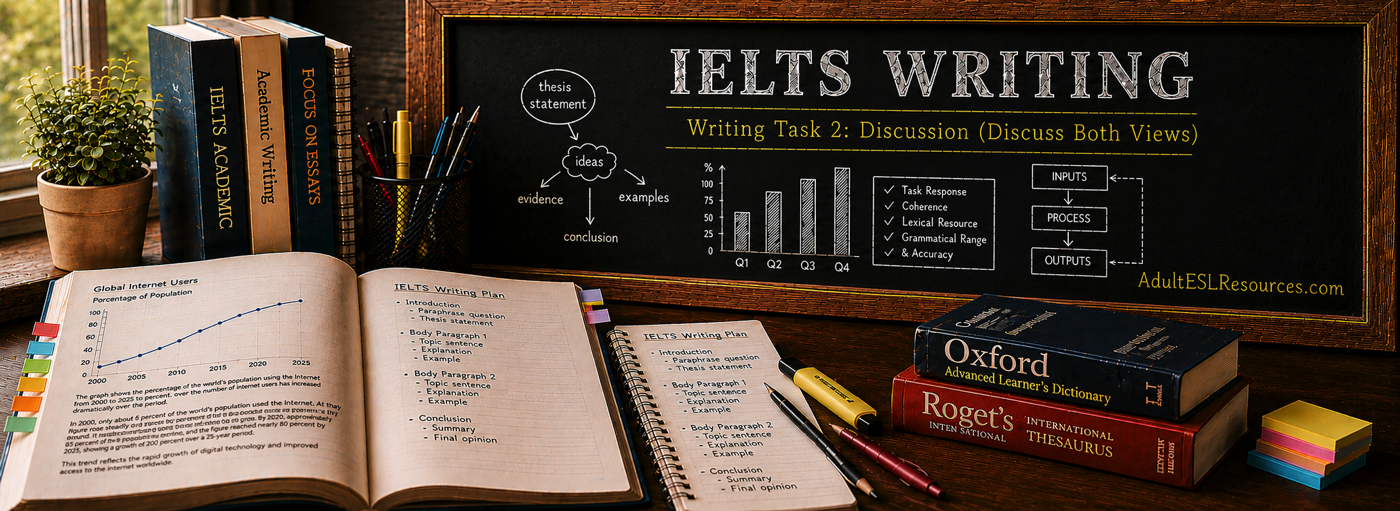
A Discussion question presents two opposing views and asks you to discuss both before giving your own opinion. Look for phrasing like “Discuss both views and give your own opinion” or “Discuss both these views.”

What it’s actually asking
Give both views a fair hearing, then commit to your own
A Discussion question is not an Opinion question in disguise. Both given views need genuine, balanced treatment — not a token sentence for one side before spending the rest of the essay arguing the other. Your own opinion still belongs in the essay, but only after both views have been fairly discussed.
A common misunderstanding
“Discuss both views” is not optional.
Some candidates read a Discussion question, immediately pick a side, and write an Opinion essay instead. This misses part of what the task is asking for and can limit your Task Response score, however well the essay is written otherwise.
Breaking down the question
Identify both views before you plan anything else
View One
The first position
Identify exactly what the first given view claims, in your own words.
View Two
The second position
Identify exactly what the second given view claims, and how it differs from the first.
Your Opinion
Your own position
Confirm the task asks for your opinion too — most Discussion questions do, but always check the exact wording.
Planning your response
One paragraph per view, then your opinion
Plan One Reason for Each View
Find at least one genuine, well-supported reason someone might hold each of the two given views — even if you don’t personally agree with both.
Decide Where Your Opinion Fits
Decide whether your own opinion aligns closely with one view, or sits somewhere between the two — and where in the essay you’ll state it clearly.
A practical tip
State your opinion early — don’t save it as a surprise.
Many strong Discussion essays state the writer’s opinion briefly in the introduction, then discuss both views in the body paragraphs, then return to and reinforce that opinion in the conclusion.
See it in practice
Sample Question and Sample Answer
The example below is original and written for teaching purposes.
Sample Question
Some people think that university students should study whatever subject they are interested in. Others believe they should only study subjects that will be useful for future employment.
Discuss both views and give your own opinion.
Sample Answer (Introduction and one Body Paragraph)
Soft Introduction
There is disagreement about whether university students should follow their personal interests or focus on subjects likely to lead to employment. Both perspectives have merit, though I believe a balance between the two produces the best outcome.
Hard Body Paragraph (First View)
Those who favour studying purely from interest argue that motivation and enjoyment lead to deeper learning and stronger academic performance. A student passionate about literature, for instance, is likely to read more widely and think more critically than one forced to study a subject purely for career prospects, ultimately producing a more capable graduate regardless of field.
Why the Sample Works
Both views treated fairly
The introduction acknowledges that “both perspectives have merit” before stating the writer’s own balanced opinion. The body paragraph genuinely explores the first view with a specific example, rather than dismissing it quickly to argue the writer’s own position.
Ready for the next step?
Explore another question type.
Advantages / Disadvantages
Learn how to weigh the benefits and drawbacks of a situation or trend.
Structuring Your Essay
Review the soft/hard/soft OREO framework that applies to every Task 2 essay.