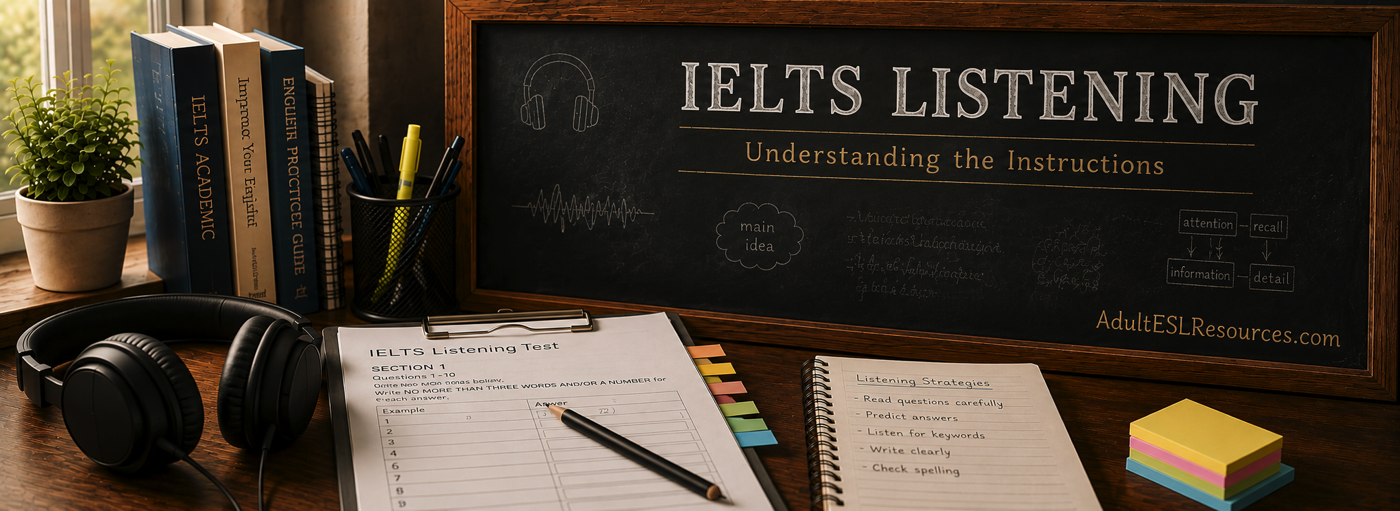
Read before you listen
A perfect answer in the wrong format still loses the mark.
Every Listening question comes with an instruction telling you exactly how to write your answer — a word limit, a number limit, or a specific format. These instructions are not suggestions. They are marked as strictly as the content of your answer.
Because you only hear the recording once, there’s no opportunity to go back and fix a formatting mistake after the fact. Reading the instructions carefully, before the audio starts, has to happen in advance.

What to watch for
Common word and number limit instructions
Strict limit
“NO MORE THAN ONE WORD”
Only a single word is acceptable. Writing two words, even two closely related ones, loses the mark.
Combined limit
“NO MORE THAN TWO WORDS AND/OR A NUMBER”
Allows up to two words, a number, or a combination of both — but never more than two words total.
Fixed format
“WRITE THE CORRECT LETTER”
Requires a specific letter from a list of options — writing the full word instead of the letter is marked incorrect.
A common mistake
Numbers count as words in most word-limit instructions.
Under “NO MORE THAN TWO WORDS,” writing “twelve May” uses two words already — adding anything else exceeds the limit. Numerals like “12” are usually treated separately from the word count, but always follow the exact instruction given.
Precision matters
Spelling counts, even in Listening
A misspelled word is marked incorrect, even if it’s clear you understood the audio correctly. Both British and American spelling are generally accepted, but the word itself must be spelled correctly.
Accepted
British or American Spelling
Both “colour” and “color” are typically accepted, as long as the spelling itself is correct and consistent.
Not accepted
Incorrect Spelling
A word that’s recognisable but misspelled is still marked incorrect, regardless of how close it is to the correct spelling.
Ready for the next step?
Learn how the four sections are structured.
Now that you know how to follow the instructions, explore how the four Listening sections progress in difficulty and formality.