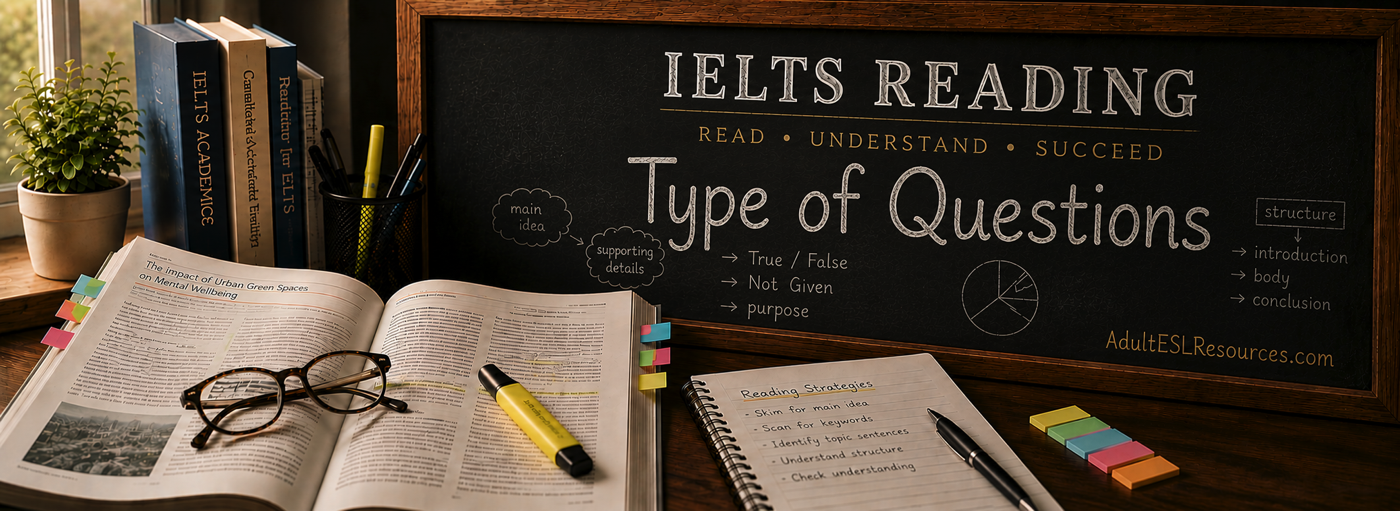
Know what you’re up against
Every question type has its own rules.
IELTS Reading uses a limited set of question formats, repeated across every version of the test. Once you recognise a format and know its rules, you can approach it with a clear, repeatable method instead of guessing.
Below is an overview of the question types you’re most likely to meet in the Reading test. Each one tests a slightly different skill — some ask you to locate specific facts, others ask you to follow the overall structure or argument of a passage.
The examples on this page are original and written for teaching purposes. They are designed to show you how each format works, not to reproduce official IELTS material.

Locating specific information
Formats that test scanning for facts
These question types reward candidates who can scan quickly and match precise wording — including paraphrased wording — between the question and the passage.
Matching
Matching Information
You are given a list of statements and must identify which paragraph of the passage contains that information.
Approach: Identify the key idea in each statement first, then scan the passage for a paraphrased match rather than an exact word.
Completion
Sentence Completion
You complete a sentence using a limited number of words taken directly from the passage.
Approach: Predict the type of word needed (a noun, a date, a number) before you search, then confirm your answer fits the instructions exactly.
Short answer
Short-Answer Questions
You answer a direct question using a limited number of words taken from the passage.
Approach: Underline the exact question word (who, when, how many) so you know precisely what kind of answer to look for.
Understanding meaning and structure
Formats that test overall comprehension
These question types reward candidates who can follow the structure and main ideas of the passage, not just find isolated facts.
Matching
Matching Headings
You match a heading to each paragraph, choosing from a list that contains more headings than paragraphs.
Approach: Identify the main idea of each paragraph — usually found in the first or last sentence — rather than matching individual words.
Fact-checking
True / False / Not Given
You decide whether a statement agrees with, contradicts, or is not addressed by the passage.
Approach: “Not Given” means the information simply isn’t in the passage — it is not the same as “False.” Base your answer only on what the text actually states.
Opinion-checking
Yes / No / Not Given
Similar to True / False / Not Given, but used when the statements test the writer’s opinions or claims rather than plain facts.
Approach: Focus on what the writer believes or argues, not simply what the passage describes.
Selecting and labelling
Formats that test precise identification
These question types combine reading comprehension with careful attention to detail, options and layout.
Selection
Multiple Choice
You select one correct answer — or sometimes more than one — from a list of options.
Approach: Eliminate options that are clearly contradicted by the passage first, then compare the remaining options closely against the exact wording of the text.
Matching
Matching Features
You match a list of statements to a set of options, such as names, dates or categories mentioned across the passage.
Approach: Scan for each name or category first, then check what the passage says about it against each statement.
Labelling
Diagram, Table & Flow-Chart Labelling
You complete labels on a diagram, table or flow chart using words from the passage.
Approach: Use the diagram’s shape and existing labels to predict what kind of information belongs in each gap before you search.
Remember
The format changes. The core skill doesn’t.
Every format above still relies on the same core skills: understanding what the question is really asking, locating the relevant part of the passage, and reading that specific section carefully before you commit to an answer.
Ready for the next step?
Learn to predict before you search.
Now that you recognise the question formats, the next skill to build is predicting the type of answer you need before you start reading the passage in detail.