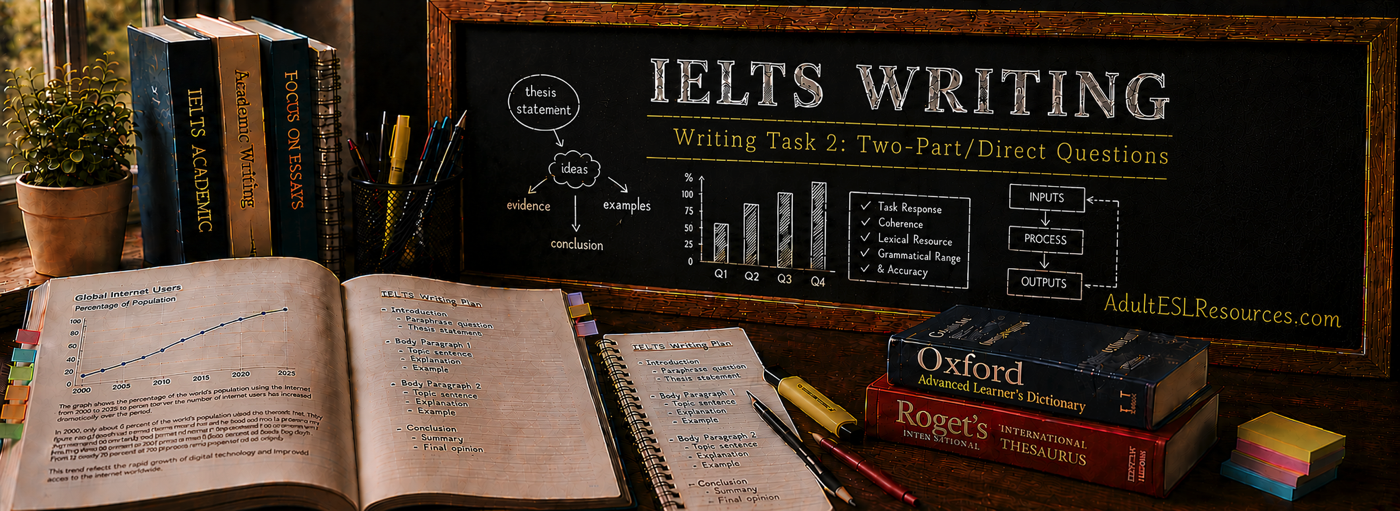
What does this question look like?
Two-Part / Direct Questions
A Two-Part question presents a topic followed by two separate, direct questions about it. There’s no single fixed phrase to watch for — instead, look for two clear question marks, each asking something distinct.

What it’s actually asking
Answer both questions fully — not one, and not one dominant
Two-Part questions expect a genuine, developed answer to each question, not a brief mention of one followed by an essay-length response to the other. Both parts count toward Task Response, and both need roughly comparable development.
A common misunderstanding
Two questions are not one topic.
It’s tempting to blend both questions into a single, general discussion of the topic. Strong responses keep the two questions clearly separated, typically with one body paragraph dedicated to each.
Breaking down the question
Separate the two questions before you plan anything else
Question One
What’s being asked first?
Write out the first question in your own words to confirm exactly what it’s asking.
Question Two
What’s being asked second?
Do the same for the second question — confirm it is genuinely a separate question, not a restatement of the first.
Connection
How do they relate?
Note how the two questions connect to the shared topic — this often helps your introduction flow naturally.
Planning your response
One body paragraph per question
Plan an Answer to Each Question Separately
Treat each question as its own mini-task, complete with its own reason and example, before thinking about how to connect them.
Balance the Space You Give Each One
Aim for roughly equal development across both questions rather than letting one dominate the essay.
A practical tip
Signpost clearly which question each paragraph answers.
A clear topic sentence at the start of each body paragraph, directly echoing the question it answers, makes it immediately obvious to the examiner that both parts of the task have been addressed.
See it in practice
Sample Question and Sample Answer
The example below is original and written for teaching purposes.
Sample Question
Many people now spend a large amount of time watching video content on their phones.
Why do you think this is the case? Is this a positive or negative development?
Sample Answer (Introduction and one Body Paragraph)
Soft Introduction
Watching video content on smartphones has become a daily habit for many people. There are clear reasons behind this shift, and while it brings some benefits, it also carries genuine downsides.
Hard Body Paragraph (First Question)
This trend is largely driven by the convenience and constant accessibility of smartphones. Unlike televisions or computers, a phone is almost always within reach, allowing people to watch short videos during brief moments of free time — while commuting, waiting in line, or taking a short break at work.
Why the Sample Works
Each question clearly signposted
The introduction acknowledges both questions (“clear reasons” for the first, “benefits” and “downsides” for the second). The body paragraph shown focuses entirely on the first question — explaining the cause — without drifting into evaluating whether the trend is positive or negative, which belongs in a separate paragraph.
Ready for the next step?
Review the structure behind every Task 2 essay.
You’ve now covered every Task 2 question type. Revisit the soft/hard/soft OREO framework that ties them all together, or return to the full list of question types.
Structuring Your Essay
Review the soft/hard/soft OREO framework that applies to every Task 2 essay.